High-Speed Networks Don’t Always Need More Complexity
As network speeds increase, there’s a tendency to assume infrastructure also needs to become more complicated. More advanced optics, additional management layers, and tighter environmental requirements often enter the picture as bandwidth rises.
But that’s not true for every part of the network.
Inside modern data centers, especially at short distances, reliability is often improved not by adding more technology, but by removing unnecessary pieces from the connection path. This is one of the main reasons 100G DAC cables continue to remain relevant, even as optical solutions become more advanced.
Sometimes the simplest physical design ends up being the most dependable.
What Makes DAC Structurally Different
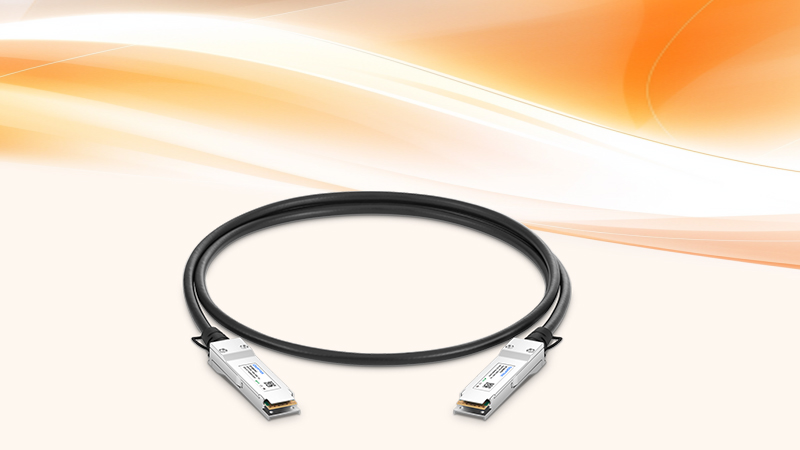
A 100G DAC cable, or Direct Attach Copper cable, combines the transceiver interface and copper cable into a single fixed assembly. Instead of plugging separate optical modules into ports and connecting them with fiber, the entire link arrives as one integrated unit.
That changes a lot operationally.
There are no optical lasers, no fiber polarity concerns, no optical signal conversion, and no separate transceiver-to-cable interfaces in the middle of the connection. The signal stays electrical from one end to the other.
The result is a connection with fewer independent components involved.
And in infrastructure, fewer components usually means fewer failure points.
Reducing the Number of Variables
One of the biggest challenges in large-scale deployments is consistency.
The more individual parts involved in a connection, the more opportunities there are for variation—different transceiver vendors, fiber quality differences, dirty connectors, optical compatibility issues, or installation mistakes.
DAC cables simplify this entire process.
Because the cable and interfaces are built together, many of those variables disappear. The link arrives pre-assembled and tested as a complete unit. Engineers aren’t matching optics to cables or worrying about connector contamination during installation.
That reduction in variables improves deployment consistency across large environments.
Especially in hyperscale data centers, consistency matters almost as much as performance itself.
Reliability in High-Density Server Environments
Modern server clusters, especially AI and GPU systems, operate in extremely dense configurations. Hundreds or even thousands of high-speed links may exist within a relatively small physical area.
In these environments, even small reliability improvements become important.
100G DAC cables work particularly well here because the distances are short and predictable. Most links stay within the same rack or between neighboring racks, well within the practical range of passive copper connections.
Since the cable contains no optical transmitters or receivers, there’s less sensitivity to temperature fluctuations and fewer active elements that can degrade over time.
This contributes to long-term stability.
It’s not that DAC cables never fail—any physical cable can eventually wear out—but the overall design reduces the number of things that can go wrong.
Simpler Troubleshooting During Failures
Operational simplicity becomes especially noticeable when something actually breaks.
With optical links, troubleshooting sometimes involves checking optical power levels, cleaning fiber connectors, verifying polarity, or testing compatibility between transceivers.
DAC failures tend to be more direct.
If a link goes down, the issue is usually physical: the cable is damaged, improperly seated, or incompatible with the system. There are simply fewer layers involved in the diagnosis.
This allows operations teams to resolve problems faster.
In large environments where downtime affects many systems simultaneously, that speed matters.
Power Efficiency Also Improves Stability
Reliability isn’t only about whether a link stays connected. Thermal behavior also plays a role.
Higher power consumption generates more heat, and excessive heat affects long-term hardware stability inside dense racks. Optical transceivers consume more power because they must convert electrical signals into optical signals and back again.
DAC cables avoid most of that overhead.
Passive DACs in particular require very little additional power. This reduces thermal load across switches and servers, helping maintain more stable operating conditions overall.
At scale, those small reductions add up significantly.
Why DAC Isn’t Used Everywhere
Despite these advantages, DAC cables are still limited by physics.
Copper simply doesn’t handle long distances as effectively as optical fiber. Signal attenuation increases quickly over longer runs, which restricts DAC deployments to relatively short connections.
Cable thickness is another consideration. Large bundles of copper cables can become difficult to manage and may obstruct airflow if routing is not planned carefully.
This is why DAC cables are typically used selectively—primarily for short intra-rack or adjacent-rack connections where their advantages are strongest.
For longer distances, optical solutions remain necessary.
How DAC Fits Into Modern Network Architecture
Most modern data centers use a layered connectivity model.
DAC cables handle short, high-density interconnects. Active Optical Cables (AOCs) cover slightly longer rack-to-rack connections. Fiber transceivers take over for broader aggregation and long-distance networking.
Each technology solves a different problem.
100G DAC cables are valuable not because they replace optics, but because they eliminate unnecessary complexity where optics aren’t required.
That targeted role is what keeps them highly relevant.
Why Simplicity Scales Well
As infrastructure grows, operational complexity becomes harder to manage than raw bandwidth.
Large environments need technologies that are repeatable, predictable, and easy to support at scale. DAC cables align with that philosophy surprisingly well.
They don’t try to solve every networking challenge. They focus on one specific job—short-range high-speed connectivity—and they do it with minimal moving parts.
In practice, that simplicity often translates directly into reliability.
Conclusion
100G DAC cables remain a dependable solution for short-range high-speed networking because their integrated, low-complexity design reduces both operational overhead and potential failure points. By eliminating separate optical components and minimizing power consumption, they provide stable connectivity in dense server and AI environments where consistency and reliability are critical. While they are limited by distance, their simplicity makes them one of the most practical choices for large-scale short-range infrastructure deployments.
Stay in touch to get more updates & news on Mix Moz!