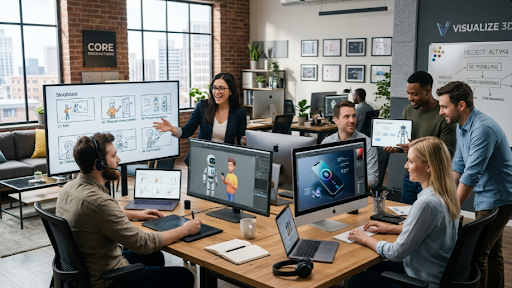
Attention is the most contested resource in marketing today, and static graphics or plain text rarely hold it for long. Animated content does. It’s why so many brands from local startups to global enterprises are folding 2D and 3D animation into how they introduce themselves to the world. This guide walks through how to increase brand awareness using animated storytelling, where it fits into a broader digital strategy, and what to look for when choosing a studio to bring it to life.
How to Increase Brand Awareness Through Animated Storytelling
If you’re exploring how to increase brand awareness without simply spending more on ads, animation offers a shortcut most competitors haven’t taken yet. Motion and character naturally draw the eye in a feed full of static posts, and a well-told animated explainer can communicate a complex idea in under a minute something a paragraph of text struggles to do.
The recall advantage matters too. People remember a visual story longer than a list of features, and a distinct animated style a color palette, a character, a tone of voice becomes something audiences associate with your brand specifically, even before they read your name. Done consistently, that visual signature does a lot of the recognition work that traditional advertising spends far more to achieve.
Digital Marketing for Brand Awareness: Where Animation Fits
Within digital marketing for brand awareness, animated content isn’t a standalone tactic it’s a multiplier across channels you’re likely already using. A single animated explainer can be repurposed as a website hero video, a set of short social clips, an email campaign visual, and a paid ad creative, all from one production.
Search benefits too: pages with embedded video tend to keep visitors on-site longer, a signal that supports better rankings over time. Social platforms increasingly favor video in their algorithms, meaning animated posts often get distributed further than a text or image post would, simply by format. And because animation can simplify abstract or technical products into something visual, it works particularly well for industries software, healthcare, finance where the product itself is hard to photograph or explain in a static image.
Effective Brand Awareness Strategies Built Around Animated Content
Among the most effective brand awareness strategies available right now, a few animation-driven approaches consistently outperform generic content:
Brand explainer videos that introduce your mission and product in 60–90 seconds give new audiences a fast, memorable first impression. Character-led mascots, reused across campaigns, give a brand a recognizable face without the cost or constraints of using real people. Animated social series, released on a regular cadence, build anticipation and repeat engagement the way a show would, rather than a one-off ad. Data and process visualizations, animated rather than left as static charts, make dry information genuinely shareable.
What ties these together is repetition of a consistent visual identity the same style, palette, and character design across every piece so each new video reinforces recognition built by the last one, instead of starting from zero.
Building a Brand Awareness Marketing Plan Around Animation
A brand awareness marketing plan that includes animation works best when production is planned alongside distribution, not treated as an afterthought once a video is finished. A practical structure looks like this:
- Define the core story your brand needs to tell one clear message, not several competing ones.
- Choose a visual style (2D, 3D, or a mix) that matches your brand’s tone and budget realistically.
- Plan distribution before production, mapping where each cut of the video will live website, social, ads, email so the format is right from the start.
- Set a release cadence, since one video rarely moves the needle alone; a connected series builds recall far more reliably.
- Measure recall and engagement, not just views completion rate and branded search lift are better indicators of awareness than raw view counts.
Treating animation as part of a planned system, rather than a single deliverable, is what separates brands that build lasting recognition from those that produce one nice video and move on.
Local Brand Awareness Marketing Through Animated Content
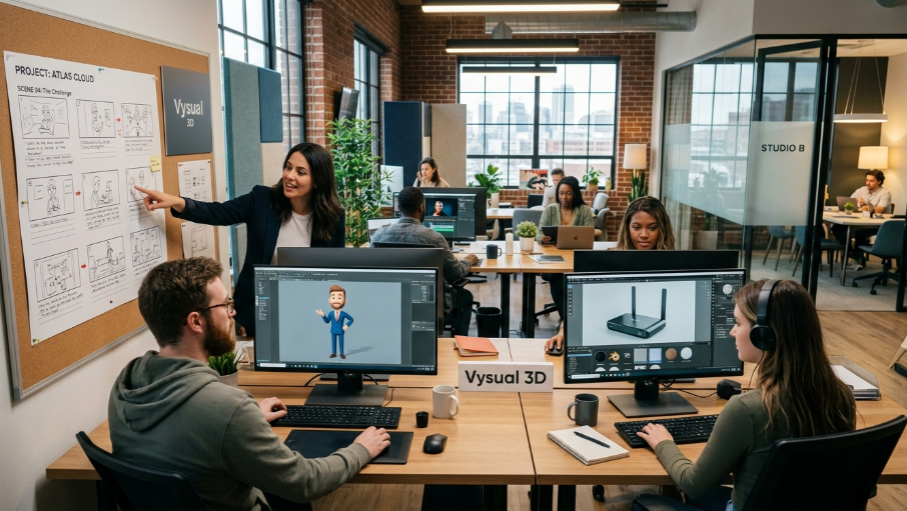
For businesses competing for attention within a specific city or region, local brand awareness marketing benefits from animation in a more grounded way: short, locally-flavored animated clips for community events, local sponsorships, or neighborhood-specific promotions tend to feel more personal than generic stock-footage ads, while still being far cheaper to produce at scale than live-action local shoots.
A locally recognizable mascot or short animated jingle, reused across local radio, social ads, and in-store displays, can also create the kind of repeated, low-cost recognition that national brands achieve through far bigger budgets simply because the same character keeps showing up in the same community.
B2B Brand Awareness Strategy vs. B2C Brand Awareness Strategy in Animation
A B2B brand awareness strategy generally uses animation differently than a B2C brand awareness strategy, even though both rely on the same underlying technique.
In B2B contexts, animation tends to favor clarity over flair process diagrams, product walkthroughs, and data visualizations that help a buying committee understand a complex offering quickly, often shared on LinkedIn or embedded directly in a sales deck. The goal is comprehension that shortens a long sales cycle, not entertainment.
In B2C contexts, animation leans more emotional and character-driven, built for short attention spans on social platforms where a memorable mascot or a punchy 15-second clip needs to land instantly and trigger sharing. The goal is recall and shareability, since consumer decisions are often faster and more impulse-driven than enterprise ones.
Studios and in-house teams that recognize this difference produce noticeably better results than those applying one creative approach to both audiences.
Choosing Between 2D Animation Services and 3D Animation Services
Not every brand story needs the same production approach, and the choice between 2D and 3D shapes both budget and tone.
2D animation services suit brands that want a friendly, approachable, and typically faster-to-produce visual style well suited to explainer videos, onboarding tutorials, and social content where charm matters more than realism. 3D animation services, by contrast, suit brands needing to showcase physical products, spatial environments, or a more premium, polished aesthetic common in real estate, manufacturing, and product design, where dimensional accuracy genuinely helps the audience understand what they’re looking at.
Many brands don’t need to choose exclusively. A combined approach say, a 2D explainer for social media paired with a 3D product showcase for the website often covers both the approachability and the credibility a brand needs at different stages of the customer journey.
What to Look for in a 2D and 3D Animation Company
When evaluating a 2D and 3D animation company, the strongest indicator of fit isn’t just their show reel it’s whether their past work demonstrates range across both styles and a clear understanding of brand storytelling, not just technical animation skill. A team offering genuinely professional animation services should be able to walk through how a previous project’s style choices tied back to a client’s specific brand goals, not only the software used to produce it.
Look for studios that ask about your audience and message before discussing visual style that ordering usually signals a strategic partner rather than a production vendor working purely off a brief.
Frequently Asked Questions
How does animation actually help increase brand awareness compared to regular video? Animation allows full control over visual style, characters, and pacing without the constraints of live-action filming, making it easier to build a consistent, instantly recognizable brand identity across every piece of content.
Is 2D or 3D animation better for brand awareness campaigns? Neither is universally better 2D tends to work well for fast, friendly, social-first content, while 3D suits brands needing to showcase products or environments with realism and depth. The right choice depends on your message and audience.
How long should a brand awareness animation be? Most effective brand awareness videos run between 30 and 90 seconds; shorter cuts for social feeds, slightly longer versions for websites and dedicated landing pages.
Do small or local businesses benefit from animation, or is it only for big brands? Small and local businesses often see strong returns from animation precisely because it’s cheaper and more scalable than live-action production, making it accessible even on a modest local marketing budget.
How do I know if an animation company offers genuinely professional animation services? Review their portfolio for variety, ask how they tie creative decisions to client goals, and request references or case studies showing measurable results, not just visually impressive output.
Awareness Thoughts
Animation has moved from a nice-to-have into a practical lever for brand awareness, particularly for businesses competing in crowded feeds and search results. Whether the goal is local recognition, a stronger B2B pipeline, or faster consumer recall, partnering with the right 2D and 3D animation company and building it into a real marketing plan rather than a one-off project turns a single creative asset into a long-term brand recognition engine.