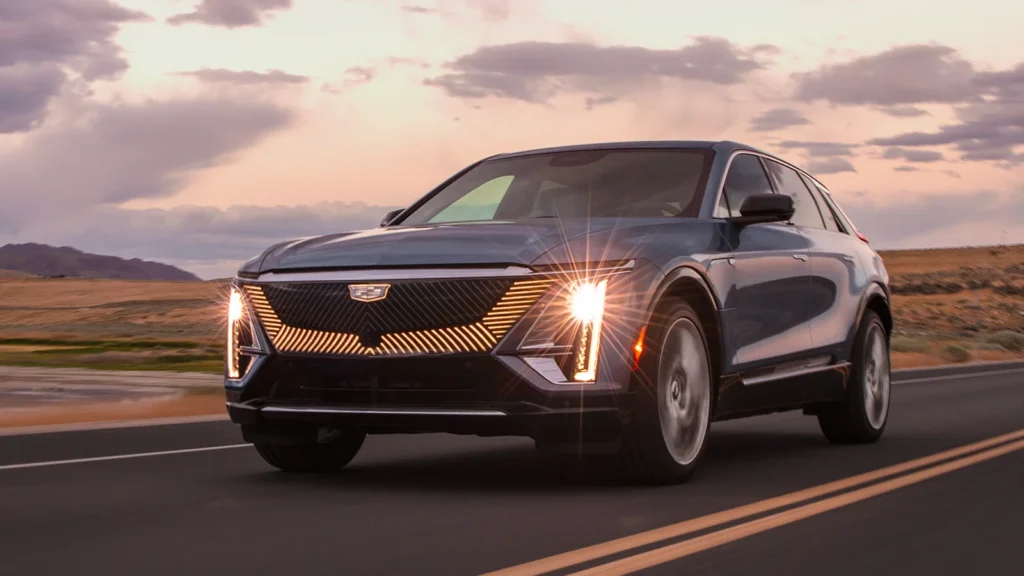
Do the driving modes in Cadillac Lyriq offer different ranges or battery usages?”, they’re really asking something deeper: does the way the car behaves in different modes actually change how far we can drive on a charge? The short answer is yes, but not in a magical or mechanical way.
Driving modes don’t change the size of the battery or suddenly unlock extra kilowatt-hours. What they do change is how efficiently the Lyriq uses the energy it already has. And that’s where real-world range gains or losses happen. The mode we choose influences throttle response, regenerative braking strength, steering and suspension tuning, and even how aggressively climate systems operate. All of those small changes add up over time.
Let’s break it down in a simple, real-world way and look at how each driving mode in the Cadillac Lyriq affects battery usage and driving range.
Understanding Driving Modes and EV Efficiency
Before jumping into individual modes, it helps to understand how efficiency works in an electric vehicle. Unlike gas cars, EVs don’t waste energy through idling or inefficient gear changes. But they do react strongly to how we accelerate, brake, and manage comfort systems.
Hard acceleration draws a lot of power instantly. Aggressive braking wastes kinetic energy unless it’s captured through regenerative braking. High climate control usage, especially heating, can noticeably reduce range. Driving modes are essentially software profiles that tell the car how to prioritize comfort, performance, traction, and efficiency.
So while the battery itself never changes, the rate at which energy is consumed definitely does.
Tour Mode: The Everyday Efficiency Baseline
Tour Mode is the default driving mode in the Cadillac Lyriq, and for most of us, it’s where the car spends the majority of its life. This mode is designed to balance comfort, responsiveness, and efficiency.
In Tour Mode, throttle response is smooth and predictable. The accelerator doesn’t feel jumpy, which makes it easier to drive efficiently without even thinking about it. The suspension and steering are tuned for relaxed cruising, and regenerative braking is set to a moderate level.
From a battery usage perspective, Tour Mode is usually the safest bet for consistent range. It doesn’t aggressively chase performance, and it doesn’t dull the car to the point where we have to press harder on the accelerator to get moving. That balance helps maintain steady energy consumption, especially during city driving and highway cruising.
If we’re trying to estimate real-world range, Tour Mode is the closest thing to a neutral baseline.
Sport Mode: More Fun, More Energy Use
Sport Mode is where the Lyriq shows its personality. Throttle response becomes sharper, steering feels heavier and more direct, and the overall driving experience feels more engaging.
All of that excitement comes at a cost.
In Sport Mode, the car delivers power more aggressively, which encourages quicker acceleration. Even if we don’t floor it, the sharper throttle mapping means we’re more likely to use more energy without realizing it. Quick bursts of acceleration draw high current from the battery, and repeated use adds up fast.
Regenerative braking behavior may also feel different, depending on settings, often favoring a more traditional driving feel rather than maximum energy recovery. That means slightly less energy is recaptured during deceleration compared to more efficiency-focused setups.
Does Sport Mode destroy range? No. But if we drive the same route in Sport Mode versus Tour Mode, we should expect slightly higher battery usage. On longer drives or repeated short trips, that difference becomes noticeable.
Snow/Ice Mode: Stability Over Efficiency
Snow/Ice Mode isn’t really about range at all. It’s about control.
In this mode, the Lyriq reduces throttle sensitivity, limits wheel spin, and adjusts traction control to keep the vehicle stable on slippery surfaces. Power delivery becomes very gentle, which can actually help efficiency in certain low-speed conditions.
However, Snow/Ice Mode is typically used in cold weather, and cold weather itself is one of the biggest range killers for EVs. Battery chemistry is less efficient in low temperatures, and heating the cabin requires a significant amount of energy.
So while Snow/Ice Mode’s gentle power delivery doesn’t inherently waste energy, the conditions in which we use it often result in reduced range. The mode itself is neutral or even mildly efficient, but winter driving overall is not.
My Mode: Customizing Efficiency and Comfort
One of the more interesting features of the Cadillac Lyriq is My Mode. This setting allows us to customize aspects like throttle response, steering feel, and braking behavior to match personal preferences.
From a battery usage standpoint, My Mode can either help or hurt range depending on how it’s configured. If we dial in a softer throttle response, stronger regenerative braking, and relaxed steering, My Mode can function as a personal efficiency profile. This setup makes it easier to drive smoothly and recapture energy during deceleration.
On the other hand, if we configure My Mode to feel more aggressive, similar to Sport Mode, the efficiency benefits disappear.
The key advantage here is consistency. When the car behaves exactly how we like, we’re less likely to make sudden inputs or fight the vehicle’s response. Smooth, predictable driving almost always leads to better range.
Regenerative Braking: The Silent Range Influencer
Driving modes often work alongside regenerative braking settings, and this is one of the biggest factors in battery usage that doesn’t get enough attention.
Regenerative braking allows the Lyriq to convert slowing down into energy sent back to the battery. Stronger regen means less reliance on friction brakes and more energy recovery. Lighter regen feels more like a traditional gas car but captures less energy.
In city driving, strong regenerative braking can significantly improve efficiency. Every stoplight and slowdown becomes an opportunity to regain energy. On highways, the impact is smaller, but still present during traffic changes and off-ramps.
Some modes encourage more regen, while others prioritize smooth coasting. Neither is inherently wrong, but from a range perspective, regen-friendly setups usually win in urban environments.
One-Pedal Driving and Its Impact on Range
One-pedal driving deserves special mention because it can dramatically affect battery usage, regardless of driving mode.
When one-pedal driving is enabled, lifting off the accelerator applies strong regenerative braking. This encourages a smoother driving style and maximizes energy recovery in stop-and-go traffic.
For many drivers, one-pedal driving improves efficiency simply because it reduces unnecessary braking and promotes anticipation. However, it does take some adjustment. Abrupt lifting off the pedal can cause stronger regen than intended, which may feel jerky at first.
Once we adapt, one-pedal driving combined with an efficiency-oriented mode can noticeably extend real-world range, especially in city driving.
Climate Control: The Hidden Energy Drain
Driving modes don’t operate in isolation. Climate control plays a huge role in battery usage, and some modes manage it more aggressively than others.
Heating, in particular, uses a lot of energy in EVs. Cooling is generally less demanding, but still noticeable. If a driving mode prioritizes cabin comfort without restraint, range can drop faster than expected.
In everyday driving, the biggest gains often come from small habits: preconditioning the cabin while plugged in, using seat heaters instead of blasting cabin heat, and choosing moderate temperature settings.
Driving modes that encourage relaxed driving often pair naturally with these efficiency-minded habits.
City Driving vs Highway Driving
The impact of driving modes on range also depends heavily on where we’re driving.
In city driving, differences between modes are more pronounced. Frequent stops, acceleration, and braking mean throttle mapping and regen behavior matter a lot. An efficiency-friendly mode with strong regen can outperform Sport Mode by a noticeable margin.
On the highway, things even out. Once we’re cruising at a steady speed, the biggest factors become aerodynamics, speed, and climate control. Driving mode still matters, but the gap in battery usage shrinks compared to city conditions.
That’s why some drivers see very different range results depending on their daily routes.
Terrain and Elevation Changes
Hills add another layer to the equation. Climbing consumes energy quickly, regardless of mode. Descending allows regen to recover some of that energy, but never all of it.
Modes that promote smoother power delivery can help manage energy use on rolling terrain. Aggressive modes may encourage harder acceleration uphill, which increases consumption. Strong regenerative braking on the way down can help reclaim some range, but efficiency-focused driving still wins overall.
Does Changing Modes Instantly Change Range Estimates?
Many drivers notice that switching modes causes the estimated range on the dashboard to change. This can be confusing.
What’s happening is not a sudden gain or loss of battery capacity. The car’s range estimator is adjusting its prediction based on recent driving behavior and the selected mode. If we switch to Sport Mode, the system assumes higher energy use going forward and lowers the estimate. Switch back to Tour or an efficiency-oriented My Mode, and the estimate may climb.
These are predictions, not guarantees. Actual range still depends on how we drive.
So, Do Driving Modes Really Matter?
Yes, but in a practical, everyday sense rather than a dramatic one.
Driving modes in Cadillac lyriq offer different ranges or battery usages capacity or permanently reduce range. What they do is influence how easily we drive efficiently. Modes that encourage smooth acceleration, stronger regenerative braking, and relaxed cruising tend to use less energy over time. Modes that emphasize performance and responsiveness naturally consume more.
The biggest takeaway is that driving style matters more than the mode itself. A calm driver in Sport Mode can outperform an aggressive driver in Tour Mode when it comes to range.
Choosing the Right Mode for Your Needs
If maximizing range is the priority, Tour Mode or a carefully tuned My Mode, combined with regenerative braking and one-pedal driving, is usually the best approach. For daily commuting, this setup provides the best balance of comfort and efficiency.
If enjoyment and responsiveness matter more, Sport Mode delivers that thrill, with a small trade-off in battery usage. For winter conditions, Snow/Ice Mode prioritizes safety and stability, even if cold weather reduces range overall.
In the end, the Cadillac Lyriq gives us flexibility. Driving modes don’t dictate how far we can go, but they do shape how efficiently we get there. Understanding that relationship helps us make smarter choices, stretch our range when it matters, and still enjoy the drive when efficiency isn’t the top priority.