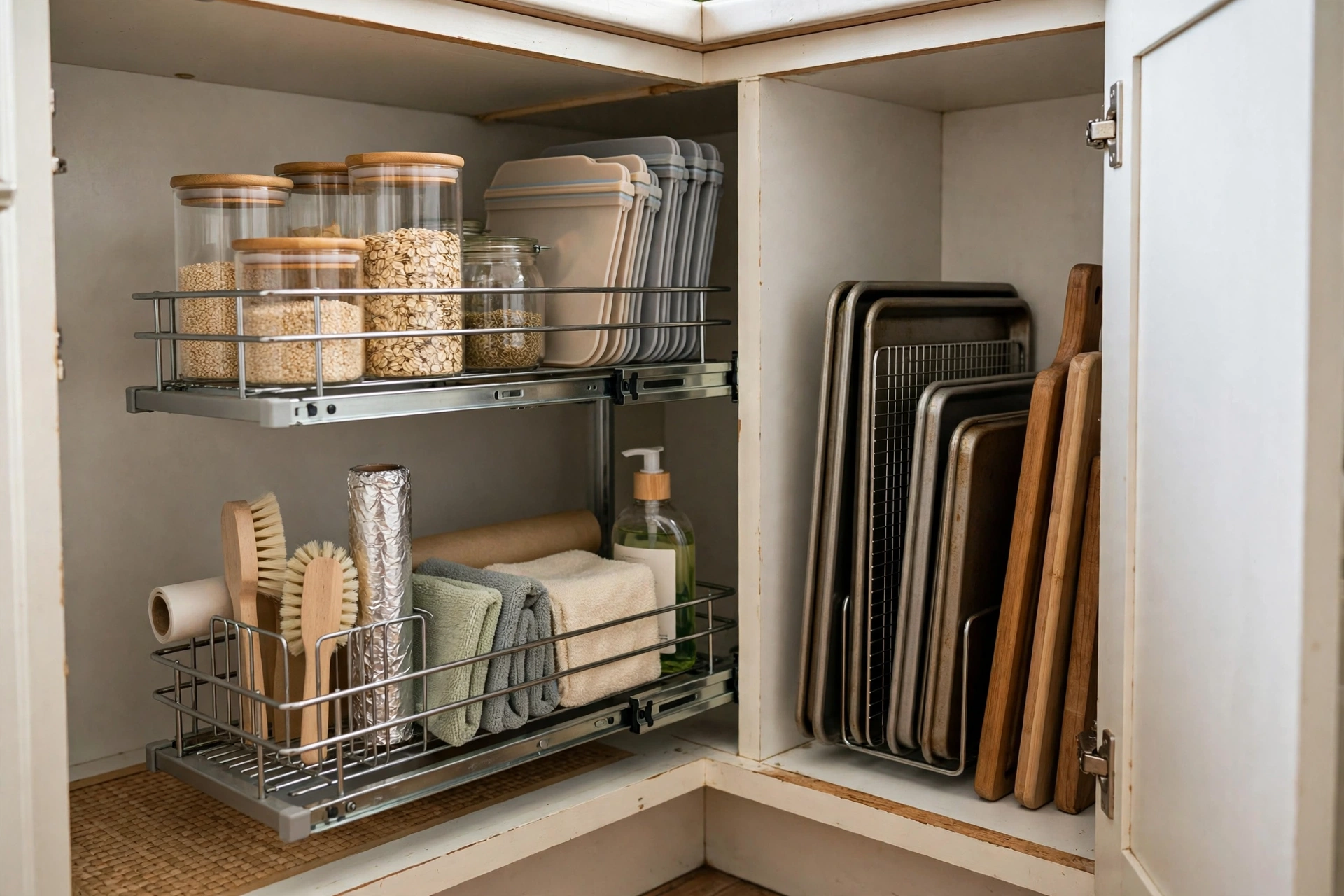
Corner cabinets hold more space than any other cabinet in a small kitchen, yet they are usually the least useful. Items slide to the back, stack on top of each other, and disappear behind the door, so homeowners buy duplicates or leave the deepest part empty. In a modern home, where kitchens are compact and every cabinet must earn its place, that wasted corner is not a minor annoyance but a daily frustration.
The direct answer is to give the corner a job and a mechanism that brings items to you, rather than asking you to reach into it. A lazy Susan, a blind-corner pull-out, or a swing-out tray can turn dead space into everyday storage, while simple bins, turntables, and shelf risers can do much of the same work without a full refit. Start by measuring the corner and deciding what you actually use there, then choose hardware that fits that use, not the most elaborate system on display.
Mapping the Awkward Corner Before Buying Storage Hardware
Open the corner cabinet and measure its width, depth, height, door opening, and any pipes, hinges, or shelf supports that intrude into the space. Note whether the corner is a true L-shaped blind corner, a diagonal corner with a wide door, or a narrow cabinet beside a tall unit, because each shape suits different hardware. Photograph the interior with a tape measure in view, so you can compare products without returning to the cabinet repeatedly.
Empty the cabinet completely and sort what was in it into daily, weekly, and rarely used groups. Daily items belong near the front or on a pull-out that reaches the front, weekly items can sit on a turntable, and rarely used items belong in the deepest part or in another cabinet altogether. If the corner currently holds heavy appliances you rarely use, moving them elsewhere may free the corner for lighter, everyday storage that benefits most from a pull-out.
Lazy Susans That Turn a Deep Corner Into Front-Row Storage
A lazy Susan is the simplest corner upgrade, because it rotates items to the front instead of asking you to reach past them. Full-round trays suit diagonal corners with wide doors, while kidney-shaped trays are designed for L-shaped corners where a round tray would hit the neighbouring cabinet. Choose a tray size that leaves a small clearance around the edges, and check that tall bottles will clear the shelf above when the tray spins.
Keep lazy Susans light and organised, grouping similar items together and avoiding tall, top-heavy stacks that tip when the tray turns. Small bins on a tray can stop jars sliding, and a non-slip liner can keep the tray itself from spinning too freely. A lazy Susan that is overloaded or overfilled quickly becomes as frustrating as the empty corner it replaced, so edit its contents as carefully as you chose the hardware.
Blind-Corner Pull-Outs That Bring the Back of the Cabinet to You
Blind-corner pull-outs are designed for L-shaped cabinets where a fixed shelf would be unreachable. When the door opens, a first shelf swings out, and a second shelf follows it, bringing the back of the cabinet into the open. This mechanism suits heavy items such as pots, pans, and small appliances, provided the cabinet carcass and hinges can support the weight when the shelves are fully loaded.
Measure the door opening and the internal depth before ordering, and check the manufacturer's weight limit and installation instructions carefully. Some pull-outs need a specific cabinet width, a minimum door opening, or a frame that can be screwed into solid material rather than thin panelling. If the cabinet is damaged, out of square, or too small for the mechanism, a simpler turntable and bin system may be the more reliable choice.
Swing-Out Trays and Shelves for Narrow Modern Kitchen Corners
Swing-out trays attach to the door or to a pivot inside the cabinet, so opening the door brings a shelf out with it. They suit narrow corners and smaller kitchens where a full pull-out would be too large, and they work well for spices, oils, baking supplies, and other small items that are easy to lose. Keep the load light and balanced, since a swing-out tray that is overloaded will sag, catch on the frame, and wear its hinges quickly.
Test the swing path before you commit, making sure the tray clears neighbouring handles, the floor, and any nearby appliance doors. A tray that swings into a dishwasher handle or a bin is not a solution, however clever it looks in a showroom. If the swing path is tight, a smaller tray, a door-mounted rack for lightweight items, or a simple pull-out basket may fit the same corner with less compromise.
Low-Cost Corner Fixes Without Replacing Cabinet Hardware
Not every corner needs new hardware. A sturdy turntable on an existing shelf, a pair of small bins labelled by category, and a shelf riser that creates two usable levels can transform a deep cabinet for a modest cost. Store rarely used items at the very back, daily items at the front, and use clear bins so you can see what is inside without pulling everything out. Label bins by use, such as baking, breakfast, or cleaning, rather than by product type alone, so the system survives a busy week.
- Measure the shelf height before buying risers or tall bins.
- Keep heavy items low, where they are safer to lift and less likely to tip.
- Use one bin per category, so a single pull brings out only what you need.
- Leave a small gap at the front, so bins slide out without catching the door.
Avoid filling every inch of the corner, because a cabinet that is packed solid is hard to use even with good hardware. Leave room for a hand to reach in, for a tray to turn, or for a bin to slide, and review the contents every few months. A corner system that is edited regularly stays useful, while one that accumulates items quietly returns to being a black hole.
Organising Corner Contents by How Often You Actually Cook
The best corner layout follows your cooking habits, not a catalogue layout. If you bake weekly, baking trays, mixing bowls, and dry ingredients belong in the corner pull-out, while rarely used serving dishes move to a higher cabinet. If you cook simple meals daily, everyday pots, oils, and spices belong at the front, and specialty appliances belong elsewhere. Grouping by task, rather than by size or shape, means one pull or spin brings out everything for that task at once.
Keep a short list on the inside of the cabinet door for the first month, noting what you reach for and what you never touch. That list will show whether the corner is serving daily cooking or merely storing overflow, and it will guide a second, smaller adjustment. Small kitchens reward that kind of honest editing, because every cabinet that is easy to use reduces clutter on the countertop as well.
Protecting Cabinet Doors, Hinges, and Shelves From Heavy Corner Loads
Corner hardware adds moving weight to doors and hinges, so check that hinges are tight, shelves are level, and the cabinet frame is solid before installation. Tighten loose hinge screws, replace stripped screws with slightly longer ones where the material allows, and avoid overloading a pull-out beyond its rated weight. Heavy cast-iron pots on a light-duty tray will sag the mechanism and damage the cabinet over time, however well it works on day one.
Clean the cabinet interior before installing new hardware, and check for water damage, especially near the sink corner, since damp particleboard will not hold screws reliably. If the cabinet base is swollen or soft, repair or replace that section before adding hardware, or choose a freestanding turntable that does not rely on the damaged base. Protecting the cabinet itself is what allows a corner solution to last for years rather than months.
Corner Storage Slip-Ups That Make a Small Kitchen Harder to Use
Common slip-ups include buying hardware before measuring, overloading a tray, filling a corner so full that nothing moves, and placing daily items at the very back because they fit there. Another is choosing a system that needs a door to open fully in a kitchen where a bin, an appliance, or a wall blocks that swing. Each mistake looks small at purchase, but together they recreate the awkward corner in a more expensive form.
Avoid those traps by measuring twice, testing the swing and slide paths, keeping loads within limits, and leaving breathing room inside the cabinet. A corner that is slightly underfilled but easy to use beats a corner that is technically full but practically inaccessible, especially in a small modern kitchen where every movement counts.
Final Thoughts: An Awkward Kitchen Corner That Works Like the Rest of the Kitchen
Turn an awkward corner into useful storage by measuring it first, choosing a mechanism that brings items to you, grouping contents by how often you cook, and keeping loads within the hardware's limits. A lazy Susan, a blind-corner pull-out, or even simple bins and turntables can make the deepest cabinet in a small kitchen as easy to use as any other. Start with the corner you avoid most, and let that one success guide the rest of the kitchen.
Kitchen Corner Storage FAQs: Hardware, Measurements, and Modern Homes
What is the best storage for a blind corner cabinet?
A blind-corner pull-out usually works best, because it brings the back shelf out when the door opens. A kidney lazy Susan is a simpler alternative, provided it fits the door opening and does not catch on the neighbouring cabinet.
Do I need to replace my cabinets to fix an awkward corner?
No. Many corners improve greatly with a turntable, bins, shelf risers, or a retrofitted pull-out that fits the existing cabinet. Replacement is only needed if the cabinet is damaged, too small for the hardware, or out of square.
How do I measure a corner cabinet for a pull-out?
Measure the internal width, depth, and height, the door opening, and any pipes or hinges inside the cabinet. Compare those measurements with the manufacturer's minimum requirements, including weight limits, before ordering.
Can a lazy Susan hold heavy pots and pans?
A sturdy lazy Susan can hold moderate weight, but heavy cast-iron cookware is better on a pull-out designed for that load, or stored low in a drawer. Overloading a turntable causes tipping, sagging, and wear on its bearing.
What should go in the deepest part of a corner cabinet?
Reserve the deepest part for light, rarely used items, such as seasonal serving dishes or specialty equipment. Daily items belong at the front, on a pull-out, or on a turntable that brings them forward.
Why does my corner pull-out catch on the door frame?
The usual causes are a tray that is too large, an overloaded shelf that sags, or hinges that have loosened. Check the size, reduce the load, tighten the hinges, and test the swing path with the cabinet empty before reloading it.