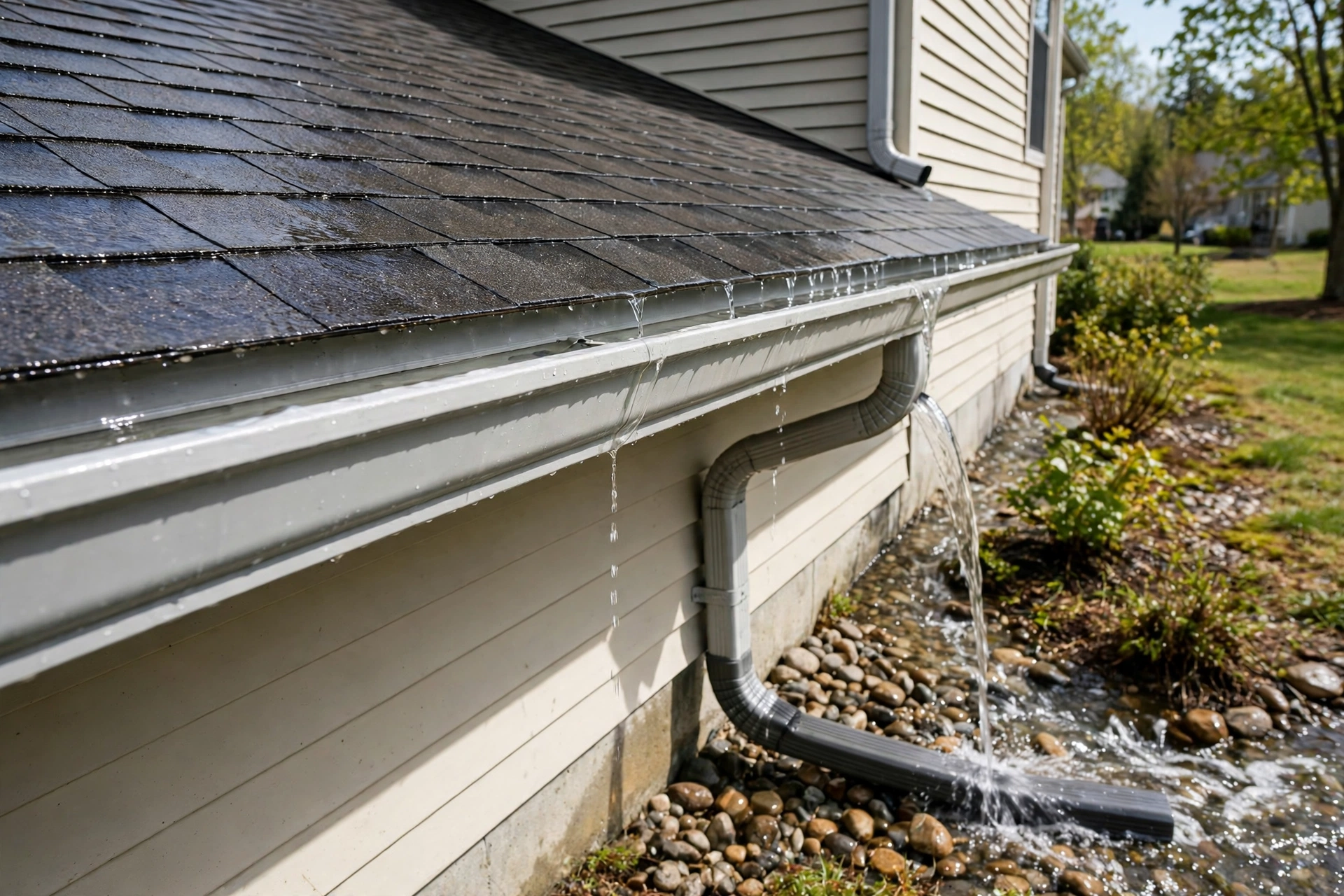
Improving roof drainage means managing one continuous path: from the roof surface, through gutters and downspouts, to a discharge point well away from the house. The fastest wins are cleaning the gutters, correcting their slope, and adding downspout extensions that release water at least 6 feet from the foundation. If water still pools beside the walls after that, the next steps are grading the soil away from the house and, where needed, adding buried drain lines or a French drain. This guide follows that same path, in order, so you fix the cause instead of chasing stains on the siding.
How Roof Runoff Reaches Walls and Foundations in the First Place
A roof collects an enormous amount of water. Every inch of rain on a 1,000-square-foot roof produces roughly 600 gallons of runoff, and all of it has to go somewhere. When gutters overflow, downspouts discharge beside the wall, or the ground slopes toward the house, that water saturates the soil against the foundation. Saturated soil expands, presses against foundation walls, and pushes moisture through even small cracks, while splashback soaks siding, rots fascia boards, and stains exterior walls. Over time the same water erodes soil from under walkways and footings, which is how a drainage problem quietly becomes a structural one.
How to Trace the Water Path From Ridge to Discharge
Walk the system during or just after heavy rain, because that is when it tells the truth. Start at the ridge and valleys, where water concentrates, and look for shingles that channel water over the gutter edge instead of into it. Check every gutter run for sagging, standing water, and overflow marks on the fascia. Follow each downspout to the ground and watch where the water actually lands: on a splash block, in a bed, or straight into soil beside the foundation. Finish at the discharge point and check whether the ground there slopes away or back toward the house.
Gutter Sizing and Slope That Actually Move Water
Standard 5-inch gutters suit many homes, but they overflow quickly under heavy rain, especially on steep roofs or large roof areas that funnel water into a short gutter run. Upgrading to 6-inch gutters, which handle roughly 40 percent more water, is one of the most effective single changes for homes that see regular downpours. Seamless gutters, formed on site from a continuous coil, cut down leak points along straight runs, though corners, outlets, and end caps still need proper sealing and periodic checks.
Slope matters as much as size. Gutters should fall gently toward the downspout, typically about 1/4 inch per 10 feet of run, so water keeps moving instead of ponding. A gutter that looks level may actually sag between brackets, creating low spots where debris collects and water stands. Check the slope with a level after cleaning, tighten or reposition brackets that have pulled loose, and make sure the outlet is not partly blocked by a crushed or misaligned downspout connection.
- Clean gutters at least twice a year, and more often if large trees overhang the roof.
- Fit gutter guards where leaves are a constant problem, but still inspect underneath them each season.
- Check that the gutter’s back edge sits high enough that roof runoff lands inside the channel, not behind it.
Replace sections that are rusted through, split at the seams, or bent out of shape, rather than patching them repeatedly.
Downspout Placement, Extensions and Buried Lines
Downspouts should sit at every roof valley and corner where water concentrates, with roughly one downspout for every 20 feet of gutter in heavy-rain areas. A single downspout serving a long run will overload in a storm, so adding a second outlet at the far end often solves overflow that looks like a gutter problem. Downspout size matters too: larger downspouts clear debris better and keep up with 6-inch gutters, while undersized ones clog and back water onto the roof edge.
Getting water into a downspout is only half the job. Extensions should carry discharge at least 6 to 10 feet from the foundation, and buried solid drain lines can carry it farther to a safe outlet such as a swale, a dry well, or a storm drain where local rules allow it. Keep the outlet where water can disperse without flooding a neighbour’s property, a driveway, or a walkway, and fit a screen or grate so leaves and grit do not clog the buried line. In cold climates, make sure buried lines slope continuously and discharge where they will not freeze into an ice sheet across a path.
Roof Drainage Upgrades Compared for Walls and Foundations
Grading and Surface Drainage Around the Foundation
Even a perfect gutter system cannot save a house whose ground slopes toward it. Soil should fall away from the foundation by at least 6 inches over the first 10 feet, and any low spots beside the walls should be filled and compacted so water runs off instead of pooling. Keep soil and mulch below the siding, brick weep holes, and any wood components, since material piled against the wall traps moisture against the structure and hides the first signs of trouble.
Flashing, Valleys and Roof Features That Redirect Runoff
Not all roof drainage happens in the gutters. Valleys concentrate large volumes of water, and worn valley flashing or a valley that dumps directly onto a lower roof section can overwhelm the gutter below it. Drip edge flashing along the eaves keeps runoff from curling back under the shingles and onto the fascia, while kick-out flashing where a roof meets a wall throws water into the gutter instead of letting it run down the siding. If you see a vertical stain line on a wall below a roof-to-wall joint, missing or failed kick-out flashing is a likely cause.
Seasonal Roof Drainage Maintenance That Prevents Overflow
Drainage systems fail gradually, then all at once in a storm, so a seasonal routine prevents most of it:
Clean gutters and downspouts in late autumn after the leaves fall, and again in spring.
Check the slope and brackets while you are up there, and flush each downspout with a hose to confirm it runs freely.
In winter, watch for ice dams; they form when heat escapes into the attic, so insulation and ventilation matter too.
Roof Drainage Mistakes That Soak Exterior Walls
The most common mistake is discharging downspouts right beside the foundation, which concentrates the whole roof’s water in the worst possible place. The second is assuming gutters are clean because they look fine from the ground; a single handful of leaves at an outlet can back water up across an entire run. A third is connecting roof runoff into a French drain or a dry well that is too small, so a heavy storm floods it and sends water back toward the house.
Other mistakes are subtler. Piling mulch or soil against the siding hides moisture and invites rot, even when the gutters work perfectly. Ignoring a sagging gutter lets water pond and spill over the back edge onto the fascia, where it rots wood out of sight. And sealing a gutter leak with caulk while ignoring the failed bracket that caused the joint to open means the leak returns with the next storm. Fix the cause, not the symptom, and check the work in the next rain.
What Roof Drainage Work Costs in Broad Terms
Costs depend on roof size, access, and local labour rates, so use these as broad planning ranges only. Cleaning and minor gutter repairs for a typical single-family home often fall in the low hundreds of dollars when hired out, and much less as a DIY job. Adding downspout extensions is inexpensive, usually tens of dollars per downspout in materials. Replacing gutters with 6-inch seamless aluminium typically runs into the low thousands for a whole house, while buried drain lines, regrading, or a French drain can each reach several thousand dollars depending on length, depth, and soil conditions.
Get quotes that itemise the work: gutter size and material, number and position of downspouts, extension length, and where the water will discharge. A quote that does not mention discharge is incomplete, because moving water off the roof without moving it away from the house solves nothing. If a contractor suggests routing roof water into a soakaway or storm drain, check local rules first, since some areas restrict where roof runoff may go.
When Roof Drainage Needs a Roofer, Not a Ladder
Cleaning gutters and fitting extensions is safe DIY work for most homeowners, but some drainage problems belong to professionals. Call a roofer if the roof is steep, high, or in poor condition; if flashing, valleys, or the roof deck itself need repair; or if you find sagging roof sections that suggest structural trouble. Working on a roof without proper fall protection is one of the most dangerous home maintenance tasks, and no gutter repair is worth a fall.
Call a drainage or foundation specialist if water keeps entering the basement despite good gutters and grading, if the foundation shows new or widening cracks, or if the lot needs major regrading or a subsurface drain system. These jobs involve excavation near footings, and doing them wrong can undermine the foundation they are meant to protect. A professional assessment first is cheaper than fixing a drainage system that made the problem worse.
Roof Drainage Questions Homeowners Ask Most
How far from the house should downspouts discharge water?
Aim for at least 6 to 10 feet from the foundation, using extensions or buried lines. The exact distance depends on soil, slope, and local rules, but water should never be released right beside the wall, where it saturates the soil against the foundation.
Why do my gutters overflow even when they are clean?
The usual causes are undersized gutters for the roof area, too few downspouts, incorrect slope, or a roof valley that dumps a large volume into one short run. Upgrading to 6-inch gutters, adding a downspout, or correcting the slope usually solves it.
Do gutter guards mean I never have to clean my gutters?
No. Guards reduce how often cleaning is needed and keep out large leaves, but fine debris can still collect, and guards themselves need inspection. Check underneath them at least once a year and after major storms.
What is the correct ground slope away from a foundation?
A widely used guideline is at least 6 inches of fall over the first 10 feet from the foundation. If the ground is flat or slopes toward the house, add and compact soil near the wall and reshape beds or swales to carry water away.
Can roof runoff go into a French drain?
It is usually a bad idea. French drains are designed for groundwater, and a storm’s roof runoff can overwhelm them, pushing water back toward the house. Keep roof water in its own solid drain line to a separate safe outlet.
How do I know if poor drainage is damaging my foundation?
Look for damp basement walls, efflorescence on foundation concrete, widening cracks, doors or windows that stick, and soil erosion beside the walls. Any of these deserves a prompt inspection, because foundation damage gets more expensive the longer it goes unaddressed.
Final Thoughts: Dry Walls Start at the Roofline
Roof drainage is a system, not a single product, and it only works when every part of the path does its job: the roof sheds water, the gutters catch it, the downspouts carry it, and the ground moves it away. Start with the cheap fixes, clean gutters, correct slope, and extensions, then move to grading and buried lines only if the water still pools. A dry foundation and clean exterior walls are the reward, and they cost far less than the repairs that follow when drainage is ignored.