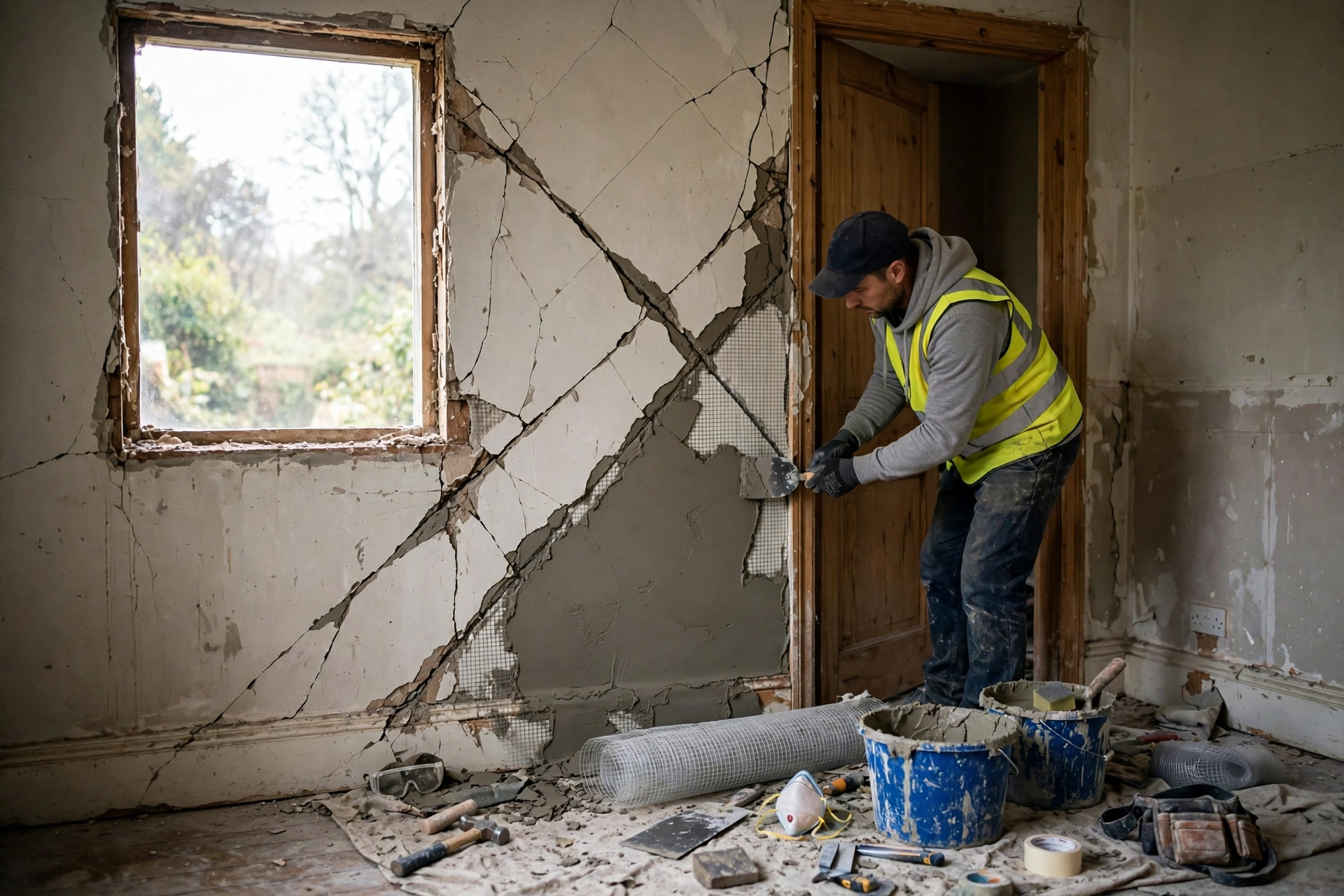
A crack running diagonally from the corner of a window or a door is one of the most common wall defects in a home, and one of the most misunderstood. It looks small, it is easy to fill and paint over, and it usually comes back within a year. That is because the crack is not the problem; it is the symptom. Every opening in a wall is a weak point where movement concentrates, and unless the wall is reinforced at that point, the same stress will open the same crack again.
The best reinforcement for cracks around doors and window openings depends on the cause, but for most stable masonry cracks the leading solution is crack stitching with stainless steel helical bars bedded in grout, combined with lintel repair or replacement where the beam above the opening has failed. For render and plaster, diagonal mesh reinforcement at every opening corner spreads the stress so the crack cannot re-form. This guide explains how to read the crack, choose the reinforcement, and repair the opening so it stays repaired.
Why Cracks Keep Appearing at the Corners of Doors and Windows
Every window and door opening breaks a wall into sections that move slightly differently, and the corners of the opening are where those movements meet. Lintels, sills, and frames expand and contract at different rates from the surrounding masonry, so stress collects at the corners. Thermal movement, seasonal moisture changes, minor settlement, and vibration all feed into the same points. A crack running diagonally from the corner of a window is the classic sign of a wall that was built or finished without reinforcement at that point.
How Can You Tell a Cosmetic Crack From a Structural One?
Not every crack around a door or window is dangerous, but the difference between cosmetic and structural is not something to guess at. Hairline cracks in render or plaster, especially fine random crazing from shrinkage as the material cured, are usually cosmetic. They can still let water in over time, so they should be filled or overcoated, but they do not threaten the structure. The cracks that deserve a closer look are the ones that grow over the months, run in straight lines, are wider at one end than the other, or appear alongside sticking windows and doors.
Learn to read the pattern. Vertical cracks that run straight up and down are often caused by natural settlement and are usually good candidates for stitching. Diagonal cracks at opening corners point to localised stress or uneven settlement; narrow, stable ones can often be stitched, while wide or growing ones need investigation. Stair-step cracks that follow the mortar joints in brickwork suggest the wall is no longer evenly supported, often because a lintel is failing or the foundation has moved. Horizontal cracks running parallel to the ground are the most serious pattern of all, because they can indicate excessive soil pressure or water damage, and they usually require professional assessment. As a rough guide, cracks wider than about a quarter of an inch, cracks that keep growing, and any crack accompanied by bowing, sagging brickwork, or water ingress around a frame should be checked by a structural engineer before any repair is attempted. Mark the ends of a crack with dated pencil lines and measure its width every few weeks; a crack that is not moving is a very different job from one that is.
Helical Bar Stitching, Carbon Fibre, and Lintel Repairs Compared
Once the crack has been diagnosed as stable and suitable for reinforcement, the choice of method depends on the wall material, the crack pattern, and whether the lintel above the opening is involved. Helical bar stitching is the workhorse for masonry cracks, carbon fibre strips suit situations where a thin, high-strength reinforcement is needed, and lintel work addresses the beam above the opening rather than the crack itself. The comparison below sets out the realistic options.
Stitching a Cracked Wall Around an Opening, Step by Step
Crack stitching is a straightforward, durable method: stainless steel bars are embedded in horizontal slots cut across the crack and secured with grout, so the stress that opened the crack is redistributed across the reinforced zone instead of concentrating at the opening corner. Done properly, the repair restores tensile strength to the wall and prevents the crack from reopening. The work is dusty and needs care with the grinder, but a competent DIYer can stitch a stable crack, and a professional can do it in a day.
Confirm the crack is stable. Mark and measure it over several weeks, and fix the cause, such as a leaking gutter, a failed lintel, or poor drainage, before stitching.
Cut horizontal slots across the crack. Use an angle grinder with a diamond blade to cut slots about half an inch deep and three quarters of an inch wide, perpendicular to the crack.
Space the slots 6 to 8 inches apart. Extend each slot at least 12 inches beyond both sides of the crack so the bar grips sound masonry.
Clean the slots thoroughly. Remove all dust and loose material so the grout bonds properly to the masonry.
Bed the bars in grout. Apply a continuous bead of grout into each slot, press the helical bar firmly into place, then cover it with more grout and finish flush.
Cure and finish. Work in temperatures between 40 and 90 degrees Fahrenheit, allow about 72 hours for full curing, then repoint or refinish to match the wall.
Lintels Above Doors and Windows: Repair or Replace?
A surprising number of cracks around openings are not wall cracks at all; they are lintel cracks. The lintel is the structural beam above a window or door that carries the weight of the wall above and transfers it down to the brickwork on either side. When it fails, the masonry above it drops slightly, and the classic signs appear: stair-step cracks in the brickwork above the opening, bowing or sagging brickwork, and water ingress around the frame that was not there before. Steel lintels in properties built before the 1980s are particularly vulnerable, because damp getting in through a failed cavity tray or degraded mortar rusts the steel, and rusting steel expands, cracking the surrounding masonry.
A cracked brick lintel can often be repaired with a remedial steel bar system, inserted across the lintel and repointed so the repair is invisible.
A concrete lintel with corroded reinforcement usually needs the cracked sections removed, the rusted rods treated or replaced, and the concrete reshaped, often with a quick-setting repair mortar.
A steel lintel that has corroded badly or a lintel that has sagged significantly usually needs full replacement rather than repair.
Replacement needs temporary support for the wall above while the old lintel comes out, and it is professional work, not a DIY job.
Because lintel failure can eventually lead to partial collapse if left unaddressed, have a structural engineer identify the cause before any repair work begins.
Flashing, Caulking, and Mesh That Stop Opening Cracks Coming Back
Reinforcement fixes the crack, but the opening still has to be weatherproofed, or water will find its way back in and start the cycle again. Moisture infiltration around doors and windows, caused by poor flashing or failed caulking, weakens the surrounding wall materials and can lead directly to further cracking. The finishing details are therefore part of the structural repair, not an afterthought.
Check and repair flashing around every opening. Damaged or missing flashing lets water behind the cladding, where it saturates the wall and corrodes lintels.
Seal the frame joint with a high-quality flexible exterior caulk, silicone or acrylic based, that can accommodate seasonal movement without splitting.
For larger or persistent gaps, fit a foam backer rod before caulking, so the sealant has support and the joint cannot open up again.
Add diagonal mesh reinforcement at every opening corner when re-rendering, embedded in the basecoat, so stress cannot concentrate at the corner.
Fit corner beads on external corners and make sure sills have proper drips, so rainwater is thrown clear of the wall below.
Repaint after repair to blend the work and add a further layer of moisture protection to the wall surface.
Final Thoughts: Reinforcing Cracked Walls Around Doors and Windows That Hold
Cracks around doors and windows keep coming back when the repair only hides them. The fix that holds starts with reading the crack honestly, distinguishing a cosmetic hairline from a structural warning, and fixing the cause, whether that is a failed lintel, water getting in, or a wall built without reinforcement at its openings. For stable masonry cracks, helical bar stitching is a proven, cost-effective reinforcement that restores strength invisibly. For failed lintels, repair or replacement by a professional is the answer. And for rendered walls, diagonal mesh at every opening corner is the detail that stops the next crack before it starts. Do the diagnosis, do the reinforcement, and finish with flashing and seals that keep the water out, and the corners of your doors and windows will stay quiet for years.
Cracks Around Doors and Windows: Repair Questions Answered
Are cracks around windows and doors always serious?
No. Fine hairline cracks in render or plaster are common and usually cosmetic, caused by shrinkage or small seasonal movement. Cracks that grow, are wider at one end, run in stair-step patterns through brickwork, or appear with sticking doors and windows are the ones to take seriously and have assessed.
What is crack stitching and how does it work?
Crack stitching embeds stainless steel helical bars in horizontal slots cut across a crack, bedded in grout. The bars bridge the crack and redistribute the stress across the reinforced zone, restoring tensile strength to the masonry and preventing the crack from reopening. It is a proven method for stepped and vertical cracks in brick, block, and stone walls.
Can I repair a cracked lintel myself?
Minor cosmetic repairs around a lintel can be DIY, but structural lintel work should not be. Repairing or replacing a lintel needs temporary support for the wall above, an assessment of the remaining capacity, and usually a professional. Because lintel failure can lead to partial collapse, have a structural engineer identify the cause before any work begins.
How long does a crack stitching repair last?
A properly installed helical bar stitch, with the cause of the crack fixed, is a long-term repair that should last for the life of the wall. The bars are stainless steel and the grout is cementitious, so neither corrodes or degrades in normal conditions. If the crack reopens, the cause was not fixed or the crack was still moving, and further investigation is needed.
Why do cracks keep coming back after I fill them?
Because filling only hides the crack without addressing the stress that opened it. Openings concentrate movement at their corners, so unless the wall is reinforced there, with helical bars, mesh, or a repaired lintel, the same stress will open the same crack again. Fix the cause, reinforce the wall, and then fill and finish.
When should I call a structural engineer about a crack?
Call one for any crack wider than about a quarter of an inch, any crack that keeps growing, horizontal cracks, stair-step cracks in brickwork, bowing or sagging above an opening, and any crack accompanied by water ingress or doors and windows that stick. An engineer’s assessment is also needed before any lintel replacement or major structural repair.