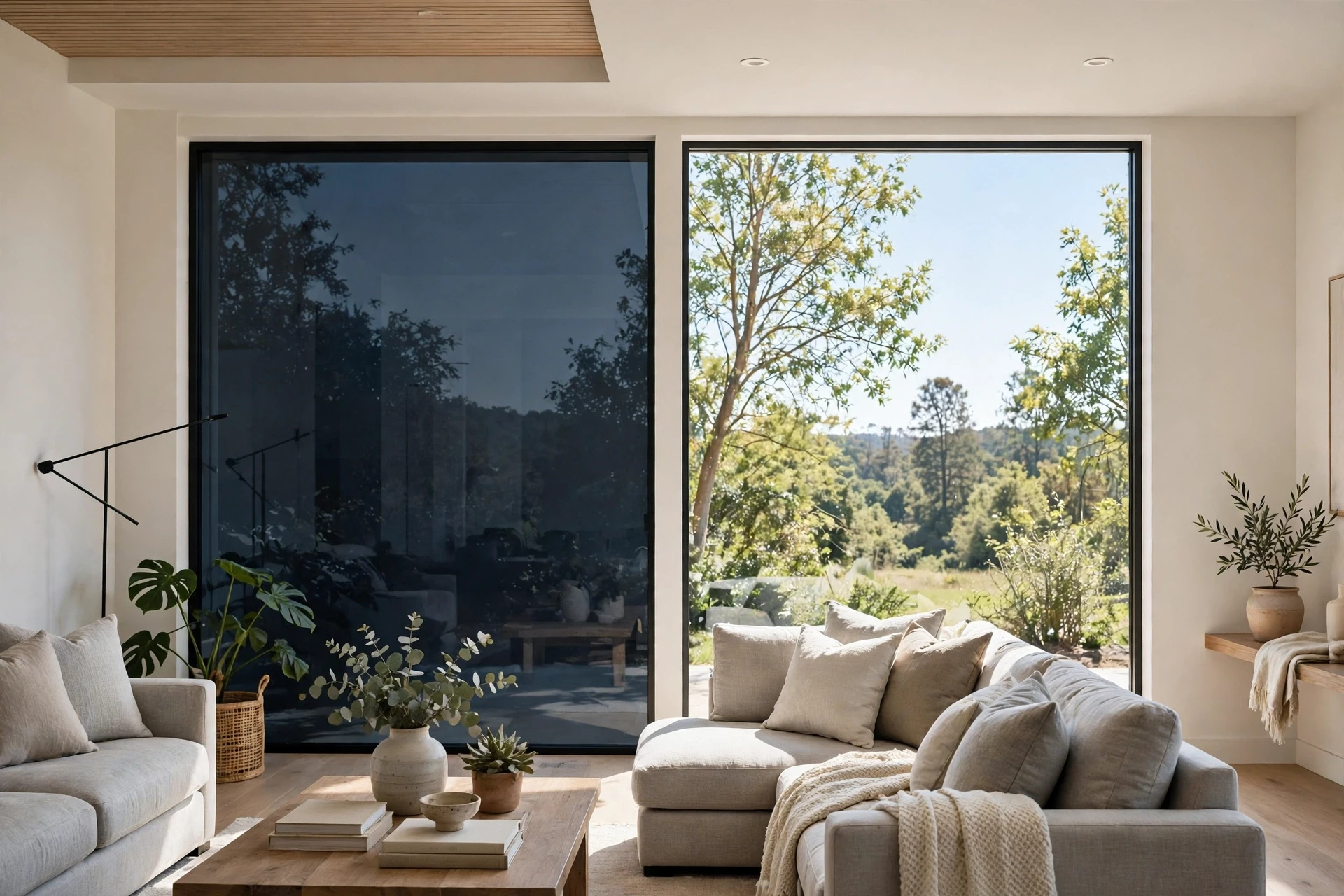
Yes, you can add electrochromic smart glass to windows you already own — in most cases without replacing the whole window. Adhesive electrochromic film sticks directly to existing glass, factory-sealed electrochromic units fit into sound frames, and full replacement is the third option for frames that are failing anyway. Each route gives you glass that tints on demand, cuts glare, and trims solar heat gain.
Electrochromic glass passes a low-voltage charge through a thin electrochromic layer sandwiched between two panes. The charge gradually shifts the tint, controlling how much light and heat pass through. The change is silent, takes roughly 90 seconds to 8 minutes depending on the product, and uses about 0.5 watts per square metre — mainly during the transition, not to hold its state.
Why Existing Window Frames Make Electrochromic Retrofits Possible
Most residential windows already have everything a retrofit needs: a flat pane of glass, a frame that holds it, and a wall nearby for the controller. Unlike a full replacement, a retrofit does not disturb the building envelope. That is the main reason retrofit film and sealed-unit swaps are the most common way homeowners try the technology.
The deciding factor is the condition of what is already there. A sound timber, aluminium, or uPVC frame with a flat, undamaged pane is a good candidate for either route. A frame that is rotting, warped, or letting in draughts is not a retrofit candidate at all — the window needs replacing, and the electrochromic unit can simply be specified as part of that new window.
How Electrochromic Glass Tints on Demand Inside a Home
A small controller sends a low-voltage signal to the electrochromic layer: ions move within the layer and the glass darkens, and reversing the signal clears it again. The transition is deliberately gradual — the glass passes through intermediate shades rather than snapping from clear to dark.
Because the tint holds without continuous power, the controller only works during the change. The glass typically runs on a low-voltage transformer, usually 36–60V AC, and the thin wiring can usually be run discreetly along a frame or behind trim to a controller tucked into a nearby cupboard or window reveal. Control options are wider than most homeowners expect: a wall switch and a smartphone app are standard, while Apple HomeKit, Google Home, and Lutron lighting systems support compatible controllers, and sensors can trigger tinting automatically in response to sunlight or rising temperature.
Three Retrofit Routes for Windows You Already Own
Adhesive electrochromic film is the lightest-touch option: it is applied directly to the inside face of the existing glass. Installation starts with cleaning the pane thoroughly with isopropyl alcohol, then cutting the film slightly smaller than the pane so its edges never touch the frame. The film is laid on with a squeegee to push out air bubbles, bus bars are attached along the edges, and thin wires run to a controller. Done well, the result looks like ordinary tinted glass.
The second route is a factory-sealed electrochromic unit fitted into the existing frame. The old unit is removed, the new electrochromic insulated unit is glazed in, and the wiring is connected through the frame. This gives a cleaner finish and better insulation than film, and the electrochromic layer is protected inside the sealed unit rather than exposed on the room side. It costs more and needs a glazier, but it is the route most professionals recommend for windows used daily.
The third route is full window replacement with electrochromic units, and it is the right choice only when the frames themselves need replacing — rotten timber, failed seals, or single glazing that needs better insulation anyway. It is the most expensive and disruptive option, and it makes no sense as a way to add smart glass alone, since the same tinting performance can be had through the first two routes far more cheaply.
Choosing Between Electrochromic Film and Sealed Glass Units
Film and sealed units are not simply a cheap and an expensive version of the same thing. Film sits on the room side of the glass, exposed to cleaning, knocks, and humidity; a sealed unit keeps the active layer inside the glazing. Film can be fitted in a day; a sealed unit needs a glazier.
The other comparison that matters is electrochromic versus PDLC film, because the two behave very differently. PDLC switches opacity in seconds, but it needs continuous power to stay clear — switch the power off and it turns milky. Electrochromic glass is slower, taking minutes to reach full tint, but it holds its state without power. Electrochromic film blocks infrared while keeping visibility; PDLC blocks up to 99% of UV in both states, which suits privacy applications better than view-driven ones.
| Feature | Electrochromic film | Sealed EC unit | PDLC film |
|---|---|---|---|
| Switching speed | 90 seconds to 8 minutes | 90 seconds to 8 minutes | Seconds |
| Power to hold state | Minimal | Minimal | Continuous power |
| Best suited to | Budget retrofits, trial rooms | Long-term daily use | Privacy glass, bathrooms |
What the Smart Controls Can Actually Do in a Lived-In Home
The controls are what turn tinted glass from a novelty into something that saves energy. A wall switch alone relies on someone noticing the glare and walking over, so automation is what makes the system earn its keep — plan the control scheme at the same time as the glass, not as an afterthought.
- Scheduled tinting: Tint the west-facing glass automatically as the afternoon sun arrives, so the room never overheats.
- Lutron scenes: Link the glass to a lighting scene, so the room dims the glass and raises the lights together.
- Sensor-driven tinting: Let a sunlight or temperature sensor drive the tint, so the glass responds to actual conditions.
Skipping automation integration is one of the most common errors in these projects: a manual-only system leaves the savings on the table, because the glass tints only when someone remembers.
Broad Cost Tiers for Electrochromic Retrofits
Electrochromic glass is still a premium product, so honest pricing means broad estimates rather than precise figures. Installed prices vary with window size, frame condition, wiring runs, and the control system, so the numbers below should be used for budgeting, not as quotes. Manufacturer indications give a sense of the range: View Dynamic Glass is roughly $600–$900 per square foot installed; RavenWindow retrofit kits run roughly $350–$500 per square foot; Halio SPD glass is roughly $400–$700 per square foot.
| Project tier | Typical scope | Broad estimate |
|---|---|---|
| Retrofit film | Key sun-facing windows | Roughly $3,000–$6,000 |
| Sealed EC units | Mid-range, several rooms | Roughly $8,000–$15,000 |
| Whole-home automated | Full house, integrated controls | Roughly $20,000–$40,000 |
Energy Savings Homeowners Can Realistically Expect
Smart glass can cut residential energy use by up to about 30% in sunny homes, and some sources report HVAC energy reductions of up to half. Those are headline figures that depend heavily on climate, orientation, and how the system is controlled.
Orientation is the biggest single factor. Install on south- and west-facing exposures, where solar gain peaks, and savings of 30–40% are claimed in those zones. A shaded or north-facing window gains almost nothing from tinting, so putting smart glass on shaded walls is a classic error: the expense is real and the energy return is close to zero. Payback is often quoted at 7–12 years — a broad estimate, not a guarantee.
Where Electrochromic Glass Earns Its Keep — and Where It Doesn’t
The technology earns its keep in rooms that fight the sun every day: a west-facing living room that overheats by late afternoon, a home office where glare makes a screen unreadable, or a kitchen with a large south-facing window. In these rooms, tinting on demand replaces blinds or curtains. It does not earn its keep on shaded walls, north-facing windows, or rooms that are already comfortable — there, the money is better spent on draught-proofing, insulation, or better-sealed standard glazing. And if you want instant privacy at the flick of a switch, for a bathroom or a street-facing ground-floor room, PDLC is the better fit despite its power draw.
Retrofit Errors That Cause Delamination, Uneven Tinting and Short Circuits
Most failed retrofits fail for preventable reasons. The first is DIY film installation without proper preparation. Film applied to a dusty or greasy pane, or cut to the full size of the glass so its edges press against the frame, will lift at the edges, trap air, and eventually delaminate. The cleaning step is not cosmetic; it is what keeps the film bonded for years.
The second error is electrical. Bus bars must be attached evenly and the wiring kept clear of moisture and sharp frame edges. A nicked wire or a bus bar pressed against a metal frame can short, leaving a window that tints unevenly or stops responding.
When a Glazier or Electrician Should Handle the Work
Adhesive film is the only part of this project a confident homeowner can reasonably attempt, and only on a straightforward flat pane with good access. Everything else — removing a sealed unit, glazing a new unit into a frame, running low-voltage wiring through walls, and connecting a controller to the household supply — belongs to a glazier, an electrician, or both.
Call a professional before ordering if the window is above ground-floor height, the frame is old or its condition is uncertain, the glass is part of a door or a large sliding panel, or the wiring run passes through an external wall. A glazier will confirm the frame can take the unit, and an electrician will size the transformer — typically 36–60V AC — and make sure the controller is supplied safely. Ask the supplier who supports the system after installation, and get a written warranty covering the unit, the controller, and the tinting performance.
Electrochromic Glass and Your Existing Windows: Answers to Common Questions
Can electrochromic film be applied to any existing window?
No. The glass needs to be flat, smooth, and undamaged, with a pane clean enough for the film to bond. Textured, wired, or badly scratched glass will not take film well. A glazier can confirm suitability in a single visit, and that check should happen before any film is ordered.
How long does electrochromic glass take to change tint?
Switching is gradual, taking roughly 90 seconds to 8 minutes depending on the product — RavenWindow retrofit kits, for example, tint in about 90 seconds. The change is silent and passes through intermediate shades, so the room dims progressively rather than switching suddenly.
Does electrochromic glass use much electricity?
Very little: about 0.5 watts per square metre, drawn mainly during the transition rather than to hold its tint — one of the main advantages over PDLC film, which needs continuous power to stay clear.
Will electrochromic glass work with my smart home system?
Most retrofit systems offer a smartphone app and a wall switch as standard, and many support Apple HomeKit, Google Home, and Lutron lighting integration, while sensors can trigger tinting automatically in response to sunlight or temperature. Check compatibility with your existing hub before buying.
How much does an electrochromic retrofit cost?
As a broad estimate, retrofit film for the key sun-facing windows runs roughly $3,000–$6,000, mid-range sealed units run roughly $8,000–$15,000, and a whole-home automated system runs roughly $20,000–$40,000. Per-square-foot indications include roughly $600–$900 for View Dynamic Glass installed, roughly $350–$500 for RavenWindow retrofit kits, and roughly $400–$700 for Halio SPD glass — all broad estimates, and local installation costs will affect the final price.
Is electrochromic glass worth it in a cloudy climate?
Probably not for energy savings alone: the benefit comes from blocking solar gain, so a cloudy climate or a heavily shaded home will see little return. South- and west-facing windows in sunny regions pay back fastest, with payback often quoted at 7–12 years as a broad estimate.
Final Thoughts: Is Electrochromic Glass the Right Smart Upgrade for Your Existing Windows?
For most homeowners, the honest answer is to start small and start on the sunny side. Fit electrochromic film or a sealed unit on the one or two windows that actually cause glare and overheating, wire it into a sensor-driven controller, and live with it for a summer before deciding whether the rest of the house needs it. That approach proves the technology in your own home before you spend more.
If the trial works, expanding is straightforward: the same controller can usually drive additional windows, and the sealed-unit route suits rooms where you want a permanent, protected installation. If it does not work, you have learned that for the price of one room rather than a whole-home system. Electrochromic glass is a genuinely useful technology, but it rewards a measured, room-by-room approach far more than an all-at-once installation.