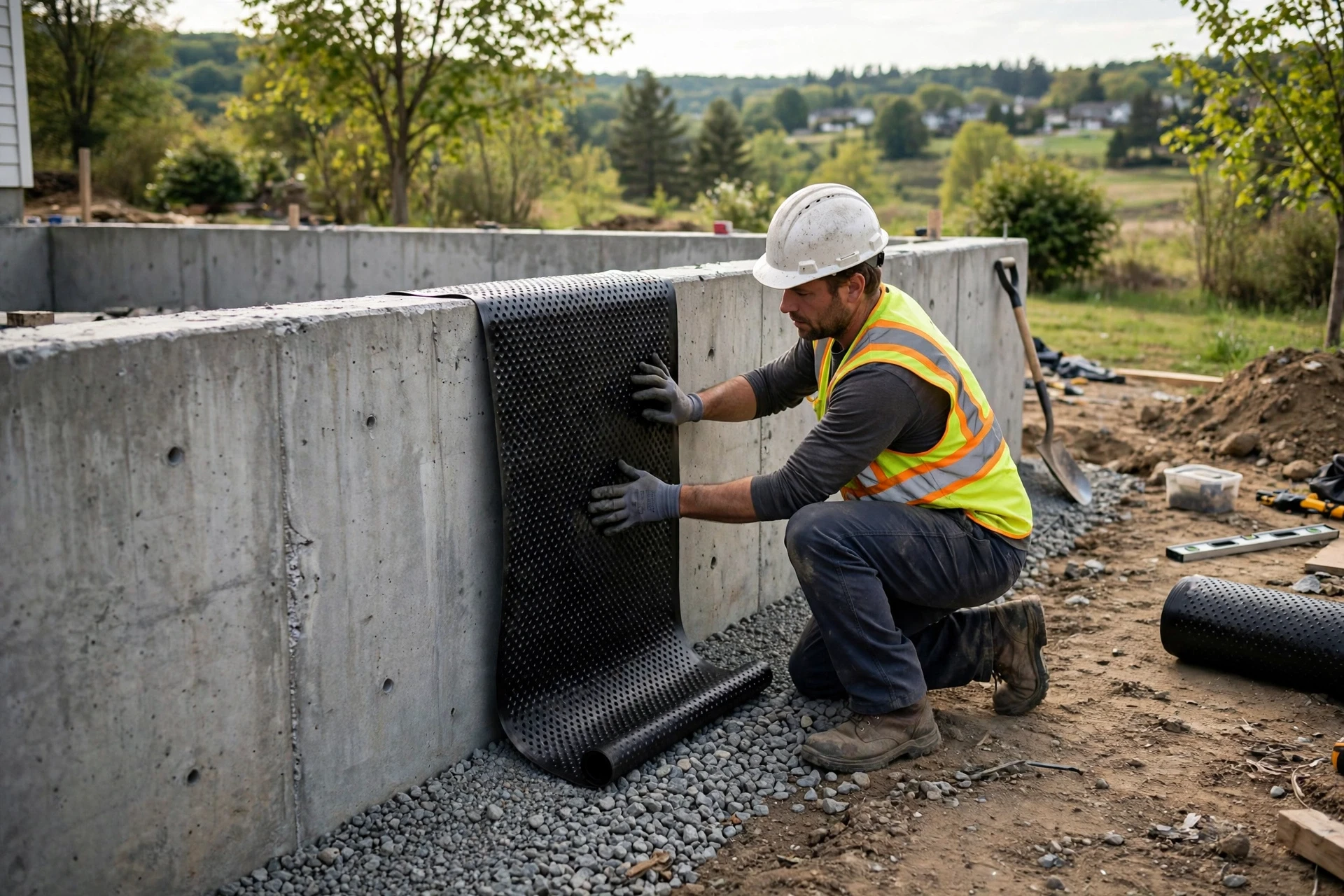
A dry-looking concrete foundation can still be moving water. Groundwater does not need a crack or a visible leak to reach the inside of a home. In porous soil and concrete it can climb, slowly and steadily, through tiny connected passages, drawn upward by surface tension. That quiet climb is capillary action, and it is a common source of damp floors, musty basements, swollen sill plates, and finishes that fail for no obvious reason.
A capillary break is the deliberate interruption of that climb: a layer built into the foundation whose pores are too large for water to bridge, so the upward chain breaks and liquid water stops. It matters most before a slab is poured, when it is cheap relative to the work around it and almost impossible to add later in the same place. It also matters during a retrofit, when dampness at the base of walls suggests that no effective break was ever installed.
Why Groundwater Climbs Through Concrete You Thought Was Solid
Concrete feels dense and impermeable, yet at a microscopic level it is a network of pores, and soil is the same. When those pores are small and connected, water clings to their walls and pulls itself along, molecule by molecule, against gravity. The narrower the passage, the stronger the pull. That is why a foundation sitting directly on damp fine soil, or a slab poured straight onto compacted earth, can draw moisture upward even when the water table is well below the floor.
What a Capillary Break Actually Does Inside a Foundation Assembly
A capillary break stops the upward movement of liquid water through connected pores, and it does this by size alone. In fine soil or concrete, pores are small enough for surface tension to pull water from one pore to the next. In a bed of clean crushed stone, the spaces between stones are far too wide for that pull to bridge. Water reaching the underside of the stone meets air-filled voids instead of a continuous wet path, and the climb ends there.
That distinction matters because a capillary break is not a waterproofing membrane and it is not a vapour barrier. It handles liquid water moving by capillary action, and that is all it handles. It does not stop water vapour diffusing through concrete, it does not stop air carrying moisture through gaps, and it does not hold back water under hydrostatic pressure. A durable foundation uses separate layers for those separate jobs.
Which Stone and Membrane Combinations Stop Wicking Without Trapping Water
The standard capillary-break material is clean, coarse aggregate: crushed stone or gravel, typically one-half to three-quarters of an inch in diameter, free of fines such as dust, silt, and clay. The word clean is doing real work here. Even a small percentage of fines can settle into the voids between stones and re-establish the fine capillary pathways the layer was meant to eliminate. A load that arrives dusty, or is contaminated by site soil during placement, can look correct while performing poorly.
A common choice is number 57 stone, a widely used crushed-stone gradation in that coarse range, valued because its particles leave open voids and compact into a stable bed without crushing into fines. Thickness is the second decision. A common specification calls for a minimum of four inches of clean stone, with some specifications calling for six inches. The thicker layer gives a more reliable break and a larger drainage capacity, and it also serves a secondary drainage function.
| Material | Role | What to look for |
|---|---|---|
| Clean coarse aggregate, 1/2 to 3/4 inch | Breaks the capillary chain; drains water sideways | Free of fines, dust, silt, and clay |
| Number 57 stone | Widely used coarse gradation | Uniform coarse particles; stable open bed |
| Polyethylene, 6-mil minimum | Vapour retarder over the stone | Seams overlapped and sealed; edges turned up |
| Polyethylene, 10-mil or heavier | Vapour retarder for slab basements | Greater puncture resistance under traffic |
Where Capillary Breaks Belong in Slab, Basement and Crawlspace Builds
The most familiar location is beneath a slab-on-grade foundation, where aggregate is placed directly on the prepared sub-base before the concrete is poured. There it sits between damp ground and the slab, breaking the climb at the very start. The same placement is used beneath basement floor slabs, where the stakes are higher because the floor is below grade and surrounded by soil, and where vapour passing through an unprotected slab can feed persistent dampness in a finished basement.
| Location | Capillary-break form | Moisture it interrupts |
|---|---|---|
| Under a slab-on-grade | Clean stone on the prepared sub-base | Liquid water rising into the slab |
| Beneath a basement floor slab | Clean stone with a vapour retarder above it | Liquid water and vapour reaching the floor |
| In a crawlspace | Vapour retarder over soil, sometimes over aggregate | Ground moisture reaching joists |
| Between footing and wall | Break layer at the footing-to-wall joint | Water wicking into the wall |
| Between concrete and sill plate | Sill gasket or membrane | Groundwater wicking into timber framing |
How to Build the Sub-Base Sequence So Liquid Water Has Nowhere to Climb
A capillary break performs best as part of an ordered sequence. The typical sub-base sequence for a slab begins with excavation, followed by compaction of the subgrade so the layers above it sit on a firm, even base. Onto that compacted subgrade goes four to six inches of clean stone, the capillary break itself, placed and levelled without mixing in soil from the sides of the excavation. Over the stone comes the vapour retarder, at least six mils of polyethylene, with seams overlapped and sealed and edges turned up.
Above the retarder, insulation boards such as extruded polystyrene are often placed before the concrete pour, where the design calls for them. At footing level, perimeter drain tile surrounded by drain rock gives water that reaches the stone layer a controlled exit, so it drains away instead of accumulating beneath the slab. The details that undo a good sequence are usually small: stone contaminated with fines, a membrane torn by foot traffic, seams overlapped but never sealed, or edges cut flush instead of turned up.
- Keep the stone clean: protect the stockpile from site soil, and do not crush the placed layer with tracked equipment.
- Check the membrane before the pour: look for tears, make sure every seam is sealed and every edge is turned up.
- Confirm the drain tile: it should sit at footing level, surrounded by drain rock, with a clear path for water to leave.
- Photograph the layers: a few dated photographs are the only record of work that is about to disappear under concrete.
Capillary Breaks, Vapor Retarders and Drainage — Reading the Limits Before You Rely on One Layer
The most common misunderstanding about capillary breaks is also the most expensive: treating one layer as if it solved every moisture problem a foundation can have. A stone bed stops liquid water moving by capillary action. It does not stop water vapour diffusing through concrete, which is driven by differences in vapour pressure rather than surface tension. That is why the polyethylene sheet above the stone is not an optional extra. Without it, a slab can stay dry from liquid water while still passing enough vapour to lift flooring and keep a basement smelling damp.
| Moisture route | Does a capillary break stop it? | What stops it instead |
|---|---|---|
| Liquid water rising by capillary action | Yes | The clean stone layer itself |
| Water vapour diffusion | No | Polyethylene vapour retarder, seams sealed |
| Air leakage through gaps | No | Air sealing at joints and penetrations |
| Water under hydrostatic pressure | No | Drainage and waterproofing for pressure |
Signs Your Existing Foundation Is Wicking Moisture Past a Missing or Failed Break
In an existing home, a missing or failed capillary break rarely announces itself with a flood. It shows up as a pattern: dampness worst at the base of walls and along slab edges, floors that feel cool and faintly damp in humid weather, and finishes that fail from below rather than from above. Paint blisters near the floor line, adhesive under vinyl or timber flooring loosens in patches, and a musty smell returns after cleaning, because the source is the slab itself rather than anything stored in the room.
Repairing a Foundation That Never Had a Capillary Break
A capillary break beneath an existing slab cannot be inserted without removing the slab, so retrofit work focuses on managing the moisture that the missing layer allows through, and on protecting the parts of the house that the moisture reaches. No surface coating applied from above recreates a stone bed below the concrete, and any proposal that promises a single coating will solve every damp problem is making a promise no single layer can keep.
Capillary Break Questions Homeowners Ask Before Pouring or Retrofitting
How thick should the stone layer under my slab be?
A common specification calls for a minimum of four inches of clean stone, with some specifications calling for six inches. The thicker layer is the more cautious choice on a wet site or where the water table is high, because it gives a more reliable break and more drainage capacity. Either way, the stone must be clean and free of fines.
Can I use any gravel I have on site as a capillary break?
No, not reliably. The material needs to be clean, coarse aggregate, typically one-half to three-quarters of an inch in diameter, free of dust, silt, and clay. Site soil and dusty or fine gravel can fill the voids between stones and restore the fine pores that allow water to climb. Number 57 stone is a common choice in that coarse range.
Do I still need a vapour retarder if I have a good stone layer?
Yes. The stone stops liquid water moving by capillary action, and the polyethylene sheet stops water vapour diffusing through the concrete. They do different jobs, and one cannot replace the other. The usual minimum is six-mil polyethylene, with ten mils or heavier preferred for slab basements, laid with seams overlapped and sealed and edges turned up.
Where does a capillary break go in a crawlspace?
In a crawlspace, a vapour retarder is commonly laid over the soil, sometimes over a thin aggregate bed, to separate the house from ground moisture. The retarder controls vapour, while the aggregate beneath it, where used, breaks the liquid path and gives the space a cleaner and more drainable base.
Why does my sill plate matter if the slab has a capillary break?
The sill plate sits where timber meets concrete at the top of the foundation, and concrete can wick groundwater into it even when the slab below is protected. A sill gasket, membrane, or waterproofing material between the concrete and the wood sill plate breaks that path. Without it, the sill can darken, soften, and decay.
Will a capillary break keep my basement dry if groundwater presses against the walls?
Not on its own. A capillary break controls liquid water moving by capillary action only. It does not stop water vapour, air leakage, or water under hydrostatic pressure. A basement on a wet site also needs a vapour retarder, air sealing, drainage that carries water away, and waterproofing designed for pressure.
Final Thoughts: Is a Capillary Break Upgrade the Right Moisture Defence for Your Concrete Foundation?
A capillary break is a modest layer with an outsized effect. Four to six inches of clean stone, a sealed polyethylene sheet above it, and drainage that gives water somewhere to go will do more for the long-term dryness of a slab or basement floor than any surface treatment applied after the pour. It is installed once, hidden under concrete, and then works without maintenance for the life of the building, provided it was built clean and protected during construction.
The right question, then, is not whether a capillary break is worth having, but whether the assembly around it is complete. Stone without a vapour retarder leaves vapour free to pass. A membrane without drainage leaves water with nowhere to go. Ask to see the stone before it is covered, check that the membrane is sealed and turned up, and keep the photographs. Once the concrete is poured, that layer is the only protection the house will ever have in that place.