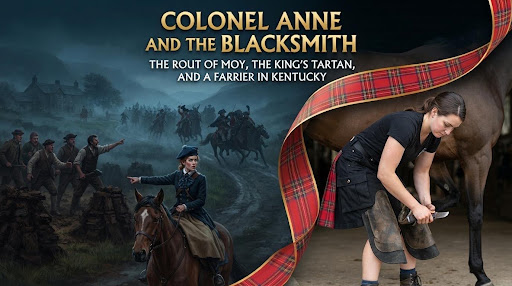
The story of the Royal Stewart tartan is tied to the Stuart prince saved at Moy by a young woman, a fifteen-year-old messenger, and a blacksmith who made a handful of men sound like an army. On the night of 16 February 1746, Prince Charles Edward Stuart was asleep at Moy Hall, south of Inverness, as the guest of a young woman whose husband was, at that moment, serving in the army that was hunting him.
She was Anne Mackintosh, born a Farquharson, twenty-two years old, and the wife of the chief of Clan Mackintosh. When the rising began the previous summer, her husband, a captain in the Black Watch, had stayed loyal to King George. His wife had not. She had ridden round the clan lands with a man’s blue bonnet on her head and pistols at her saddle, and raised several hundred men of Clan Chattan for the Prince, and sent them south under a kinsman to fight at Falkirk. Highlanders called her Colonel Anne. Her husband’s superiors called her something else.
Now the Prince, marching north after Falkirk, had stopped for the night at her house. And in Inverness, twelve miles away, the government commander Lord Loudoun had heard about it, and saw the chance of the whole war.
Fifteen hundred men in the dark
Loudoun set out after dark with about fifteen hundred men. He put a cordon round Inverness so that no messenger could get out. He very nearly succeeded. But a Jacobite sympathiser in the town, the story says the Dowager Lady Mackintosh, got word to a boy of fifteen, Lachlan Mackintosh, who slipped through the lines and ran the twelve miles across country to Moy in the dark to say that the redcoats were coming.
The Prince was got out of bed and hurried down to the loch side in his nightshirt, with his shoes in his hand, or so the story goes. Colonel Anne, in her nightgown, did what she could with what she had. And what she had was the blacksmith.
His name was Donald Fraser. He had been posted on the Inverness road with four or five other men as a lookout, the whole of the guard that the household could spare. When he heard the column coming in the dark, Fraser did not run back to the house. He spread his handful of men out along the road, behind peat stacks and in the heather, and told each of them to shout the war cry of a different clan.
The head of Loudoun’s column came round the bend, and the night exploded. Muskets fired from the dark. Voices roared out of the heather, one after another: the cry of the Camerons, the cry of the MacDonalds, the cry of the Mackintoshes, a call for the Lochiel men to advance, a call for the Keppoch men to come up on the flank. The soldiers at the front, in pitch blackness, believed they had walked into the whole Jacobite army in ambush. They turned. The men behind them turned. Within minutes fifteen hundred men were running for Inverness, and they did not stop until they got there.
One man was killed. He was Donald Ban MacCrimmon, hereditary piper to MacLeod of Dunvegan, shot at the head of the column. He is remembered as the composer of the lament Cha till mi tuille, I shall return no more, which the pipers say he wrote for himself before he set out.
That was the Rout of Moy. Two months later, at Culloden, the government army had its revenge, and Colonel Anne was arrested and handed into the custody of her mother-in-law, which was thought punishment enough. She lived to be sixty-three. When she and her husband met again after the rising she is supposed to have said, “Your servant, captain,” and he to have answered, “Your servant, colonel.”
The Prince’s tartan, and the King’s
The prince she saved gave his name to the most famous tartan in the world, though he never wore it. The Royal Stewart as we know it, a scarlet ground with blocks of blue and green and fine lines of yellow, white and black, appears in the pattern books of the Bannockburn weavers in 1819, seventy years after Culloden. It was the tartan George IV chose for his visit to Edinburgh in 1822, to advertise his own Stewart blood, and it has been the personal tartan of the British sovereign ever since. By a very old courtesy, since clansfolk may wear their chief’s tartan, all the monarch’s subjects may wear this one, which is why it is on every biscuit tin on earth.
So the Royal Stewart tartan is the one tartan that everyone may wear and that belongs, strictly, to only one person. Retailers offer it in Modern and Ancient colours, made to order as kilts, skirts, waistcoats, scarves and ties, or by the yard, and it is probably the single most produced tartan in existence. Colonel Anne would have found that funny. She spent a year raising an army for the Stuart prince against the Hanoverian king, and the tartan that carries the Stuart name now belongs to the Hanoverians’ descendant.
Lexington, Kentucky, a Tuesday in March
Jess Stuart is thirty-four, and she shoes horses for a living. She is a farrier in the bluegrass country of Kentucky, which means she spends her days bent double under thoroughbreds worth more than her house, with a hoof between her knees and a hammer in her hand, and she has strong opinions about what to wear for it.
For ten years it was jeans, and the jeans lasted about four months each. The work is done from the knees and the hips, in a crouch, with a horse’s leg held against the thigh, and denim splits at the crotch and binds behind the knee. Then, at a Highland games in Glasgow, Kentucky, three summers ago, she saw a man with a farrier’s truck in a heavy cotton kilt with cargo pockets, and asked him about it, and has not worn trousers to work since.
Hers came from Scottish Kilt, whose utility kilt for women is described as heavy pure cotton with cargo pockets, D rings and straps, kilt construction built for work, cut to the wearer’s own measurements. It sits at her hip, a little lower than a traditional kilt, and it fastens with snaps and a strap. The pleats give her the full crouch without a seam anywhere near the strain. The cargo pockets take a hoof knife, a rasp handle and her phone. The D rings take a clip for her keys. It goes in the washing machine at the end of the day and comes out clean of everything a horse can produce.
She has two. One is plain black cotton, for days when she will be under twelve horses and does not want to think about it. The one she wears most is a hybrid: a plain black cotton body with the pleats at the back cut in the Royal Stewart. She chose it, she says, because her name is Stuart and it was the only tartan she could think of, and because a farrier crouched under a horse is mostly seen from behind, and it seemed a waste not to put something there. The trainers she works for have got used to it. The horses never minded.
This morning she is at a training barn outside Lexington doing a set of front shoes on a two-year-old who does not care for the process. The trainer, a Scotsman from Ayrshire who has been in Kentucky for twenty years, leans on the stall door and watches the pleats.
“Royal Stewart,” he says.
“Yep.”
“You know that’s the King’s tartan.”
“I know it’s the Stuarts’ tartan. I’m a Stuart.” She sets the hoof down and picks up the rasp. “Anyway, it was a blacksmith saved the Prince. Did you know that? Guy called Fraser. Five men and a lot of shouting. Fifteen hundred soldiers ran home.”
“I did know that,” says the trainer, who is from Ayrshire and knows most things. “Colonel Anne.”
“Colonel Anne.” Jess lifts the next hoof. “Twenty-two years old, and her husband was on the other side. Woman like that could shoe a horse, I’d bet.”
Your servant, colonel
The Rout of Moy was won by a woman who would not do as she was told, a fifteen-year-old who ran twelve miles in the dark, and a blacksmith who understood that in the right conditions five men can sound like five thousand. It saved a prince who went on to lose everything, and none of the three ever got much credit.
The tartan that took his family’s name is now the property of a king, and by his courtesy of everyone else, and it looks well in the pleats of a heavy cotton working kilt on a woman under a horse in Kentucky. Donald Fraser, who spent his life at an anvil, would have recognised the job before he recognised the cloth.