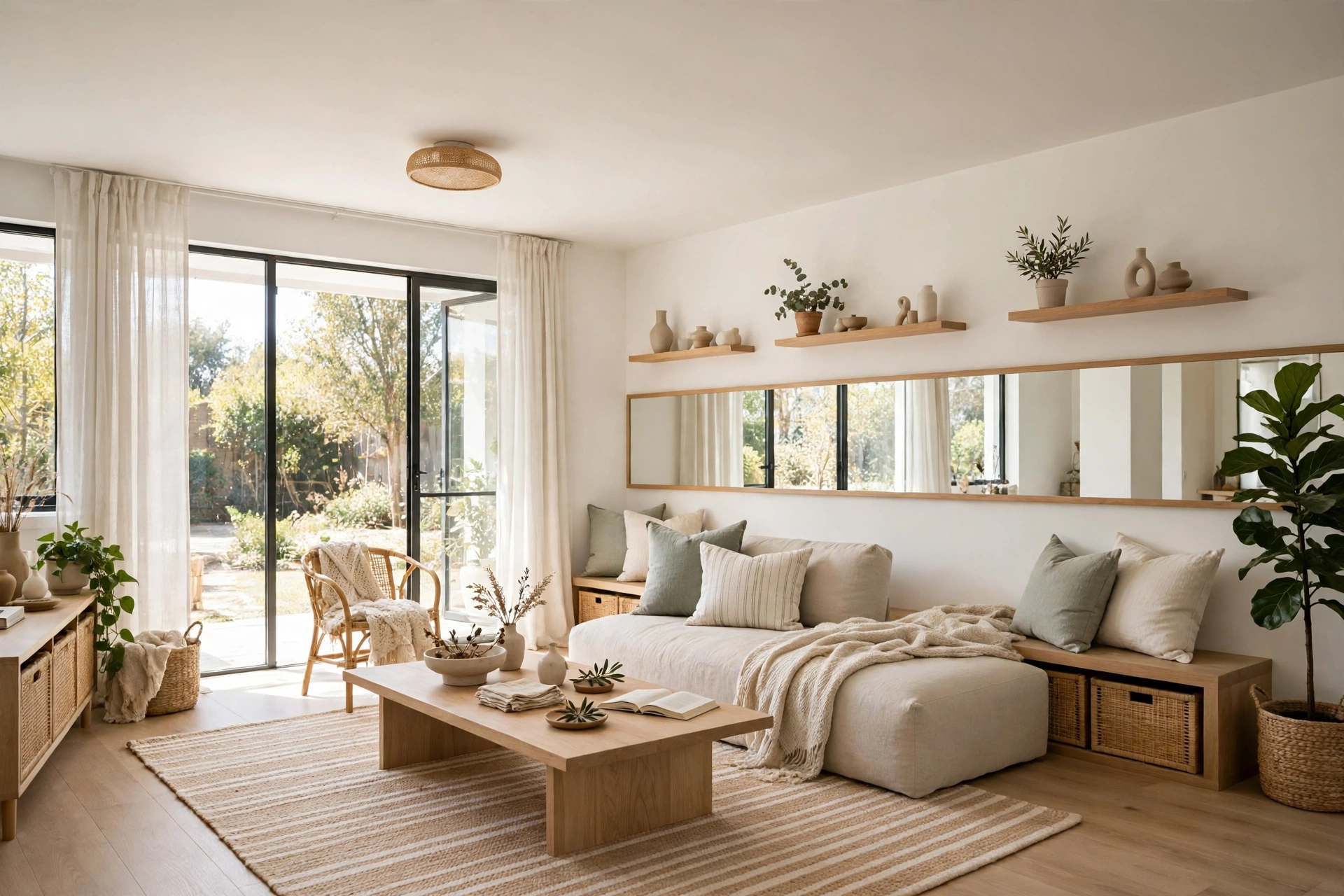
Walk into a room with a low ceiling and you feel it before you can name it. The room is not small, exactly — but something about it feels pressed down, like the walls are leaning in a little. The furniture seems too tall, the light seems to stop halfway down the walls, and every tall guest ducks slightly, even though they do not need to. Here is the reassuring part: you do not need to raise the ceiling to fix that feeling. Low ceilings are a problem of perception, not of inches, and perception is exactly what decorating is for. The eye can be guided, light can be borrowed, and a room that feels cramped on Monday can feel generous by the weekend — with paint, curtains, and furniture choices that cost far less than any structural work. This guide is built around the tricks that actually work in real homes, including the ones that work in rented rooms where you cannot touch the ceiling at all.
How the Eye Reads Height — and Why That Is Good News for You
To decorate a low ceiling well, it helps to know what the eye is actually doing when it walks into a room. It does not carry a tape measure. It looks for lines, contrasts, and stopping points, and it judges height by where the strongest horizontal line sits. That line is usually the top of a curtain rod, the edge of a dark picture rail, or the place where a dark wall meets a white ceiling. Every strong horizontal line near the top of a wall tells the brain the ceiling is right there — and the brain believes it. The good news is that every one of those lines is under your control. Raise the curtain rod, soften the contrast, draw the eye upward with a vertical line, and the same ceiling reads taller, even though nothing has moved. The rest of this guide is just that idea, applied room by room, in the order that gives you the biggest change for the least money.
One more thing before the practical part, because it saves people from a common mistake: the goal is not to make the ceiling disappear. A room with a low ceiling that has been painted entirely white and stripped of everything can feel like a hospital corridor — taller, perhaps, but not a room anyone wants to sit in. The goal is a room that feels taller and still feels like home, which means keeping warmth, texture and a few things worth looking at. The tricks below are chosen with that balance in mind.
Which Paint and Colour Choices Lift a Low Ceiling the Most
Paint is the cheapest tool in this entire guide, and it is also the most powerful, because colour is what the eye reads first. The principle is simple: light colours recede, dark colours advance. A dark ceiling feels lower because it visually presses down; a ceiling painted lighter than the walls feels further away. But the real trick is not just painting the ceiling white — it is removing the hard line where the wall ends and the ceiling begins.
- Paint the ceiling a shade lighter than the walls, not a different colour entirely. A soft white ceiling over pale walls reads as one continuous surface, and the eye slides up without stopping at a boundary.
- Carry the ceiling colour a few centimetres down the wall. This old decorator’s trick creates a false cornice that reads as ceiling, so the wall appears to start lower and the ceiling appears higher. It works best in rooms with no existing coving.
- Use one colour for walls, trim and skirting in a low room. Every contrast line is a horizontal line, and horizontal lines chop a wall into bands. One continuous colour lets the eye travel the full height uninterrupted.
- Choose a flat or matte finish for the ceiling. Gloss reflects light in patches and draws attention to every bump and join; matte paint absorbs the light evenly and the ceiling quietly recedes.
- Keep the floor a mid-tone, not a dark one. A very dark floor with a pale ceiling creates a strong contrast that makes the room feel like a box. A mid-tone floor keeps the balance and lets the vertical lines do their work.
- Use vertical stripes or elongated patterns sparingly, on one wall only. A single feature wall with narrow vertical stripes or tall botanical motifs pulls the eye upward; the same pattern on all four walls closes the room in.
If you take only one idea from this section, take the one about carrying the ceiling colour down the wall. It costs nothing extra — the same tin of paint — and it is the single most effective paint trick for a low ceiling, precisely because it removes the line the eye uses to judge where the ceiling starts. I have seen it transform rooms that no amount of white paint alone could fix.
Furniture Scale: What to Keep Low and What to Take Tall
Furniture is where most low-ceiling rooms go wrong, and it is usually a question of scale rather than taste. A tall, heavy wardrobe in a room with a low ceiling does two bad things at once: it fills the vertical space the eye wants to travel through, and its top edge creates a strong horizontal line right where you do not want one. The answer is not to buy only tiny furniture — a room full of small things feels cluttered and cramped in its own way. The answer is to choose furniture that leaves a clear gap between its top and the ceiling, and to let one or two tall, narrow pieces do the vertical work instead of many wide ones.
| Furniture choice | Effect on a low room | What to do instead |
|---|---|---|
| Tall wide wardrobe | Blocks vertical sightlines; top edge reads as a false ceiling | Use a tall narrow unit, or a low wide chest with wall space above it |
| Low, long sofa | Leaves a generous gap to the ceiling; room feels taller | Keep — this is the right scale for a low room |
| High-backed dining chairs | Chop the room into vertical bands | Choose chairs with a lower back and visible legs |
| Heavy pendant light | Hangs into the eyeline and lowers the ceiling visually | Use flush or semi-flush fittings, or wall lights |
| Short bookcase | Creates a horizontal line halfway up the wall | Go floor-to-ceiling with a narrow bookcase, or keep it low and uncluttered |
| Oversized rug | Draws the eye down and anchors the room to the floor | Choose a rug that leaves a border of floor visible around it |
The pattern in that table is worth stating plainly: in a low room, you want either clearly low furniture with open space above it, or clearly tall and narrow furniture that draws the eye all the way up. It is the in-between pieces — the ones that stop two-thirds of the way up the wall — that do the damage, because their top edge becomes the line the eye reads as the ceiling. Choose one or the other, and the room immediately feels calmer.
How to Use Art and Mirrors to Stretch a Low Room
Art and mirrors are the quiet workhorses of a low room, because they give the eye somewhere to travel vertically without adding any furniture. A tall, narrow piece of art — or a column of three small frames stacked vertically — creates a line the eye follows upward, and the wall reads taller for it. Hang art a little higher than feels natural, so the centre of the piece sits above eye level and pulls the gaze up. Mirrors work the same way, with the added benefit of reflecting light: a tall mirror leaned against the wall opposite a window doubles the daylight and the sense of depth, and because it is leaned rather than hung, its top edge stays soft and does not create a hard horizontal line.
How to Give a Low Room a Taller Feel in One Weekend
If you want a visible change by Sunday evening, here is the sequence I would follow. It is ordered so that each step builds on the last, and it deliberately puts the cheapest, highest-impact changes first — so if you run out of time, you have still done the things that matter most.
Start with the curtains. Take the rod down and remount it as close to the ceiling as you can, and extend it wider than the window frame. Hang floor-length curtains that just kiss the floor. This one change makes the window — and therefore the wall — read taller, and it takes about an hour.
Paint the ceiling and the top band of wall in one session. Use the ceiling colour, carried a few centimetres down the wall, with a flat matte finish. Do the ceiling first, then the band, while the paint is still wet enough to blend.
Swap the light fitting. Replace any hanging pendant with a flush or semi-flush fitting, or add two wall lights at picture height. A pendant in a low room hangs in the eyeline; removing it instantly lifts the ceiling.
Rearrange the furniture to open a vertical lane. Pull tall pieces away from the centre of the wall, and leave at least one clear vertical strip — a tall narrow shelf, a floor-to-ceiling curtain, a vertical piece of art — that the eye can follow from floor to ceiling without interruption.
Add one large mirror, leaned against the wall. A tall mirror reflects light and doubles the sense of depth, and leaning it rather than hanging it keeps the top edge soft. Place it opposite a window if you can, so it borrows the daylight.
Finish with a bold rug and almost nothing on the ceiling. A rug with a strong pattern gives the eye something to enjoy at floor level, so it stops staring at the ceiling — and a ceiling with nothing hanging from it reads higher than one with a pendant, a fan and a light fitting competing for attention.
That is a full weekend, but notice how little of it costs real money: a curtain rod, a tin of paint, a light fitting, and a mirror you may already own. The expensive version of this project — raising the ceiling, adding skylights, rebuilding the room — is rarely necessary, and it is worth trying the weekend version first. Most people who do are surprised by how far it goes.
Lighting a Low Room So the Ceiling Disappears Instead of Pressing Down
Light is the other half of the height illusion, and it is the half most people get wrong by accident. A single bright ceiling light in a low room does two unhelpful things: it throws hard shadows at the top of the walls, which emphasise exactly where the ceiling is, and it makes the ceiling itself the brightest surface in the room, so the eye goes straight to it. The fix is to light the walls instead of the ceiling. Wall lights, picture lights, and floor lamps that wash light upward create a soft glow at the top of the room with no hard edge for the eye to catch on, and the ceiling simply recedes into a gentle brightness. Add a dimmer wherever you can — a low room lit at full brightness feels exposed, while the same room at a warm, lower level feels intimate and taller. And if you have a dark corner that the light never reaches, a small uplighter in that corner is worth more than a second ceiling fitting, because it removes the shadow that was telling the brain the room ends there.
Creative Decorating for Low Ceilings: Frequently Asked Questions
Should I paint a low ceiling white or the same colour as the walls?
A shade lighter than the walls is usually the best answer. Pure white against a coloured wall creates a hard line at the ceiling, which is exactly what you want to avoid. A ceiling a tone or two lighter than the walls, in the same colour family, reads as a continuation of the wall and feels higher.
Do vertical stripes really make a ceiling look higher?
Yes, on one wall, used with restraint. Narrow vertical stripes or tall, elongated patterns draw the eye upward and the brain reads the wall as taller. The same pattern on all four walls has the opposite effect — it closes the room in and feels busy, so keep it to a single feature wall.
Can I use a ceiling fan in a room with a low ceiling?
Only a flush-mount or hugger fan designed for low ceilings, and only if the blades sit well above head height. A fan on a long drop rod in a low room is a hazard and a visual anchor that pulls the ceiling down. If the ceiling is under about 2.4 metres, skip the fan and use a wall-mounted circulator instead.
What height should I hang curtains in a low room?
As close to the ceiling as you can manage, and wider than the window frame. The curtain rod should sit a few centimetres below the ceiling, and the curtains should run to the floor. Hanging curtains just above the window frame is the single most common mistake in a low room — it chops the wall in half.
Are low ceilings a problem when selling a house?
They can put some buyers off, but they rarely decide a sale on their own. A low room that is well lit, lightly furnished and decorated with the tricks in this guide reads as cosy rather than cramped, and most buyers respond to the feeling of the room rather than the measurement on a survey. Focus on light and scale, and the ceiling stops being the story.
Final Thoughts on Decorating a Home With Low Ceilings
A low ceiling is not a flaw to hide — it is a constraint to design around, and the rooms that do it best are often the most characterful in the house. The principles are simple enough to remember: remove the hard lines that tell the eye where the ceiling is, give the eye a vertical path to follow, keep furniture either clearly low or clearly tall, and light the walls instead of the ceiling. Do those four things, in that order, and the room will feel taller without a single structural change. And if you only do one of them, hang the curtains at the ceiling. It takes an hour, it costs almost nothing, and it is the change you will notice every single time you walk into the room.