As data center networks move toward higher port speeds, fiber cabling design becomes more than a matter of connecting one transceiver to another. The optical interface determines how fibers are allocated, how trunk cables are routed, and how easily the infrastructure can accommodate future upgrades. With its parallel optical architecture, 40GBASE-SR4 introduces specific cabling requirements that network designers need to consider from the beginning.
Eight Fibers for One 40G Link
Unlike duplex optical interfaces that transmit and receive over a single pair of fibers, 40GBASE-SR4 uses parallel optics. Four optical lanes transmit data, while four separate lanes receive it. This requires eight active fibers for a full-duplex link.
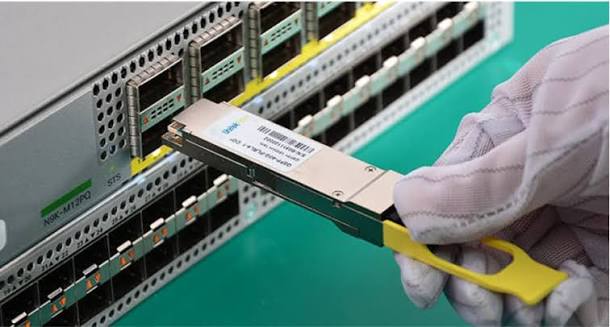
The QSFP+ SR4 transceiver typically uses a 12-fiber MPO connector, with four fibers allocated to transmission and four to reception. The remaining four positions are unused for a standard SR4 connection. Although the connector accommodates 12 fibers, the link does not use all 12.
This distinction matters when planning trunk cables. A design based only on connector type may overestimate usable fiber capacity or overlook how individual links consume fibers within a larger cabling system.
Planning MPO Trunks and Patch Panels
MPO trunk cables can simplify high-density cabling between racks, patch panels, and network switches. Instead of routing multiple individual duplex jumpers, installers can manage groups of fibers through a single trunk assembly.
However, trunk capacity must be planned around the eight active fibers required by each SR4 link, as well as connector polarity and lane mapping. Incorrect polarity can prevent the transmit lanes at one end from aligning with the receive lanes at the other. Standardized polarity plans and clear labeling help reduce installation errors and simplify troubleshooting.
Patch panels and cassettes also affect the design. Each additional connection introduces potential insertion loss, so the complete channel must remain within the optical loss budget specified for the transceivers. Keeping the number of unnecessary connections under control can make link performance easier to manage.
Fiber Utilization and Port Density
At first glance, using eight fibers per 40G link may seem inefficient compared with duplex interfaces. Yet the impact depends on the wider cabling architecture. MPO trunks can consolidate many fibers into compact cable assemblies, helping maintain orderly routing in high-density racks.
The key is to calculate fiber demand at the system level. Designers should account for the number of SR4 links, available trunk fiber counts, patch-panel capacity, spare fibers, and the space needed for cable management. Leaving some capacity unused may be worthwhile when it provides room for repairs or future connections.
Cable diameter, bend radius, and airflow around equipment also deserve attention. Poor routing can complicate maintenance and obstruct access to switch ports, even when the optical links themselves perform correctly.
Designing for Future Upgrades
A cabling system built for 40G SR4 should not be assumed to support every future interface simply because it uses MPO connectors. Higher-speed parallel optics may require different fiber types, connector arrangements, polarity schemes, or channel-loss limits. Compatibility must be checked against the target transceiver and application specifications.
For some deployments, existing multimode trunks may remain useful during a staged migration. In others, new cabling may be necessary to meet future reach or performance requirements. Planning for both scenarios helps avoid costly redesigns.
Build the Cabling Plan Around the Link
Successful 40G SR4 deployment depends on more than selecting compatible transceivers. Understanding its eight-fiber transmission path helps teams plan MPO trunks, manage patch-panel capacity, control optical loss, and reserve space for expansion. By treating fiber infrastructure as part of the network architecture rather than an afterthought, data center operators can build a cleaner, more maintainable foundation for current 40G links and future upgrades.