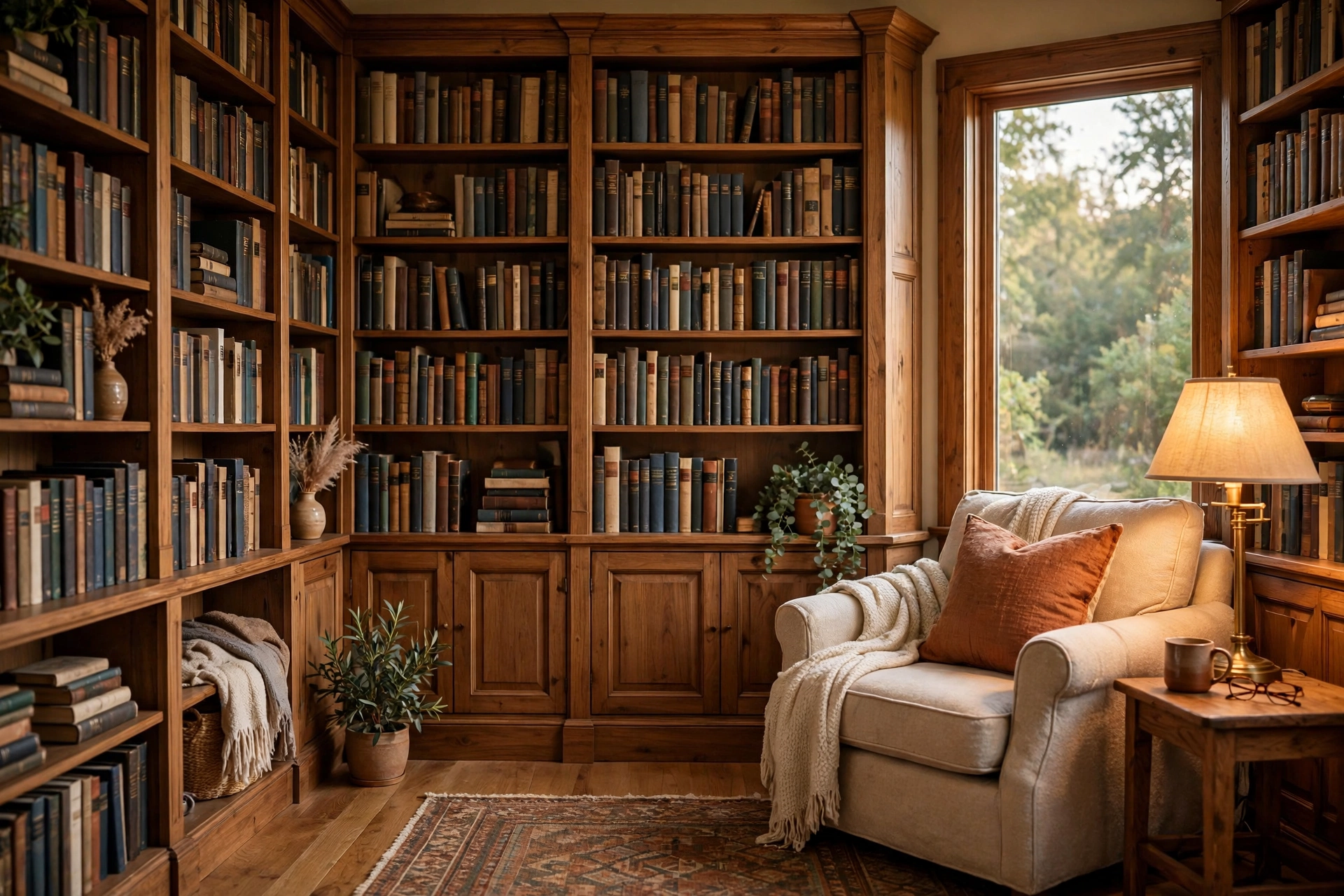
Most home libraries fail in the same quiet way. The shelves go up, the books go on, and then nobody sits down. A room full of books is not yet a library, because a library is a place where reading actually happens — a chair that invites a long sit, light that falls on the page without glare, and shelves arranged so the next book is always within reach.
The short answer: design the shelves around the books you already own, put the reading seat in the best light in the room, and let the shelf style follow the architecture of the house rather than a catalogue photograph. A comfortable reading corner needs only four things — a chair you can sit in for an hour, a light over your shoulder, a surface for a drink and a book, and a rug or screen that marks the spot as yours.
Start With the Books, Not the Shelves: Sizing Your Library Around What You Own
A shelf designed for imaginary books fits nobody’s collection. Before ordering a single board, count and measure what you actually own. Pull the tallest books — art books, atlases, and coffee-table volumes — and measure their height, then group the rest by size. Standard paperbacks and hardcovers sit happily on shelves spaced about 10 to 12 inches apart, but oversized volumes need 14 to 16 inches of clearance.
Depth matters just as much. Around 10 to 12 inches suits most books and objects, while deeper shelves swallow paperbacks and leave a dead strip of dust behind them. If you own many large-format books, plan one or two deeper bays rather than making every shelf deep. Adjustable shelves are worth their small extra cost: collections change, and a shelf that can move two inches will still fit the collection five years from now.
Built-Ins That Fit the Room’s Bones: Alcoves, Corners, and Awkward Walls
The most distinctive home libraries are rarely freestanding bookcases lined up against a flat wall. They are built into the parts of a house other furniture cannot use well: an alcove beside a fireplace, the wall under a staircase, a deep window recess, or a sloped attic wall. Building into these spaces makes the library feel like part of the house rather than furniture parked in it.
Alcoves are the easiest win: two matching runs flanking a fireplace turn a blank wall into a focal point, and a low cabinet beneath hides chargers and clutter while giving the shelves a solid base. Under-stair space suits a bench with storage underneath, shelves above, and a reading light. Corners deserve more respect than they usually get — shelves that wrap around a corner use wall space a flat run wastes, and a chair tucked into the angle becomes a genuinely enclosed spot.
Alcove walls: match shelf width to the alcove exactly, and scribe side panels to uneven plaster so no gap shows.
Under-stair nooks: keep the bench seat around 18 inches high and 16 to 18 inches deep so it works as a seat, not just a shelf.
Five Shelf Styles That Change the Whole Room
Shelf style is not decoration — it sets the room’s character and its price. A floor-to-ceiling built-in wall reads as architecture; floating shelves read as a gallery; a rolling ladder reads as old-world charm. Choose the style that matches how the room is already used. Paint-grade timber painted the wall colour makes built-ins disappear into the room and forgives uneven walls, while natural oak or walnut brings warmth at a higher price.
A Reading Corner That Earns Its Keep: Chair, Light, and Landing Space
The reading corner is where a library succeeds or fails, and it starts with the chair. A good reading chair is deep enough to curl into and supportive enough to sit upright in, sized to the corner — an oversized recliner swallows a small room, while a dining chair punishes a long chapter. Sit in the chair before buying it, book in hand, and check that your arms rest naturally at reading height.
Next to the chair, within arm’s reach, put a small side table or a shelf at elbow height. It holds the current book, a drink, and reading glasses, and its absence is the reason many beautiful corners go unused — nobody wants to stand up every time they set a cup down. A basket beside the chair holds a throw and the next two books, and a rug under chair and table defines the zone and warms bare floors. Keep the television out of the sightline, or the corner becomes a second television seat.
Lighting a Library in Three Layers Without Glare on the Page
One ceiling light is the fastest way to ruin a library. It throws shadows across the page and leaves shelf rows in darkness. Good library lighting works in three layers: ambient light from a ceiling fixture sets the general level; task light from a floor lamp, table lamp, or sconce beside the chair does the actual reading work; accent light from LED strips under each shelf lip makes the collection glow in the evening.
Task light placement is specific: the lamp should sit over or just behind the reader’s shoulder, so light falls on the page without shining into the eyes or casting the reader’s own shadow. A warm bulb, around 2700K, suits evening reading; cooler daylight bulbs suit a daytime work corner but can feel clinical at night. Plan shelf lighting before the shelves go up: LED strips concealed behind a small pelmet cast an even wash down the spines, with cables routed through the carcass so no wiring shows.
Styling Shelves So They Read as a Collection, Not a Warehouse
A library that looks curated follows a few simple habits. Sort with a system you can maintain: by subject for a working library, by author for a literary collection, or by colour only if you genuinely remember where books live by their spines. Break up long runs of vertical spines every few feet with a small horizontal stack topped by a candle or a photograph, or leave a short stretch empty so the eye has somewhere to rest.
A Weekend Build Sequence for a Book Wall That Actually Gets Finished
The difference between a library project that finishes and one that stalls in the garage is sequence. Start small and finish one wall before starting the next — a single well-finished wall, styled and lit, beats three half-built walls.
Measure the collection: count books, measure the tallest volumes, and work out total shelf length needed.
Sketch the wall to scale, marking alcoves, sockets, radiators, and door swings shelves must clear.
Fix the reading seat first — chair position, lamp point, side table — then design shelves around it.
Build the lowest run first, level it carefully, and anchor it to wall studs before loading a book.
Add upper shelves, adjustable where possible, leaving one shelf height free for oversized books.
Load heavy books low, current reads at eye level, light objects high, then style in short passes.
What a Home Library Costs at Three Levels of Ambition
Library costs spread widely because the scope does. A corner assembled from furniture already in the house can cost almost nothing beyond a lamp and a rug, while a full fitted room with custom millwork, a ladder, and integrated lighting is a serious joinery project. The estimates below are broad only — local labour rates, timber prices, and room size move every figure. Spend where it is touched daily — the chair, the task lamp, and the shelf fixings.
Library Slip-Ups That Leave Shelves Sagging, Books Fading, and Corners Unused
The most common library mistake is overloading shelves that were never fixed properly. A shelf full of books is heavy — a three-foot run of hardcovers can weigh as much as a small adult — so shelves must be anchored into wall studs, not just plasterboard, and long spans need a centre support or thicker board. Anti-tip fixings are essential in homes with children, and heavy books belong on the lowest shelves so the unit cannot topple forward.
Sunlight is the quieter destroyer: direct sun fades spines, yellows pages, and warps covers, so the sunniest wall is often the worst place for the main collection. Use sheer curtains or UV-filtering window film there, and keep rare or sentimental volumes on a shaded wall. Damp is the other enemy — shelves fixed tight against an exterior wall with no air gap can trap moisture behind books, so leave a small gap and check for damp before building. And guard against the library nobody sits in: if the chair faces the busiest walkway or the lamp is across the room, the corner will stay empty no matter how beautiful the shelves are.
When the Library Job Belongs With a Joiner or an Electrician
Most library work is comfortably do-it-yourself: painting, assembling freestanding shelves, arranging furniture, and fitting plug-in lights. The line is crossed when work becomes structural or electrical. Fixing tall, heavy shelving to walls, cutting into walls for alcove built-ins, or building a window seat into a structural bay all deserve a joiner who can confirm the wall will carry the load. New circuits, hardwired sconces, and LED drivers wired into the mains supply should be installed by a qualified electrician. Any project that uncovers damp, mould, or damaged plaster behind a planned shelf wall should pause until the cause is found.
Home Library Design Questions Readers Ask Before Ordering a Single Shelf
How deep should library shelves be for a mixed collection of books?
A depth of 10 to 12 inches suits most paperbacks, hardcovers, and decorative objects, and keeps books within easy reach. Reserve one or two deeper bays, around 14 to 16 inches, for oversized art books and atlases, rather than making every shelf deep — deep shelves hide paperbacks behind a strip of dust.
Can a genuine reading corner fit in a small flat or a single room?
Yes. A reading corner needs a chair, a light, and a surface, not a room of its own. An armchair angled into a quiet corner, a floor lamp over the shoulder, a small side table, and a narrow bookshelf or basket of current reads create a corner that works in a studio flat.
Should books be organized by colour, subject, or author?
Organize by the system you will actually maintain. Subject or author order helps you find a specific book quickly, which matters in a working library. Colour order looks striking in photographs but makes finding titles harder.
Do built-in bookshelves add value to a home?
Well-built, well-fitted shelving is generally seen as a desirable permanent feature, particularly in living rooms and studies, because it adds storage and character buyers can use immediately. Freestanding bookcases add less, since they leave with the seller. No article can promise a specific return, and value depends far more on workmanship quality and the local market than on the shelves alone.
How do I stop tall bookshelves from sagging or tipping?
Anchor every tall unit into wall studs with proper fixings, keep spans short or use thicker shelving boards, and load the heaviest books on the lowest shelves. Anti-tip hardware is essential in homes with children, and a shelf that has bowed under load should be replaced rather than loaded further.
What lighting works best for reading without eye strain?
A warm task lamp, around 2700K, positioned over or just behind the shoulder so light falls on the page without glare, is the single most effective choice. Combine it with soft ambient light so the room is not dark around the bright page.
The Library That Gets Read In: A Room Shaped Around One Good Chair
A unique home library is not defined by how many books it holds or how dramatic the shelves look. It is defined by whether someone reaches for a book, sits down, and stays. Build the shelves to fit the collection you own and the walls you have, put the chair in the best light, and keep current reads within reach.