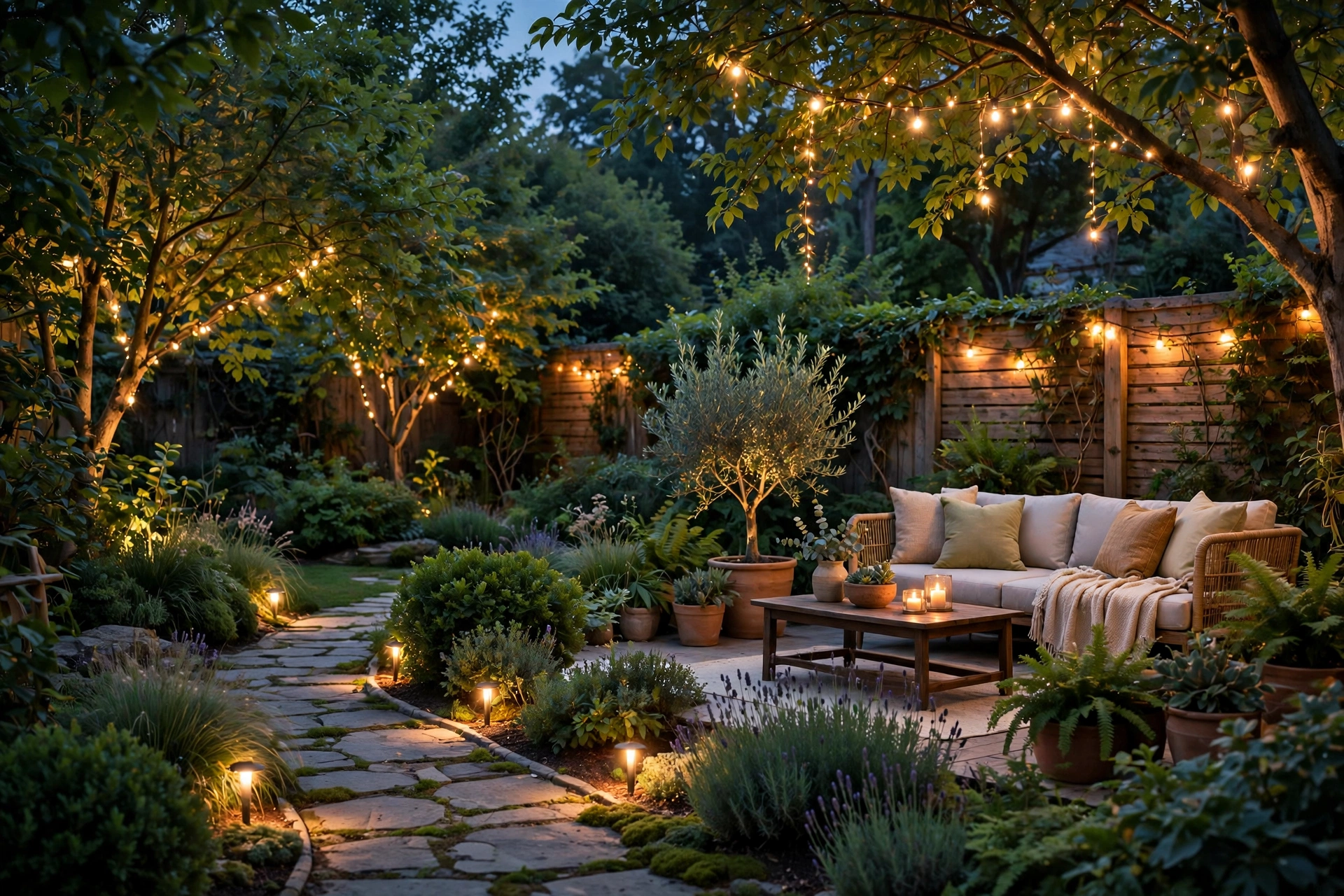
Most backyards look finished in daylight and forgotten after dark. The lawn goes black, the planting disappears, and a single bright porch bulb turns the whole garden into a flat backdrop. Evenings move indoors, and a space that could carry the best hours of the day sits unused.
The short answer: a backyard becomes an evening retreat when three or four layers of warm, shielded, low-level light work together — safe paths, one or two lit focal points, and a soft glow where people sit. Keep the colour warm, around 2700K to 3000K, hide the fixtures so you see the effect rather than the hardware, and give each zone its own control. That layering, not brightness, is what separates a lit garden from a retreat.
Why an Ordinary Backyard Feels Different Once the Light Is Layered
Step into a garden lit by a single floodlight and the problem is obvious. Everything is visible and nothing is inviting. Harsh light flattens texture, kills shadow, and makes people feel watched rather than welcomed. Designers describe the goal the other way round: illuminate the landscape, not the fixtures. You should notice the tree, the wall, the water, and the path — never the bulb. Layering achieves this, as in a living room: path lights for safety, uplights for drama, wash lights for softness, and a gentle glow around seating for atmosphere.
Reading Your Garden After Dark: The Walk That Decides the Whole Design
Before buying a single fixture, take one walk through your garden at dusk with a notebook. Stand at the back door, walk the main path, sit in the usual seating spot, and look back toward the house. This dusk walk reveals what the garden offers after dark and what it hides.
- Dark zones: stretches of path or steps where you hesitate or cannot see your footing. These are safety priorities, not decoration.
- Natural focal points: a mature tree, a handsome wall, a water feature, or a sculptural shrub. One or two, lit well, carry the whole design.
- Sightlines from inside: views from the kitchen and living room matter, because you will enjoy the lighting from indoors on cold evenings too.
Sketch the garden, marking the path, focal points, and seating area. Almost every successful retreat design grows from that sketch; it also prevents marching identical stake lights around the lawn like runway markers.
Four Layers of Evening Light That Make a Backyard Feel Like a Retreat
Path and step lighting comes first, because safety is non-negotiable. Low, shielded fixtures throw light downward onto the walking surface. A single small LED path light typically covers a pool of light roughly six feet across, so a forty-foot walkway needs around five or six fixtures spaced for overlap, staggered slightly rather than lined up in a rigid row. Steps deserve their own recessed lights, because a missed step in the dark ruins an evening fast.
Uplighting creates the vertical drama: a small adjustable spotlight placed eight to twelve inches from a tree trunk, angled slightly off vertical, sends light up through bark and canopy. One well-aimed uplight can become the evening’s centrepiece while the lawn stays deep and dark. Wash lights then soften walls, hedges, and beds, downlighting high in a tree or under a pergola beam mimics moonlight over seating, and ambient glow around seating — lanterns, a low festoon run, or a strip under a bench edge — gives faces warm light and makes conversation comfortable.
Choosing Fixtures That Flatter Plants, Stone, and Water
Fixtures are tools, not ornaments. Look for outdoor-rated housings, warm-white LEDs, and finishes that disappear against soil or foliage by day — matte black, bronze, or copper age gracefully, while shiny chrome rarely does.
Water deserves a special note: a pond or fountain lit from a low angle becomes a second focal point, with reflections doubling the effect. Keep fixtures out of the water unless specifically rated for submersion.
The Warmth Rule: Why 2700K Light Turns a Garden Into a Retreat
Colour temperature is the most powerful mood control in garden lighting, measured in kelvins. Warm white between 2700K and 3000K renders foliage, timber, and masonry most naturally, and it is the range installers return to again and again. Cooler light at 4000K and above reads harsh against wood and greenery and attracts more insects on summer evenings. One exception: blue or silver foliage can look washed out under very warm light, so test a single portable fixture at dusk before ordering a full run. Consistency matters too — mixing warm path lights with cool-white string lights makes a garden look patched together.
A Weekend Plan for Lighting a Backyard Retreat, One Zone at a Time
A full scheme need not happen in one weekend. Start with the zone you use most, live with it for a week, and let the next zone learn from it. The sequence below assumes a low-voltage LED system, which most homeowners can install without an electrician, provided the transformer plugs into an existing outdoor socket protected by a residual-current device.
Map the zones: the path, one focal tree or feature, and the seating area. These three are the first weekend’s work.
Place the transformer near the house wall, tucked behind a shrub, plugged into a GFCI or RCD-protected socket. Total your fixtures’ wattage and multiply by 1.25 — that is the minimum transformer capacity, and the headroom prevents dimming at the far end of a run.
Lay out fixtures before burying anything. Set them in place, run cable loosely on the surface, and switch on at dusk. Adjust aim and spacing while changes are still free.
Bury cable shallowly under mulch or a shallow lawn slit, leaving slack at each fixture for re-aiming. Set a photocell for dusk switch-on and a timer to dim zones late at night.
On long runs, watch for voltage drop: a fixture eighty feet from the transformer on thin cable can dim and shift toward amber. Fix it with hub wiring — branching from mid-run junctions rather than daisy-chaining — or by splitting runs across transformer taps.
Solar, Low-Voltage, or Mains: Picking the Power Behind Your Retreat
Solar fixtures are the easiest start: no wiring, no transformer, and a fixture can move with the seasons. Their weakness is consistency — output drops after cloudy days and in winter, and most solar stakes cannot sustain path lighting through a long night. They shine as decorative accents in full sun, not as the backbone of a safety scheme. Low-voltage systems at twelve volts are the sweet spot for most retreat gardens: safer to bury, easy to dim and control, and installable without a permit in most jurisdictions when plugged into an existing socket. Mains-voltage lighting belongs to security floods and gate posts; it needs a licensed electrician, buried conduit, and often a permit.
What a Garden Retreat Glow Typically Costs, and Where the Money Goes
Treat every figure here as an estimate, not a quote. A simple do-it-yourself kit of six to eight solar or plug-in path lights can come in under a few hundred dollars or pounds. A solid do-it-yourself low-voltage system with ten to fifteen fixtures, transformer, and cable typically lands in the mid-hundreds to around a thousand. Professional installation is a different scale: published 2026 guides put a system for a typical suburban lot at roughly $2,500 to $6,500, with per-fixture installation around $100 to $150. In the UK, trade guides quote roughly £150 to £200 for a basic low-voltage install, and around £400 for ten LED garden lights with cabling from an existing socket.
Labour is the variable — trenching, aiming, and testing take time, and a mature garden takes longer than a new build. Running costs are almost negligible: a ten-fixture LED system typically costs only a few dollars or pounds a year. The smartest saving is phasing: buy quality fixtures for seating and the focal tree first, and use simpler fixtures for far paths and beds.
Retreat Lighting Habits That Keep the Magic Working Year After Year
Garden lighting fails quietly: a fixture tips in soft soil, a lens clouds with algae, a cable works loose after a freeze. A short seasonal routine prevents almost all of it. In spring, clean lenses and re-aim shifted fixtures. In summer, trim foliage growing into beams. In autumn, clear leaves and test timers as evenings draw in. In winter, check fixtures have not been buried by mulch or snow and confirm the transformer housing is dry. Choose fixtures with replaceable lamps rather than sealed units, and keep a spare fixture and connectors in the shed.
When a Backyard Lighting Dream Needs a Licensed Electrician, Not a Ladder
Most low-voltage garden lighting is genuinely do-it-yourself, but the line into professional territory is clear. Call a licensed electrician for any new mains circuit, new outdoor socket, buried mains-voltage cable, or connection inside the consumer unit or breaker panel. In the UK, new circuits and some outdoor electrical work may be notifiable under Part P building regulations, so check before work begins. Downlighting high in a mature tree is climbing work with electrical equipment and belongs to someone trained and insured, as does any scheme near a pool or pond. If a transformer keeps tripping or you smell burning near a socket, switch off and call someone qualified.
Garden Lighting Slip-Ups That Flatten an Evening Retreat
The most common mistake is over-lighting: too many fixtures at too high an intensity, creating glare instead of atmosphere. A retreat should feel dimmer than a kitchen and brighter than moonlight; if you can read a newspaper anywhere in the garden, something is too bright. The second slip-up is lighting the fixtures instead of the garden — bare bulbs visible from seating pull the eye to the hardware, so shield every fixture guests can see directly. Finally, stagger path lights rather than marching them in a perfect line, angle uplights slightly off vertical so they catch canopy as well as trunk, and never let light spill into a neighbour’s window.
Evening Retreat Lighting Questions Homeowners Ask Before Buying a Single Fixture
How many lights does a small backyard retreat actually need?
Fewer than most people buy: roughly five or six path lights, one or two uplights for a focal tree, and two or three ambient sources around seating — about ten fixtures. Start with that core, live with it for a week, and add only where a dark corner genuinely bothers you.
Can solar lights carry a whole evening retreat on their own?
For decoration, yes; for the whole scheme, usually not. Solar works well as accents in sunny beds, but output falls after cloudy days and in winter, so it struggles as path safety lighting. Use a low-voltage wired core for paths and focal points, with solar accents layered on top.
What colour temperature makes a garden feel sophisticated rather than stark?
Warm white, around 2700K to 3000K, flatters foliage, timber, stone, and skin tones, and reads as candlelight rather than office light. Keep one warm temperature across the whole scheme so the garden reads as a single designed space.
Is low-voltage garden lighting safe to install without an electrician?
In most cases, yes, provided the system plugs into an existing outdoor socket protected by a residual-current device, and you follow the manufacturer’s instructions. Anything involving a new circuit, new socket, buried mains cable, or work inside the consumer unit belongs to a licensed electrician.
What does a professionally designed garden lighting scheme cost?
As an estimate, published 2026 guides put a professionally installed system for a typical suburban lot at roughly $2,500 to $6,500, with larger schemes exceeding that. A do-it-yourself low-voltage system costs far less in materials, and LED running costs are minimal. Get two local quotes and check what each includes.
The Last Light to Switch On: Your Backyard, Ready for Slow Evenings
A sophisticated garden lighting design is not a display. It is a quiet invitation: a path you can trust in the dark, a tree more beautiful at nine in the evening than at noon, and a seat glowing just warmly enough to make staying outside the obvious choice. Build it in layers, keep the light warm and shielded, and start with the zones you actually use.
Tonight, take the dusk walk. Note the dark path, the tree worth showing off, and the chair where you would like to sit a little longer. Those three notes are the beginning of the retreat — everything else is just fixtures.