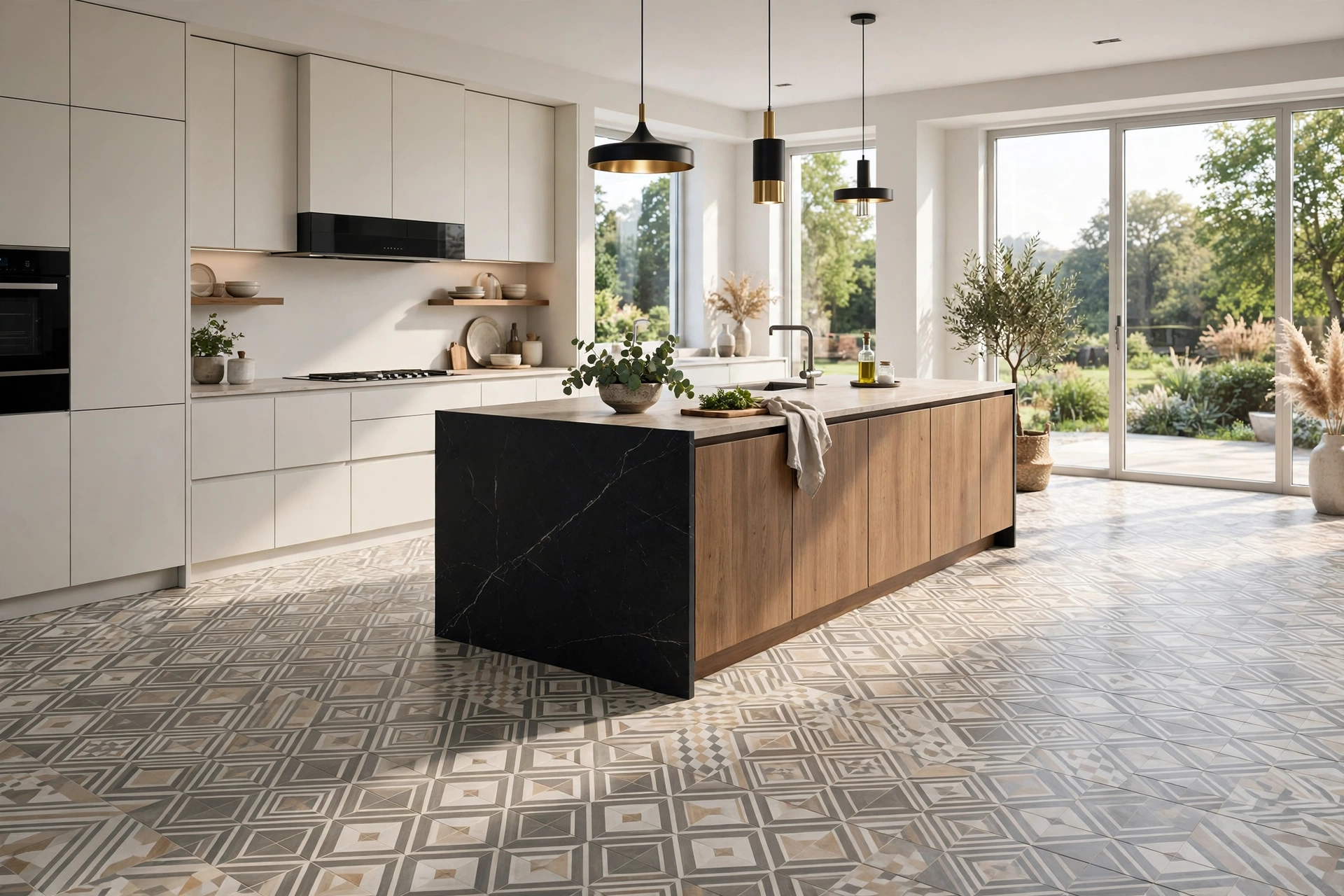
A kitchen floor works harder than any other surface in the house. It catches boiling pasta water, oil splashes, muddy shoes, and dropped pans, and in open-plan homes it is on full display from the living and dining areas. Modern kitchen flooring must therefore be both tough and beautiful.
The short answer: for most modern kitchens, large-format porcelain tile or a high-quality rigid-core luxury vinyl plank gives the best blend of durability, water resistance, and contemporary style. Porcelain wins on lifespan and scratch resistance, while luxury vinyl wins on comfort and gentler installed cost. Engineered hardwood suits kitchens where warmth matters most and spills are cleaned promptly, and patterned tile suits homeowners who want the floor itself to be a design feature.
Reading a Kitchen Floor the Way Cooks Actually Use It
The busiest strip in most kitchens runs between the sink, the cooker, and the refrigerator, and that triangle collects almost all spills and foot traffic. A second wear zone forms in front of the dishwasher and around an island, where stools scrape and feet shuffle, while pets add claw traffic and water-bowl splashes.
Moisture is the kitchen floor’s main enemy, and it rarely arrives as a flood. It arrives as a slow dishwasher drip, a puddle under a pet bowl, and mop water seeping into seams, so water resistance should be judged at seams and edges, not just on the face of a plank or tile.
Porcelain That Plays Marble Without the Upkeep
Large-format porcelain tile is the workhorse of the modern kitchen. Tiles of 24 by 48 inches or larger cover a floor with far fewer grout lines than standard tiles, giving a calm, almost seamless look that suits contemporary cabinetry. Stone-look porcelain now reproduces marble veining and limestone texture convincingly, while offering a dense, nearly impervious surface.
Porcelain resists scratches from dragged chairs, stains from tomato sauce and red wine, and heat from a dropped baking tray. When shopping, check the PEI hardness rating: tiles rated PEI 4 or 5 are made for heavy traffic and suit a busy kitchen. The trade-offs are honest: porcelain is hard and cool underfoot, although underfloor heating removes that objection, and it needs a flat, stable subfloor.
Wide-Plank Warmth That Survives a Working Kitchen
Nothing softens a contemporary kitchen quite like wood, and wide planks in warm white oak, pale ash, or muted greige tones are the current favourite for kitchens that flow into living spaces. In a kitchen, engineered hardwood is the safer wood choice: its layered construction resists the swelling and shrinking that humidity swings cause in solid boards, while its real wood surface can be refinished.
Luxury vinyl plank is the other route to the same warm look. Rigid-core planks print wood grain with embossed texture that fools most visitors, and they are waterproof at the surface, warmer and quieter than tile, and gentler on dropped dishes. Both options need honest expectations: engineered wood dislikes standing water, and vinyl cannot be refinished, so choose a wear layer of 20 mil or thicker for a kitchen.
Terrazzo, Checkerboard, and Patterned Tile That Earn Their Drama
For homeowners who want the floor to be the kitchen’s signature, patterned surfaces are back in a softer, more contemporary form. Micro-terrazzo, with fine stone chips scattered through a calm base, adds texture without shouting, and porcelain terrazzo-look tiles give that effect with far easier cleaning than traditional poured terrazzo.
Patterned tile works best when the rest of the kitchen stays quiet: pair a bold floor with plain cabinetry and a simple countertop, and the pattern reads as intentional rather than busy. A strong pattern also hides crumbs better than a plain pale floor, a genuine benefit in a family kitchen. Checkerboard in warm cream-and-taupe pairings keeps the look current. Plan a clear centre line and border, and order around ten percent extra so a cracked tile years later can be replaced from the same batch.
Concrete-Look Floors for a Calm, Seamless Modern Kitchen
Concrete-look surfaces suit kitchens that lean industrial or minimalist. Warm taupe, beige-grey, and sand tones give a quiet backdrop that lets timber or brass details stand out. Real polished concrete offers exceptional longevity and a genuinely seamless surface, but it needs a suitable slab, professional grinding and sealing, and it is unforgivingly hard underfoot.
For most remodels, concrete-look porcelain or luxury vinyl plank delivers the same visual calm with fewer complications. Porcelain gives durability and stain resistance with a matte finish that hides footprints far better than a glossy surface, while vinyl adds warmth and acoustic softness. One caution: a cool grey can make a north-facing kitchen feel cold, so balance it with warm timber or brass accents, and always check large samples in your own kitchen light.
A Side-by-Side Look at Six Kitchen Flooring Surfaces
The table below compares the surfaces most often specified for modern kitchens; installed costs are broad estimates per square foot including typical labour.
Read the table as a shortlist, not a verdict: a household with dogs will weight scratch resistance highest, while a household that cooks for hours may weight comfort above all else.
Measuring, Ordering, and Laying a Kitchen Floor Without Costly Rework
A smooth project starts before any material is ordered. Measure the room in sections, note the footprint of fixed cabinetry, islands, and appliances, and decide whether flooring runs beneath them or stops at their plinths. Check the subfloor for level, moisture, and movement: tile needs flatness, vinyl needs smoothness, and wood needs dryness.
Measure each wall run, sketch the layout, and run planks or tiles along the longest sightline.
Order the measured area plus ten percent for cuts and waste, fifteen percent for diagonal or patterned layouts.
- Acclimatise wood and vinyl in the kitchen for at least 48 hours before fixing.
- Prepare the subfloor: level dips, repair loose boards, test for moisture, and lay the specified underlayment.
- Dry-lay the first rows, check colour variation across boxes, and avoid narrow slivers at visible doorways.
- Protect the finished floor with breathable coverings until the rest of the remodel is complete.
Expansion gaps deserve attention in every material. Wood and vinyl move with temperature and humidity, so a perimeter gap hidden by skirting prevents buckling and gapping. Tile needs movement joints where it meets other materials, sealed with a flexible sealant rather than rigid grout.
The Grout, Seams, and Edges That Decide How a Kitchen Floor Ages
Most kitchen floors do not fail in the middle of a tile or plank; they fail at the joins. Grout absorbs grease, coffee, and mop water, and unsealed grout darkens over time. Sealing grout after installation and resealing it every year or two keeps it closer to its original colour, and epoxy grout resists staining far better than standard cement grout.
Vinyl and wood floors fail at seams when standing water sits on them, so wipe up spills, keep a tray under pet bowls, and check dishwasher and refrigerator water-line seals every few months. For daily care, sweep or vacuum with a hard-floor setting to remove grit, and damp-mop with a cleaner suited to the material.
Kitchen Flooring Slip-Ups That Show Up in the First Year
The most expensive kitchen flooring mistakes are rarely about choosing the wrong material; they are about rushing preparation. Laying tile over a bouncy or uneven subfloor, skipping moisture testing on a concrete slab, or installing wood over a damp floor all produce problems that appear months later, when the fix means lifting the finished floor.
Choosing by showroom sample alone is another frequent slip. Small samples hide colour variation between boxes, and a tile that looks warm in a store can read cold under your kitchen’s lighting. View full-size samples at home in daylight and in the evening, and mix planks from several boxes so variation spreads evenly.
What a Modern Kitchen Floor Runs, Line by Line
Budgeting means counting more than the material: subfloor levelling, underlayment, trims, and old-floor removal can add a meaningful share. The figures below are broad installed estimates for a typical 200-square-foot kitchen, to be confirmed with local quotes.
Get at least two itemised quotes that separate material, labour, preparation, and trims, and ask what is excluded. A quote that looks cheap because it omits levelling or old-floor removal is not cheaper; it is incomplete.
When a Kitchen Floor Job Belongs With a Flooring Contractor, Not a Weekend
Many homeowners can lay click-together vinyl planks themselves, and a careful DIYer with a flat subfloor can achieve a good result. Tile, natural stone, polished concrete, and any floor involving levelling compounds or underfloor heating reward professional installation, from a tiler’s eye for layout to a proper guarantee.
Call a professional without hesitation if the subfloor is uneven, springy, or damp, if the kitchen has a history of leaks, or if underfloor heating, asbestos-containing old flooring, or electrical work is involved. Asbestos in old vinyl tiles or adhesive must never be disturbed without specialist advice. When hiring, ask for recent kitchen projects, a written specification, and a clear statement of what the guarantee covers.
Modern Kitchen Flooring Questions Homeowners Ask Before Ordering Samples
Is porcelain tile or luxury vinyl plank better for a busy family kitchen?
Porcelain lasts longer and resists scratches better, which suits households with dogs and heavy cookware. Luxury vinyl is warmer, quieter, and more forgiving underfoot, and it costs less to install. If lifespan matters most, choose porcelain; if comfort and budget matter most, choose a thick-wear-layer vinyl.
Can I put underfloor heating under a modern kitchen floor?
Yes, and tile and stone are ideal partners because they conduct heat evenly and feel warm underfoot. Vinyl and engineered wood can also work, but only if the product is rated for underfloor heating and the system stays within the manufacturer’s temperature limits.
How do I keep grout lines looking clean in a kitchen?
Choose a grout colour close to the tile, seal the grout after installation, and reseal it every year or two. Epoxy grout resists staining far better than standard grout and is worth the extra cost in a hard-working kitchen.
Will pets scratch a modern kitchen floor?
Porcelain and stone resist claw scratches best, and a thick wear layer on vinyl handles most pet traffic well. Engineered wood will eventually show claw marks, although a matte finish and a harder species such as oak hide them better than a glossy finish. Keep claws trimmed and use mats under food bowls.
Should kitchen flooring run through into the living room?
Running the same floor through an open-plan kitchen and living area makes the space feel larger and calmer and removes awkward transition strips. It works best with vinyl, engineered wood, and large-format tile. Just confirm the material suits both rooms, since a living room adds furniture weight and a kitchen adds moisture.
Can a damaged kitchen floor be repaired without replacing everything?
Often, yes. Individual vinyl planks and tiles can usually be replaced if spare material from the same batch was kept, and engineered wood can be spot-repaired or refinished depending on the damage. That is why ordering ten percent extra matters: a repair with matching material is invisible, while a repair with a new batch often is not.
A Kitchen Floor That Still Looks New After a Thousand Dinners
The most successful modern kitchen floors share a quiet quality: they were chosen for the kitchen’s real life, not just for a photograph. A large-format porcelain floor that shrugs off spills, a warm wide-plank vinyl that is kind to feet, or a calm concrete-look surface will all serve well, provided the subfloor was prepared and the wet zones were respected. Start with samples in your own kitchen light.