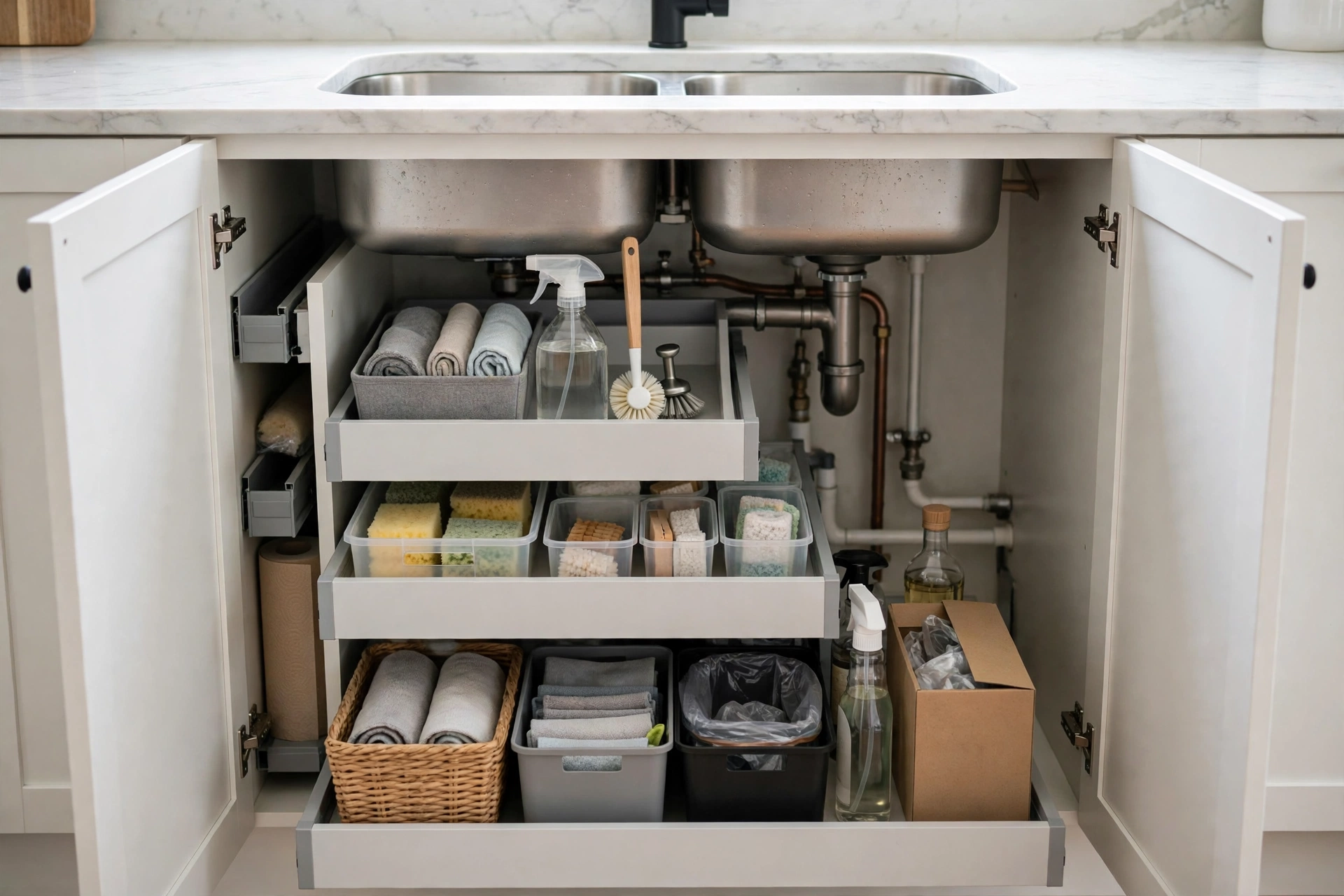
Open the cabinet beneath your kitchen or bathroom sink and you will usually find the same scene: bottles crowded at the front, a dark gap behind the pipes where things disappear, and a damp patch nobody wants to investigate. The space looks generous when empty, but the drain, the trap, the shutoff valves, and sometimes a disposal or water filter carve it into awkward pockets that ordinary shelves cannot use.
The short answer: the best under-sink organization starts with a pullout drawer or tray that slides the back of the cabinet to the front, shaped to clear your pipes — a U-shaped pullout wrapping around the trap, split drawers flanking the drain, or a shallow inner drawer tucked behind the cabinet front. Add a waterproof liner, one home for every category of item, and breathing room around the valves, and the cabinet stops being a dumping ground.
Why the Cabinet Beneath Your Sink Defeats Ordinary Shelving
A normal cabinet is a simple box. An under-sink cabinet is a box with a drainpipe running through the middle, a trap hanging below the bowl, supply lines along the sides, and often a disposal unit or filter housing taking up the lower half. A fixed shelf laid across that space either blocks the pipes or leaves the deepest part unreachable, and bottles stacked on the floor have the same flaw: anything at the back can only be reached by kneeling and reaching past everything at the front. Pullout storage reverses the work — instead of you reaching into the cabinet, the contents come out to you.
Mapping the Pipes Before You Buy a Single Drawer
Every successful under-sink project starts with a tape measure and an empty cabinet. Take everything out, wipe the floor, and note the drain and trap position, whether the trap sits centrally or off to one side, how far the bowl hangs down, where the shutoff valves sit, and whether a disposal, dishwasher hose, or filter housing intrudes.
- Interior width at the front, middle, and back — the narrowest reading rules.
- Depth from the door frame to the back wall, which sets the maximum slide length.
- Height from the floor to the lowest point of the bowl, trap, or disposal.
- Clear space on each side of the drain, plus shutoff valve and hinge positions.
A cardboard mock-up is worth ten minutes of your time. Cut card to the size of the pullout you are considering, slide it in and out by hand, and check it clears the pipes, hinges, and door frame.
The U-Shaped Pullout That Wraps Around the Trap
The U-shaped pullout is the signature under-sink solution. Instead of fighting the drain, it wraps around it: two side compartments run down either side of the trap, joined at the front by a shallower section, so the whole drawer slides out as one unit while the plumbing passes through its open center. In a wide cabinet — typically 80 centimeters or more — this recovers space a straight tray would surrender. It works best when the trap sits roughly centrally; in a narrow cabinet the side sections become too thin for anything but the smallest bottles.
Split Drawers That Flank the Drain on Both Sides
When the drain sits off-center, or two people share one sink, split drawers are often the smarter answer. Two narrower pullouts, one on each side of the plumbing, slide independently, so you open just the side you need — one side for cleaning supplies, the other for bin liners, or one side per person in a bathroom. Split drawers also solve the low-trap problem: if the trap hangs low, a full-width tray may only fit below it, wasting the height above, while two independent drawers can be sized differently to use each side’s own clearance.
Shallow Top Trays and Hidden Inner Drawers Behind the Cabinet Front
Some of the cleverest under-sink storage is barely noticeable. A shallow top tray sliding just beneath the sink bowl uses the thin band of space above the trap — too low for tall bottles, perfect for bin liners, dishwasher tablets, sponges, and cloths. In many manufactured sink cabinets this is an inner drawer: it sits behind the main cabinet front, invisible when the doors are closed, and opens only when pulled. Inner drawers are especially valuable in narrow cabinets where a U-shaped pullout will not fit, holding the small, frequently used items that otherwise clutter the worktop.
Concealed Bins, Caddies, and False Fronts That Keep Clutter Out of Sight
Not everything under a sink belongs in a drawer. A pullout bin system — one or two bins on runners behind the cabinet front — makes the sink cabinet the natural home for rubbish and recycling, right where scraps and packaging are produced, and pairing it with a cleaning-supply pullout puts the whole cleanup zone in one place. Look for bins with lids, which keep odors in and stop items falling behind the bin. False fronts add another layer: the decorative panel in front of many kitchen sinks, which traditionally looks like a drawer but is fixed, can be hinged to reveal a slim tilt-out tray for sponges and brushes. It needs a drip-proof base and a habit of emptying it.
Pullout Systems Compared: What Each Under-Sink Design Actually Holds
No single design wins everywhere. A wide kitchen cabinet with a central drain is a different problem from a narrow bathroom vanity with an off-center trap, and the right answer follows the plumbing, not the catalogue photograph.
A Weekend Fit: Installing a Pullout Drawer Around Existing Plumbing
Most retrofit pullouts are a weekend job, not a renovation — measuring, assembling, and screwing runners level, with no plumbing changes required, provided you do not move, loosen, or lean on any pipe. Choose a unit that fits the narrowest width and lowest clearance you recorded, assemble it outside the cabinet, and test its slide on a flat surface before it goes in.
- Empty the cabinet and lay a waterproof liner on the floor before anything goes back in.
- Mark runner positions on both sides with a level, keeping screws clear of hinges, valves, and supply lines.
- Fix support blocks first, checking they sit flat, then mount the runners and set the drawer in place.
Slide the drawer fully in and out several times before loading it, then load heavy bottles low and toward the back.
Two safety notes deserve emphasis. Never screw into a cabinet side without checking what is behind it — supply lines and electrical runs sometimes pass through cabinet walls, and a careless screw can turn an organizing project into a repair bill. And never use the plumbing itself as a support or anchor for a drawer; hanging weight on a trap or supply line risks a slow leak that will do far more damage than any clutter ever did.
Keeping the Cabinet Dry: Liners, Leak Checks, and Bottle Discipline
Under-sink cabinets sit where a small leak can go unnoticed for months, soaking the floor and everything on it. A waterproof liner is the cheapest insurance available: a tray or sheet under the pullout catches drips, contains a tipped bottle, and lifts out for cleaning. Check beneath the liner every few months, because a liner that hides a leak is worse than none — the point is to see water early, not conceal it. Store products upright with caps tight, never decant chemicals into unlabelled containers, and keep products that must not mix, such as bleach and ammonia-based cleaners, in separate compartments.
What a Customized Under-Sink Drawer Setup Tends to Cost
Costs vary widely with whether you buy ready-made, adapt a standard unit, or commission custom cabinetry, so treat every figure here as a broad estimate, not a quote.
Under-Sink Pullout Slip-Ups That Leave Drawers Jammed Against the Pipes
The most common failure is buying before measuring: a drawer a fraction too wide, a runner landing on a hinge, or a tray too tall for the trap will jam, scrape, or refuse to close — and a jammed drawer is worse than no drawer, because it blocks everything behind it. The second failure is overloading, filling a pullout until the runners sag and it drags. The third is filling every inch, leaving no room to reach a shutoff valve and no space for the odd-sized item. Leave one open zone for the item that belongs nowhere else, and never store food, medicines, or anything damaged by damp or heat beside hot water pipes and cleaning chemicals.
When an Under-Sink Storage Job Belongs With a Plumber or Cabinetmaker
Most pullout installations are straightforward DIY, but some situations call for a professional. If the plumbing needs moving — a trap that must be offset, a disposal repositioned, supply lines blocking every possible drawer — that is a plumber’s job; moving a trap without understanding venting and fall can cause slow drainage or sewer odors no organizer will fix. Any sign of an active leak, water damage to the cabinet base, mold growth, or a soft or swollen floor should be assessed before new storage goes in. A cabinetmaker earns their fee when the cabinet itself is the problem: a very narrow or unusually shaped vanity, damaged sides that will not hold runners, or a new kitchen built from scratch.
Under-Sink Pullout Drawer Questions Homeowners Ask Before Ordering
Can a pullout drawer fit around a garbage disposal?
Often, yes, but the disposal decides the layout. The disposal body usually occupies the lower half of the cabinet on one side, so a full-width deep drawer will not work. Split drawers on either side, a shallow drawer above it, or a narrow pullout on the free side are the usual answers — measured to leave breathing room around the housing.
How do I measure an under-sink cabinet for a pullout?
Measure the interior width at the front, middle, and back, the depth from the door frame to the back wall, and the height from the floor to the lowest point of the bowl or trap. Then measure the clear space on each side of the drain and the shutoff valve positions. Use the narrowest width and lowest clearance as your limits, and test the fit with a cardboard mock-up before ordering.
What should I store in an under-sink pullout drawer?
Sink-related supplies work best: cleaning sprays, washing-up liquid, dishwasher tablets, sponges, cloths, gloves, bin liners, and spare brushes, with one category per drawer so nothing drifts.
Are U-shaped pullouts worth it in a narrow cabinet?
Usually not. In a narrow cabinet the side compartments become too thin to hold useful items, and the mechanism costs more than the space it recovers. A single tray below the trap, split side drawers, or a shallow inner drawer for small items will serve a narrow cabinet better and cost less.
How do I stop bottles tipping over inside a sliding drawer?
Use dividers or small caddies to create compartments sized to your bottles, store tall bottles at the back or in the deepest section, and avoid overfilling any compartment. Removable trays with raised edges contain a tipped bottle before it spills, and a non-slip liner stops smaller items sliding when the drawer moves.
Can I install an under-sink pullout in a rented home?
Yes, with freestanding or no-drill options. Two-tier organizers that sit on the cabinet floor, suction-anchored units, and tension-mounted baskets need no screws and leave no holes. Check your tenancy terms before drilling, and keep the original cabinet fittings untouched so the space can be restored when you leave.
A Sink Cabinet That Finally Closes on a Tidy Secret
The best under-sink organization is the kind you stop noticing. The doors close on a drawer that slides smoothly, every bottle has a compartment, the valves are reachable, the floor is dry, and nothing you need is ever more than one pull away.