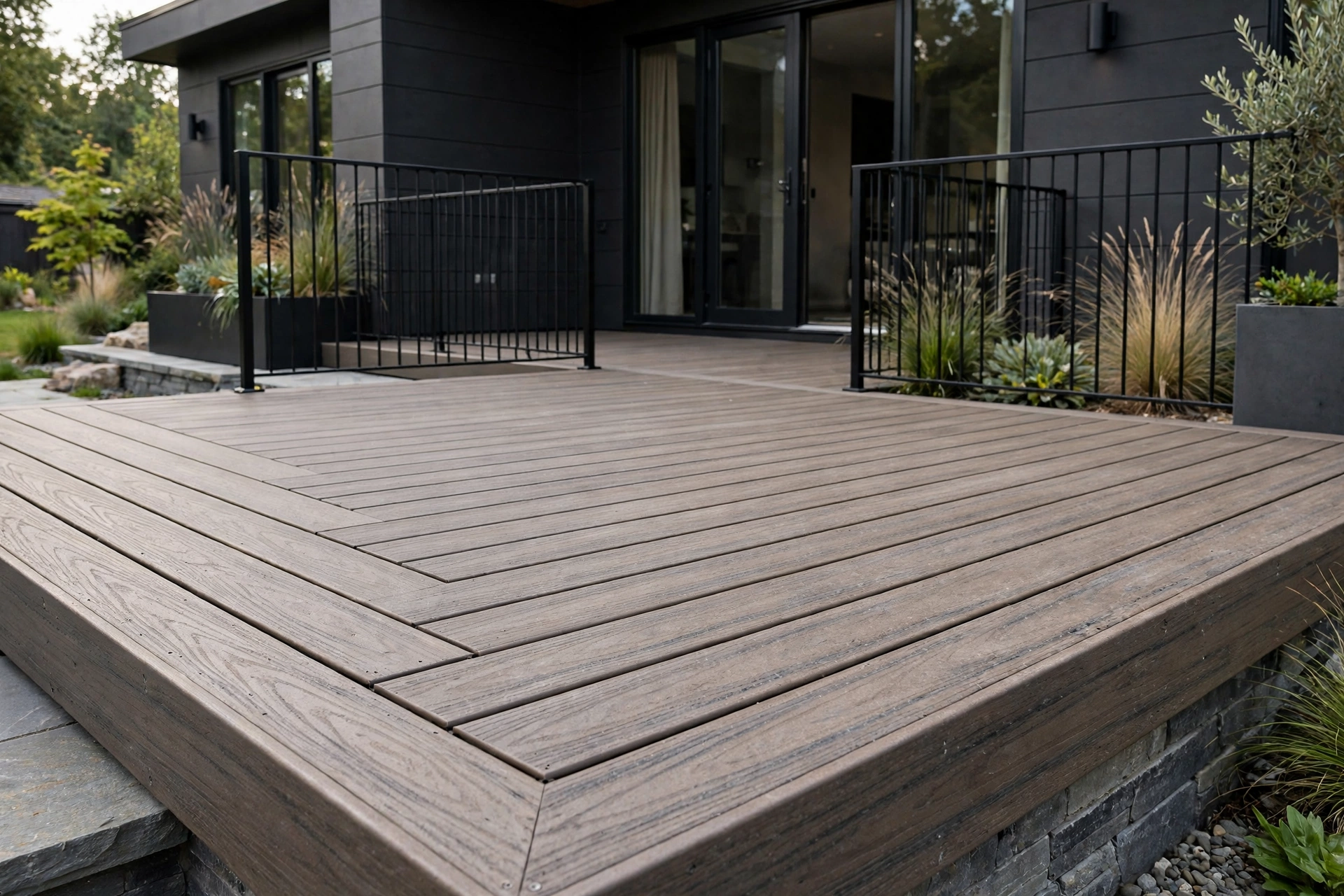
Composite materials promise the look of timber without the yearly sanding, staining and sealing — and for many outdoor projects that promise is real. A good composite deck, cladding or fence can last 25 years or more with little more than an occasional wash. But not all composites are equal: cheap uncapped boards can stain, swell and fade, while the wrong board in the wrong climate can warp within a few seasons. The direct answer is to choose by four things in this order: whether the board is capped, how it will handle your climate’s sun and moisture, whether its fire and slip ratings suit the project, and whether the warranty behind it is written down in plain terms. Get those right and the higher upfront cost pays for itself in maintenance you never have to do.
What Composite Materials Are — and What They Are Not
Most residential composites are wood-plastic composites, usually called WPC: recycled wood fibres blended with plastic polymers such as polyethylene or PVC, plus pigments and additives for colour, UV resistance and mould resistance. The result looks and feels more like timber than plastic does, but it does not behave like timber — it will not rot, splinter or need oiling, and it expands and contracts with temperature rather than swelling with rain. That distinction matters, because composites are often sold as maintenance-free. They are not. They are low-maintenance: they still need cleaning, they still fade a little in the first months before the colour stabilises, and they still depend on a proper subframe and fixings. Understanding that difference is what separates a 25-year installation from a disappointing one.
Which Composite Should You Buy: Capped, Uncapped or PVC?
The single most important choice is whether the board is capped. A capped, or co-extruded, board has a protective polymer shell bonded around the composite core, and that shell is what resists fading, staining and moisture. Uncapped boards cost less but absorb more water, stain more easily and weather faster, especially in wet climates — they are a false economy for most outdoor projects. PVC decking sits at the top of the range: it contains no wood fibre at all, so it absorbs almost no moisture and suits poolside areas, hot tubs and damp, low-lying gardens better than any wood composite. Solid boards are heavier and more rigid than hollow ones, and grooved boards allow hidden fasteners while square-edged boards suit picture-framed borders and steps. Ask every supplier for the same four facts — capped or uncapped, the wood-to-plastic ratio, the fire rating and the warranty — and compare products on those, not on the sample colour.
- Is this board capped, and what does the cap protect against?
- What is the wood-to-plastic ratio of the core?
- What fire rating does it carry, and under which test standard?
- What does the warranty cover — fading, staining and structure?
- How far apart must the joists be for this board?
Matching Composite Materials to Your Climate and Exposure
Climate decides which composite lasts and which one fails early, so start there rather than with colour. In hot, sunny regions, dark boards absorb more heat, expand more and fade faster, so lighter or mid-tone boards with a proven fade warranty are the safer choice, and expansion gaps must be generous. In wet, cold climates with frost and snow, low water absorption and a dense, well-capped board matter most, because a board that swells with moisture will move, cup and grow mould. Near the coast, salt air and wind-driven rain punish fixings as much as boards, so stainless or coated fasteners are worth the extra cost. Ask suppliers for accelerated weathering test results and a written fade warranty measured in years, not vague promises, and be cautious of very cheap boards with high wood content and no protective cap — they are the ones that stain and warp first.
The most reliable test costs nothing: take a full-length sample board home and leave it where the project will go. Leave it in full sun and in the rain for two or three weeks, spill coffee and barbecue grease on it, and try cleaning it with soap and water. A good capped board will wash clean and hold its colour; a poor board will show the stain and fade unevenly. Compare samples from different suppliers side by side in the same light rather than trusting brochure photographs, and check the board’s weight — very light boards often mean a hollow profile or a low-density core that will flex more underfoot.
Decking, Cladding, Fencing and Trim: Where Each Composite Works Best
Composites are not one product, and the best board for a deck is rarely the best board for a facade. For decking, slip resistance and strength underfoot matter most, along with a grooved profile for hidden fasteners and a solid board where furniture and planters will sit. For cladding, fire rating comes first — composite boards contain polymers, so check the test standard your region uses, such as ASTM E84 in North America or EN 13501-1 in Europe, and confirm any height or boundary restrictions with the local authority before ordering. For fencing and screening, wind loading and post spacing matter more than the board itself, and for trim and fascia the priority is a board that holds its colour and does not need painting. Match the product to the job, and never assume a decking board is suitable as cladding without checking its fire and fixing requirements.
The Subframe and Fixings That Decide How Long Composites Last
How to Work Through the Composite Choice in Five Steps
- Measure the area and note sun exposure, shade and drainage.
- Shortlist two or three capped products that suit your climate.
- Test full-length samples outdoors for two or three weeks.
- Price the whole system — boards, subframe, fixings and trims.
- Check the fire rating and warranty in writing before ordering.
A composite deck is only as good as what it sits on, and subframe failures are the most common reason good boards perform badly. Joists must be spaced to the manufacturer’s specification — usually closer together than for timber, because composite boards flex more — and the frame must be level, well-drained and ventilated underneath so water cannot pool. Aluminium battens last longest for cladding, while treated timber joists are acceptable for decking if they are kept dry and clear of the ground. Use the fixing system the manufacturer specifies, usually concealed clips that let boards expand and contract with temperature, and leave the recommended expansion gaps at ends and against walls. Boards fixed too tightly will buckle in summer heat; boards fixed to a rotting or undersized frame will feel bouncy within a year no matter how good the boards are.
Composite Costs Over Twenty Years, Not Just at the Till
Composites cost more than basic timber on day one, and that is the number most buyers fixate on — but it is the wrong number to compare. Over twenty years, a timber deck needs regular staining, sealing, replacement boards and labour, while a capped composite deck needs little more than soap and water. As a broad guide, a quality capped composite system can work out cheaper over its life than a mid-range timber deck once maintenance is counted, while the cheapest uncapped boards often cost more in the end because they need replacing sooner. Get quotes that include the subframe, fixings and trims, not just the boards, and ask what the warranty actually covers: a good warranty runs 10 to 25 years and states its terms on fading, staining and structural defects in writing. A warranty that only covers manufacturing defects is not the same as one that covers fading and staining.
When comparing quotes, insist that every supplier prices the same scope so the numbers mean something. A quote that lists boards only will always look cheaper than one that includes joists, clips, trims and delivery, yet the finished cost is what matters. Ask whether the price includes a spare pack of boards for future repairs — colour batches change over the years, and a matching spare board is worth far more than the small saving from ordering exactly to measure.
Composite Buying Mistakes That Shorten a Twenty-Five-Year Board
Most composite disappointments trace back to a buying mistake rather than a bad product. The classic errors are choosing uncapped boards to save money in a wet climate, picking a dark colour for a sun-baked south-facing deck, ignoring the fire rating on a tall facade, and spacing joists as if the boards were timber. Others are subtler: ordering without seeing a full-length sample outdoors, mixing batches with slightly different colours, and assuming the cheapest clip system will do. Take a sample board home, leave it in the sun and rain for a few weeks, and compare it with the brochure colour — composites fade slightly in the first months before stabilising, and that early change surprises buyers who expected the sample colour to last forever.
- Buying uncapped boards for a wet or shaded garden to save money.
- Choosing dark colours for a hot, south-facing deck.
- Ignoring fire ratings on tall facades or near boundaries.
- Spacing joists for timber instead of following the composite specification.
- Fixing boards tight with no expansion gaps.
- Ordering without a written warranty covering fading and staining.
Final Thoughts: Buy the Composite Your Climate Demands, Not the Cheapest Board
Composite materials reward buyers who choose on evidence rather than on price or colour alone. A capped board, matched to your sun and rain, fixed to a proper subframe with room to move, and backed by a written warranty, will quietly outlast the timber it replaced — and it will do so without a single weekend spent sanding and staining. Buy that board, and the higher price on the invoice becomes the cheapest money you spend on the project.
Outdoor Composite Materials FAQs
How long does composite decking last?
A well-installed capped composite deck commonly lasts 25 years or more, and many manufacturers offer warranties of 20 to 25 years. Lifespan depends on the board quality, the subframe, correct spacing and regular cleaning.
Is composite decking completely maintenance-free?
No. It is low-maintenance rather than maintenance-free. It needs regular washing with mild soap and water, and it will fade slightly in the first months before the colour stabilises. It does not need staining, sealing or sanding like timber.
What is the difference between capped and uncapped composite?
A capped board has a protective polymer shell around the core that resists fading, staining and moisture. Uncapped boards cost less but absorb more water and weather faster, especially in wet climates.
Does composite decking get hot in the sun?
Yes, particularly dark colours, which absorb more heat. Lighter or mid-tone boards stay cooler, and all composite decks are hotter underfoot than shaded timber. Consider lighter colours for sunny, south-facing decks.
Can composite decking be used around a swimming pool?
Yes, and PVC decking is often the best choice there because it absorbs almost no moisture. Use boards with good slip resistance and fixings that resist salt and chlorinated water.
Is composite cladding fire safe?
It depends on the product and the building. Composite boards contain polymers, so always ask for fire test reports under your region’s standard and confirm any height or boundary restrictions with the local authority before ordering.