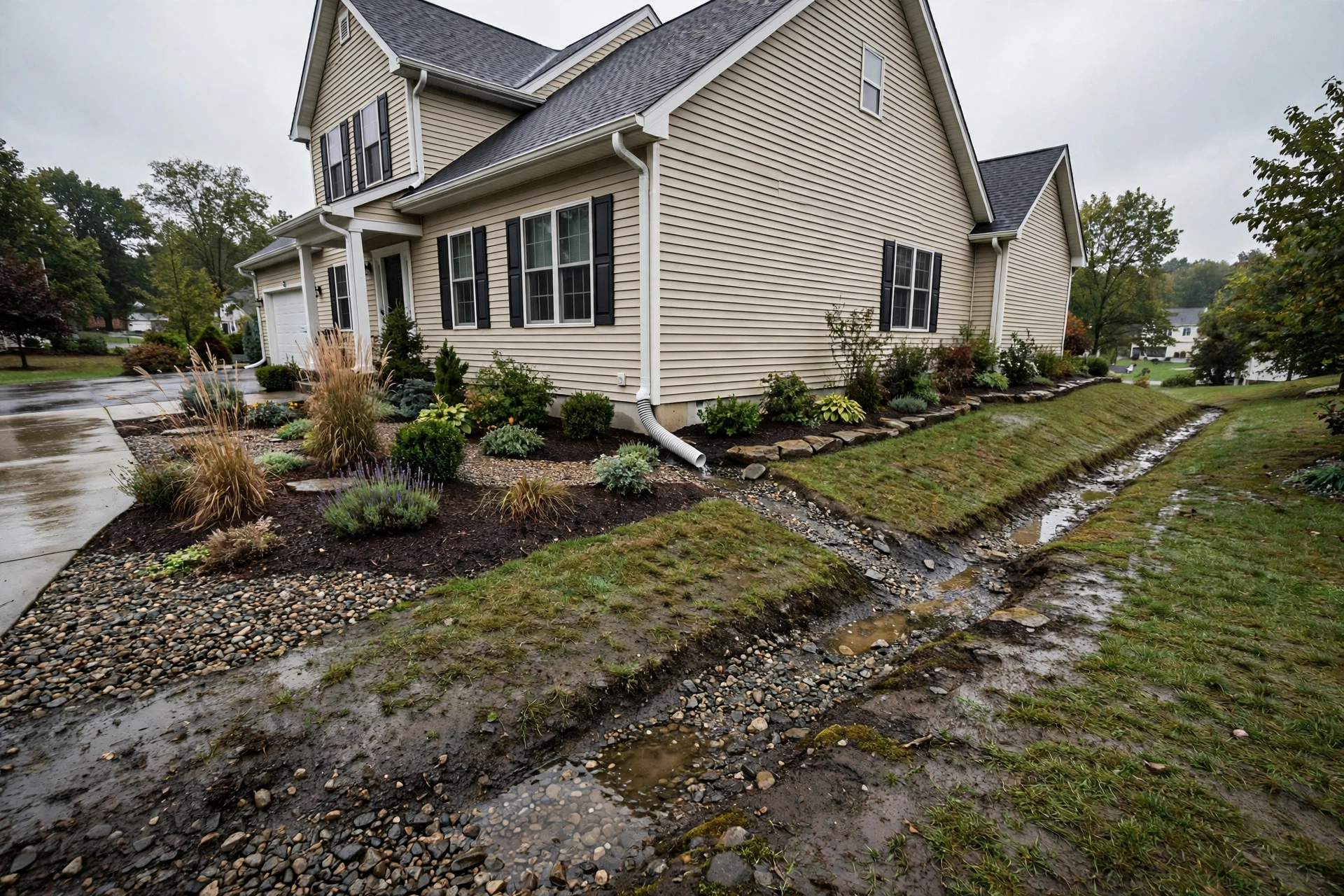
A home built on poorly drained ground faces a quiet, persistent problem: water that has nowhere to go will eventually find its way toward the house. It collects in low spots, saturates the soil against the foundation, seeps into basements and crawl spaces, and feeds mould, rot, and damp smells that never quite go away. The good news is that moisture on a poorly drained lot is manageable, and the most effective fixes are usually a combination of simple surface work and one or two well-chosen drainage systems rather than a single expensive project.
The best moisture management solution for a home on poorly drained land is to move water away from the house in layers: first regrade the soil so the ground slopes away from the foundation, then extend downspouts well clear of the walls, then add a French drain or curtain drain to intercept groundwater, and finally protect the interior with a sump pump and a sound vapour barrier. Each layer catches the water the previous one missed, so the house stays dry even during long wet spells.
Reading the Signs of Poor Drainage Before Choosing a Fix
Before spending money on any system, spend a rainy afternoon watching how water behaves on the lot. Note where puddles linger more than a day after rain, which side of the house stays soggy, whether water runs toward the foundation or away from it, and whether the basement floor or walls feel damp after storms. Photograph the worst spots, because the pattern tells you whether the problem is surface runoff, a high water table, or water trapped by compacted soil.
Inside the house, look for the quieter clues. Musty odours in the basement, white mineral deposits called efflorescence on foundation walls, peeling paint near the floor, swollen skirting boards, and condensation on windows all point to excess moisture. A moisture meter, borrowed or bought for a modest price, can confirm which walls are wet and how wet they are. This evidence matters because a home with surface pooling needs grading and gutters, while a home with groundwater pressure needs subsurface drains, and treating the wrong cause wastes money.
How Clay, Silt, and Compacted Soil Hold Water Against a House
Soil type decides how a lot drains. Sandy soil lets water pass quickly, while clay and silt hold it like a sponge, and compacted soil from construction machinery can seal the surface so rain cannot soak in at all. On many residential lots the worst ground is the backfill placed against the foundation when the house was built: loosely packed at first, it settles over time into a trench that channels water straight to the wall.
Grading the Ground So Rain Runs Away From the Foundation
Regrading is the single most effective moisture measure on most poorly drained lots, and it is also one of the cheapest. The ground should fall away from the house by roughly 15 centimetres over the first three metres, so rain runs outward instead of pooling against the wall. Low spots near the foundation should be filled with compacted topsoil, not loose mulch or gravel, which water passes through too easily.
Start by removing mulch, plants, and debris from the first metre beside the house, then add soil in thin layers, compacting each one, until the slope is right. Check the slope with a level and a straight board, and finish with a dense, low-permeability top layer that sheds water. Keep soil at least 15 centimetres below the damp-proof course or siding so it does not bridge the barrier. Where the lot itself slopes toward the house, grading alone may not be enough, and a swale or curtain drain further up the slope becomes the next step.
Gutters, Downspouts, and Splash Control on Slow-Draining Lots
Roof runoff is the largest single source of water near a foundation, and on a poorly drained lot a single downspout can dump hundreds of litres beside the wall in one storm. Clean gutters twice a year and after major storms, check that they slope gently toward the downspouts, and repair any sagging sections or leaking joints before the wet season.
Extend every downspout at least two to three metres from the house, and further on flat ground where water has nowhere to run. Rigid extensions, buried drain pipes, or splash blocks all work, but buried pipes should discharge to daylight or a dry well rather than into a soakaway beside the foundation. Where downspouts connect to an underground drain, make sure the outlet is clear and that the pipe is not crushed or blocked with silt, because a blocked underground drain quietly returns all that water to the base of the wall.
French Drains and Curtain Drains That Intercept Groundwater
When surface measures are not enough, a French drain is the workhorse solution. It is a gravel-filled trench holding a perforated pipe, wrapped in landscape fabric, that collects groundwater and carries it away by gravity. Installed around the foundation footing or across the yard, it lowers the water level near the house and relieves the pressure that pushes water through foundation cracks.
- French drain: deep, beside the footing, relieves water pressure on the foundation.
- Curtain drain: shallow, uphill of the house, intercepts water before it arrives.
- Both need a clear outlet and a steady fall, or they will not work at all.
Dry Wells, Rain Gardens, and Swales That Give Water Somewhere to Go
Every drain needs a destination, and on a poorly drained lot the destination is often the hardest part. A dry well is a buried chamber filled with gravel or a plastic crate that holds runoff and lets it soak slowly into the surrounding soil, away from the house. It works best where the deeper soil drains reasonably well even if the surface does not, and it should sit at least three metres from the foundation.
Interior Lines of Defence: Sump Pumps and Basement Drainage
Even good exterior drainage can be overwhelmed in a long storm, so a damp basement needs an interior backup. A sump pump sits in a pit at the lowest point of the basement floor, collects water that seeps in, and discharges it well away from the house. A battery backup or a water-powered backup pump matters, because the storms that flood basements are often the same storms that cut power.
Interior drain tile, a perforated pipe set in a channel around the inside of the footing, feeds the sump pit and catches water before it spreads across the floor. It is a bigger job than a pump alone, but it is often the right answer for a basement that floods repeatedly. Test the pump every few months by pouring water into the pit, clean the intake screen, and make sure the discharge pipe cannot freeze or clog. A pump that has not been tested is not a defence, it is a hope.
Moisture Barriers, Ventilation, and Crawl Space Protection
Moisture does not only enter as liquid water. Warm humid air condensing on cool foundation walls, and damp air rising from bare soil in a crawl space, can keep a house damp all year. A heavy polyethylene vapour barrier laid over the crawl space floor, sealed at the seams and run up the walls, cuts ground moisture dramatically, and it is one of the cheapest effective measures in the whole moisture toolkit.
Ventilation needs to be balanced rather than generous. In a humid climate, open crawl space vents can admit more damp air than they remove, so sealed crawl spaces with a small dehumidifier often perform better. Inside the house, run bathroom and kitchen extract fans, keep indoor humidity roughly between 30 and 50 percent, and use a dehumidifier in the basement during the damp months. Check the vapour barrier each year for tears and gaps, because a barrier that is torn at the seams is barely a barrier at all.
When Poor Drainage Means Calling a Drainage Contractor
Some moisture problems are beyond a weekend project. Call a drainage contractor or a structural engineer when the foundation has horizontal cracks, when the floor is heaving, when water appears after every rain despite new grading and gutters, or when the lot is so flat that no drain can fall to a legal outlet. A professional can survey levels, test the soil, and design a system that accounts for the water table, the neighbours’ runoff, and local rules about where water may be discharged.
Before hiring, ask for a written plan showing where water will go, get at least two quotes, and check that the contractor is licensed and insured for drainage work in your area. Be wary of anyone who promises a single product will fix everything, or who wants to install an interior system without first looking at the outside of the house. The right professional will start at the roof and the ground, because that is where most moisture problems begin.
Final Thoughts: A Dryer Lot Starts With the Water Outside
Managing moisture on a poorly drained property is less about one clever product and more about working in order: shape the ground, control the roof water, intercept what remains underground, and protect the interior as a last line of defence. Start with the cheap measures, watch the next few storms, and add the next layer only if the house still shows damp. A lot that once stayed soggy for days can become a dry, usable garden with steady, patient work, and the house will repay that work with drier air, sounder timber, and fewer repairs.
Poorly Drained Property Moisture FAQs
How can I tell if my lot has poor drainage?
Watch the yard after rain. Puddles that last more than a day, soil that stays soft and squelchy underfoot, water pooling against the foundation, and a damp or musty basement are the clearest signs. A simple test is to dig a small hole about 30 centimetres deep, fill it with water, and see how long it takes to drain; if it is still full after a day, the soil drains poorly.
Will regrading my yard really fix a damp basement?
Often, yes, at least partly. Much basement moisture comes from surface water running toward the wall, and correcting the slope removes that source. If the basement stays damp after regrading and extending the downspouts, the problem is likely groundwater, and a French drain or interior drainage will be needed as well.
How much does a French drain cost on a residential lot?
Costs vary widely with length, depth, soil, and access, so treat any single figure with caution. As a broad estimate, a straightforward French drain often costs a few thousand dollars for a typical residential run, while deep footing drains or systems that need a pump cost considerably more. Get local quotes before budgeting.
Can I install a French drain myself?
A shallow curtain drain in soft soil is a realistic DIY project for a fit homeowner with a weekend to spare. A deep footing drain beside a foundation is not, because it involves digging next to structural walls and working below ground level, and mistakes can damage the foundation or bury a drain that cannot be reached again.
Do rain gardens work on poorly drained soil?
They can, if they are sized and sited properly. A rain garden on heavy clay needs a deeper basin and a mix of soil and compost that drains better than the native ground, and it should sit away from the house. On very poorly drained lots it works best as a destination for roof and drain water rather than as the only drainage measure.
Why does my basement smell musty even when it looks dry?
Musty smells usually mean hidden moisture: damp air, condensation on cool walls, or water wicking through the slab. A dehumidifier helps the symptoms, but the lasting fix is to find the moisture source, improve ventilation, and check the vapour barrier and drainage outside the wall.