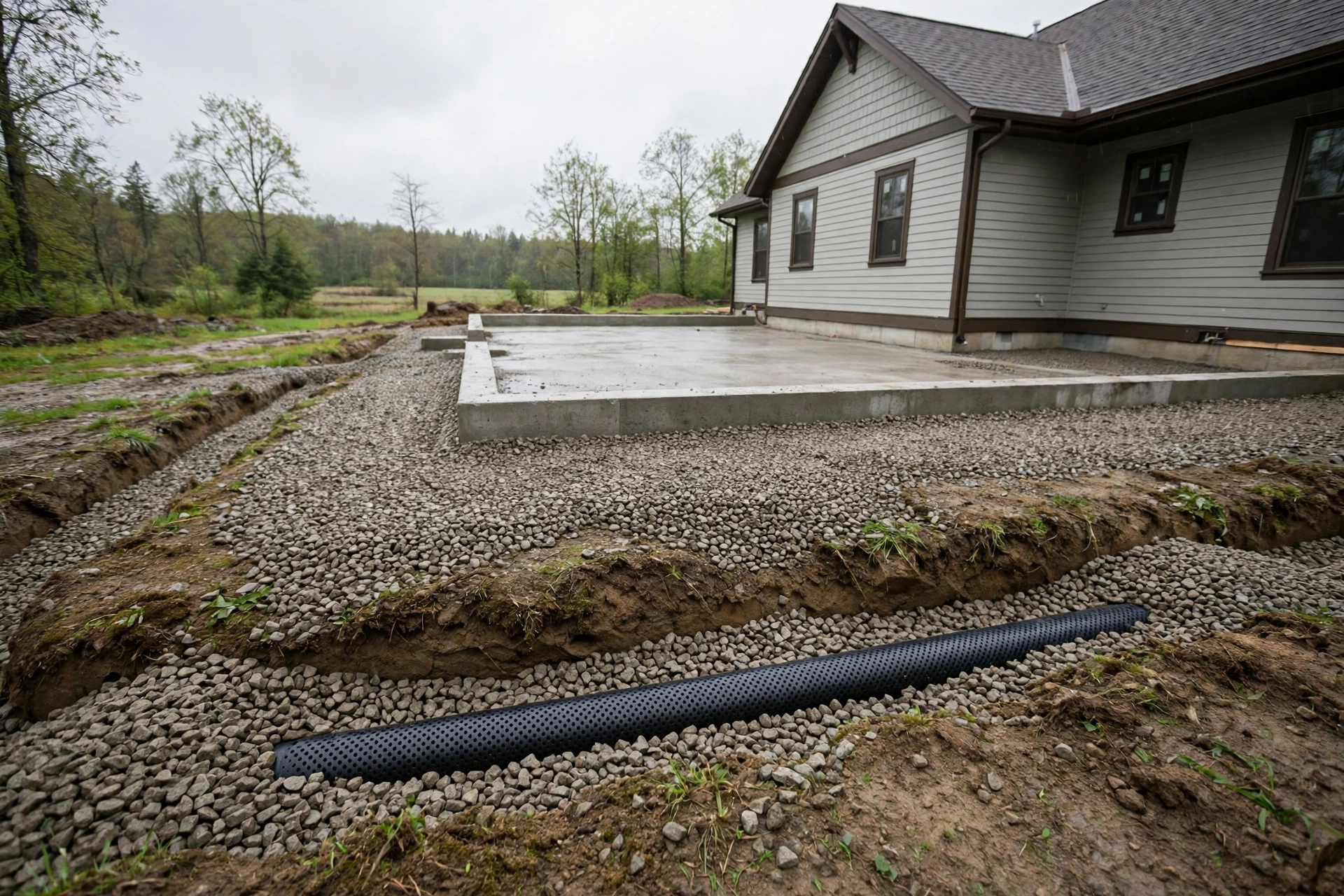
Most foundation drainage failures are not pipe failures. They are stone failures. The perforated pipe at the base of a foundation wall can only carry away the water that reaches it, and the water reaches it through the aggregate packed around it. Choose the wrong stone, or the right stone full of dust and fines, and the trench slowly clogs, the water table rises against the wall, and the damp patches, the musty basement, and the hydrostatic pressure all come back.
For most residential foundation protection projects, the right drainage aggregate is clean, washed, angular crushed stone in the 3/4 inch range, commonly sold as #57 stone. Its particles are large enough to leave generous voids for water to flow through, angular enough to lock together and resist shifting, and free of the fines that clog a drain over time. This guide explains how aggregate size, shape, and cleanliness affect drainage, how to match the stone to the job, and how to lay it so the system keeps working for decades.
Why the Stone Around a Foundation Matters More Than the Pipe
A foundation drainage trench works as a system, and the aggregate is the part of the system that does the most work. Water moving through soil arrives at the trench slowly, seeps through the voids between the stones, drops to the perforated pipe at the bottom, and is carried away. If the voids are filled with dust, sand, or silt, the water cannot move, and the trench becomes just another band of wet soil against the wall. If the stones are too small, they pack tightly and the voids shrink. If they are too large, the voids are generous but the stone no longer filters the soil, and fine particles wash straight through into the pipe.
Which Drainage Aggregate Size Keeps Foundation Water Moving?
For most residential foundation drainage, 3/4 inch to 1-1/4 inch washed stone is the sweet spot, and 3/4 inch #57 stone is the standard choice that contractors reach for first. Particles in this range leave about 40 percent void space between them, which is generous enough for water to flow freely to the pipe, while the stone is still small enough to filter out the fine soil particles that would otherwise wash into the drain. For heavy flow areas such as ditches and swales, larger stone in the 1-1/2 to 2 inch range is used, and for lighter decorative drainage, small pea gravel around 3/8 inch can work, though it is not the first choice for a foundation trench.
Washed #57 Stone, Pea Gravel, and Crushed Rock Compared
The aggregate yard offers a confusing range of names, and several of them sound like they would work for drainage even when they will not. The table below compares the materials homeowners most often encounter, so the choice can be made on performance rather than on price alone.
Two properties separate good drainage aggregate from poor material: shape and cleanliness. Angular crushed stone locks together, because the jagged faces of neighbouring particles grip each other and resist shifting when the trench is loaded or when water flows through it. Rounded river rock, by contrast, behaves like a pile of marbles: the particles roll, settle, and can migrate into the pipe perforations. Cleanliness is equally important. Stone that has been washed is free of the dust, sand, and clay that fill voids and form an impermeable layer over time. Unwashed stone may look acceptable on the truck, but its fines wash downward with the first heavy rain and begin clogging the system from the bottom up. If a sample leaves a dusty film on your hands, it is not clean enough for a foundation drain.
How to Lay Drainage Aggregate Around a Footing Drain
Even the best stone fails if it is laid badly. The trench has to be prepared, the pipe has to be bedded and pitched correctly, and the stone has to be placed in a way that protects the pipe and the filter fabric rather than damaging them. The sequence below is the standard approach for a residential footing drain.
Dig the trench to the footing. Excavate down to the base of the foundation wall, keeping the trench wide enough to work in and shoring it if it is deep.
Line the trench with filter fabric. Lay a non-woven geotextile along the bottom and sides, leaving enough fabric to wrap over the top of the stone once it is placed.
Bed the pipe in stone. Spread a 4 to 6 inch layer of washed #57 stone, set the perforated pipe on it with the holes facing down, and check the fall with a level so water runs to the outlet.
Cover the pipe. Add washed stone around and above the pipe to a depth of at least 12 inches over the crown, keeping the pipe centred in the stone envelope.
Wrap the fabric over the top. Fold the filter fabric over the stone to form a closed envelope that keeps soil fines out of the aggregate.
Backfill in layers. Place clean, free-draining backfill against the drainage board in shallow layers, compacting gently so the pipe and fabric are not crushed.
Filter Fabric, Soil Separation, and the Clogging Mistakes That Kill Drains
Filter fabric is the most misunderstood part of a foundation drainage system, and also one of the most important. Its job is to separate the soil from the aggregate, letting water through while holding back the fine particles that would otherwise migrate into the stone and the pipe. Without it, a drain in clay soil can lose much of its capacity within a few years as silt fills the voids from the outside in. With the wrong fabric, the drain can clog even faster, because a tightly woven fabric can itself blind over with silt.
Use a non-woven geotextile fabric, which passes water readily and resists clogging better than tightly woven slit-film fabrics.
Wrap the fabric fully around the stone envelope, overlapping the joints, so soil cannot find a gap into the aggregate.
- Never use sand or fine gravel as a base under drain rock; fines migrate downward and defeat the system.
- Do not lay the pipe directly on the trench bottom; bed it in stone so it stays supported and keeps its fall.
- Keep the trench dewatered during installation so silt-laden water is not washed into the fresh stone.
Protect the finished drain during backfilling; heavy clay dumped straight onto the fabric can puncture it and crush the pipe.
The most common clogging mistakes are all avoidable. Using unwashed stone full of fines, skipping the fabric, backfilling with heavy clay, and laying the pipe flat or with bellies account for most premature drain failures. A second, slower failure comes from the surface: gutters that discharge beside the foundation, ground that slopes toward the house, and window wells without drainage all pour far more water into the trench than it was designed for, and no aggregate can compensate for a system that is permanently overloaded. Fix the surface water first, and the trench will last far longer.
How Much Aggregate a Foundation Drainage Trench Really Needs
Ordering the right amount of stone is a simple calculation that is often guessed instead, and guessing usually means a second delivery at a premium or a trench finished short. Measure the trench length, width, and the depth of stone, multiply them together for cubic feet, and divide by 27 for cubic yards. Washed #57 stone weighs roughly 1.4 to 1.7 tons per cubic yard, so multiply the cubic yards by about 1.5 to get the tonnage to order. Always add ten percent for settlement and spillage, and order the whole load from one supplier so the grading is consistent.
Final Thoughts: Choosing Drainage Aggregate That Protects a Foundation for Decades
Foundation protection is mostly a matter of giving water an easier path away from the house than through the wall, and the aggregate in the drainage trench is what makes that path possible. Clean, washed, angular 3/4 inch stone, laid around a properly pitched pipe and wrapped in filter fabric, keeps the voids open, the pipe clear, and the water moving for decades. The mistakes that kill drains are all cheap to avoid: unwashed stone, no fabric, a flat pipe, and clay backfill. Spend the money on the right stone, check the fall before backfilling, and fix the gutters and grading at the surface, and the foundation will stay dry long after the trench is forgotten.
Foundation Drainage Aggregate Questions Homeowners Ask
What size gravel is best for foundation drainage?
For most residential foundations, 3/4 inch clean washed crushed stone, sold as #57 stone, is the best choice. It gives the ideal balance of void space for water flow and filtration of fine soil particles. For heavy flow areas such as ditches, larger stone in the 1-1/2 to 2 inch range is used, and for window wells, 1/2 to 3/4 inch washed stone works well.
Can I use pea gravel around a foundation drain?
Pea gravel drains well because its small, rounded particles leave voids, but it is not the best choice for a main foundation drain. The rounded stones shift and migrate more easily than angular crushed stone, and the small size packs more tightly over time. Pea gravel is fine for decorative drainage and for window wells, where a 6 to 12 inch layer at the base lets water percolate down quickly.
Why must drainage aggregate be washed?
Washing removes the dust, sand, and clay fines that would otherwise fill the voids between the stones and form an impermeable layer. Unwashed stone can look clean on delivery, but its fines migrate downward with the first heavy rain and begin clogging the system from the bottom up. Clean stone is the single most important quality to check before accepting a delivery.
Do I need filter fabric around the drainage stone?
Yes, in almost all soils. A non-woven geotextile wrapped around the stone envelope lets water through while holding back the fine soil particles that would otherwise wash into the aggregate and the pipe. Without it, a drain in clay soil can lose much of its capacity within a few years. Overlap the fabric joints and wrap it fully over the top of the stone.
How deep should the drainage stone go around a footing?
The stone envelope should surround the perforated pipe completely, with at least 4 to 6 inches of stone beneath the pipe and at least 12 inches above its crown, running down to the footing. In a window well, a 6 to 12 inch layer of gravel at the bottom is the usual minimum for effective drainage.
Can I reuse the soil I dug out as backfill over the drain?
Only if it is clean, free-draining material. Heavy clay excavated from beside the foundation is the worst backfill, because it holds water against the wall and can puncture the filter fabric. Use clean granular backfill against the drainage board, placed in shallow layers and compacted gently, and save the clay for areas well away from the house.