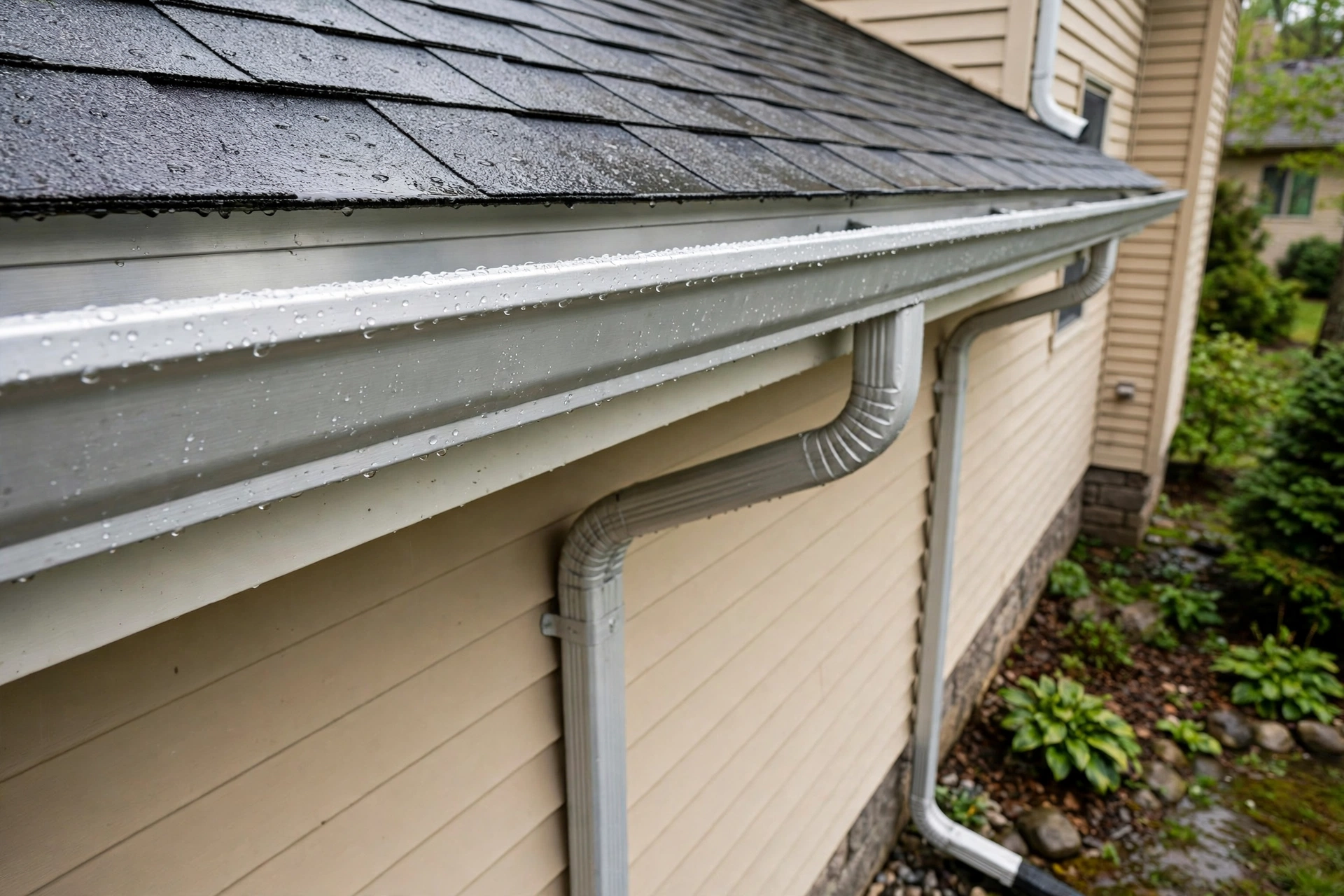
Seamless aluminum gutters are formed on site from a single continuous coil of metal, cut to the exact length of each roof section. Because a straight run has no joints along its length, the places where sectional gutters most often leak simply do not exist. The result is a cleaner roofline, fewer repairs, and rainwater that follows a controlled path from the eave to the ground instead of sheeting off the edge and pounding the soil below.
This guide explains how seamless gutters differ from sectional systems, which profile and size suit your roof, how a professional crew measures, forms, and hangs a run, and what upkeep keeps the system leak-free for decades. It also covers the sizing mistakes that cause overflow, the hardware details that decide whether a gutter drains or ponds, and how guards and rainwater collection fit into the same system.
Why Uncontrolled Roof Runoff Damages More Than the Landscaping
A roof collects an enormous amount of water in a single storm, and without gutters that water falls in a concentrated sheet right beside the foundation. Over time it erodes soil, washes out planting beds, splashes mud onto siding, and keeps the ground next to the house wet long after the rain stops. That persistent moisture is what feeds foundation staining, basement damp, and fascia rot, all of which cost far more to repair than the gutter system that would have prevented them.
What Makes a Seamless Aluminum Gutter Different From Sectional Gutters
A sectional gutter is assembled from ten-foot lengths joined with connectors, and every joint is a future leak. The sealant dries, the metal moves with temperature, and the joint opens just enough to drip. A seamless gutter removes that weakness entirely: a mobile roll-forming machine in the driveway extrudes one continuous piece for each straight run, so the only seams are at inside and outside corners and at end caps. Fewer seams mean fewer leaks, less debris catching in joints, and a longer service life.
Aluminum is the usual material because it is light, does not rust, and takes paint well in a wide range of colors. Residential coil is typically 0.027 to 0.032 inches thick, light enough to hang without stressing the fascia yet strong enough to hold a full load of water and debris. The metal also carries a sustainability advantage: aluminum gutter coil commonly contains 75 to 80 percent recycled content and is fully recyclable at the end of its life.
- One continuous run per roof section, with seams only at corners and end caps.
- No mid-run joints to reseal, so maintenance drops sharply after installation.
- Custom-formed on site, so the fit follows the actual fascia rather than a standard length.
- Cleaner appearance, since the gutter reads as a single line along the roof edge.
K-Style, Half-Round, and Box Profiles: Which Profile Carries Your Roof’s Water
Profile is the shape of the gutter’s cross-section, and it decides both capacity and appearance. K-style is the workhorse of residential work: its flat back sits flush against the fascia and its decorative front mimics crown molding, so it suits most modern homes. Half-round gutters are the traditional choice for historic and high-end homes, with a smooth semicircular trough that sheds debris well. Box gutters are deep, square channels built for large roofs and heavy rainfall.
| Profile | Typical Size | Roof Area Served (per 100 ft) | Best For |
|---|---|---|---|
| 5-inch K-style | 5 in | About 5,500 sq ft | Most standard homes |
| 6-inch K-style | 6 in | About 7,900 sq ft | Steep or large roofs, heavy rain |
| Half-round | 5-6 in | Moderate, varies by depth | Historic and traditional homes |
| Box gutter | 6-8 in | Large volumes without overflow | Long runs, commercial-style loads |
Size matters as much as shape. A five-inch K-style gutter handles the runoff of an average home, but a steep roof sheds water faster and a large roof collects more of it, and both cases call for the six-inch profile. The wider opening also catches fast-moving water that would otherwise shoot over the front edge during a downpour. Choosing the larger size costs little extra at installation and prevents the overflow that stains siding and erodes soil.
Sizing the Run: 5-Inch vs 6-Inch Gutters and Downspout Placement
Sizing starts with the roof, not the gutter catalog. Measure the roof area draining into each run, note the pitch, and check the local rainfall intensity. A shallow roof on a small house may be served well by five-inch gutters, while a steep, large roof in a storm-prone region needs six-inch runs and more downspouts. The rule is simple: the gutter must hold the peak flow of the heaviest storm the area sees, not the average shower.
Downspouts decide whether that capacity is usable. A long run with a single downspout at one end will pond at the far end no matter how wide the gutter is, so runs are usually limited to about 30 to 40 feet per downspout, with the spout placed where water can be carried well away from the house. Discharge should release roof runoff at least six to ten feet from the foundation wall, either through an extension, a splash block, or an underground drain. More downspouts cost little and prevent most overflow problems.
How a Crew Forms and Hangs Seamless Gutters on Site
Seamless gutter installation is professional work because the forming machine is the job. No home center sells a seamless run; the coil is extruded through a roll former parked in the driveway, cut to the measured length, and carried to the eave in one piece. A typical crew of two or three can measure, form, and hang a whole house in a day, but the sequence is precise and every step affects how the gutter drains.
Measure every fascia run and plan the drainage layout, marking where each downspout will sit.
Snap a chalk line along the fascia to set the pitch, usually about a quarter inch of fall for every ten feet of run toward the downspout.
Feed the aluminum coil through the on-site roll former and cut each run to its exact length.
Fit end caps and corner pieces, sealing the corner joints before the run goes up.
Hang the run with hidden hangers screwed into the rafter tails about every 24 inches, following the chalk line so the pitch stays true.
Attach downspouts with straps, add extensions that carry water well away from the foundation, and test the run with a hose.
Pitch, Hangers, and End Caps: The Details That Decide Whether Gutters Drain or Pond
A gutter that looks level is a gutter that ponds. Water needs a steady fall toward the downspout, and the chalk line set before hanging is what guarantees it. Too little pitch leaves standing water that breeds mosquitoes, adds weight, and corrodes the sealant at the corners. Too much pitch looks crooked from the ground and leaves the high end starved of depth during a storm. The standard fall of about a quarter inch per ten feet balances drainage against appearance.
- Hidden hangers screwed into rafter tails every 24 inches hold far better than spikes driven into fascia alone.
- End caps and corner miters are the only seams in the system, so they get sealed and checked first.
- Aluminum expands and contracts with temperature, and the hanger spacing lets the run move without popping joints.
- A level check after hanging, with a hose test, catches pitch errors before the first real storm does.
Gutter Guards and Rainwater Collection on a Seamless Run
A seamless gutter is a good base for guards because the run is straight and true, which is exactly what guard systems need to sit properly. Mesh screens keep leaves out while letting water through, and surface-tension guards use the way water clings to a curved edge to carry it into the trough while debris slides over the front. Either type reduces cleaning, but neither eliminates it: fine grit and shingle granules still settle, and a yearly flush remains good practice.
The same controlled collection makes rainwater harvesting practical. Because the water arrives at a known point, it can be routed into barrels, larger tanks, or a full cistern, with screened inlets to keep out debris and UV-protected storage to limit algae. Overflow control matters here too: the system needs a planned path for excess water during a big storm, or the first overflow will find its own path, usually against the foundation.
Seasonal Care That Keeps Seamless Aluminum Gutters Leak-Free for Decades
Properly installed aluminum seamless gutters generally last twenty years or more, and the difference between twenty years and thirty is mostly maintenance. Clean the runs at least twice a year, in late spring and after the leaves fall, and check the downspouts by running a hose through them. Look along the fascia for staining that signals a slow leak at a corner, and check that hangers are still tight after a winter of snow and ice loading.
- Clear leaves and grit before they compact into a dam that forces water backward under the shingles.
- Reseal corner joints when the sealant shows cracks, rather than waiting for a drip.
- Confirm downspout extensions are still in place after mowing, landscaping, or snow removal.
- Watch for sagging between hangers, which signals a loose fastener or a run carrying too much standing water.
Seamless Gutter Installation Errors That Show Up as Fascia Rot and Foundation Stains
Most gutter failures trace back to installation shortcuts rather than the material. The pattern is consistent: the gutter was hung, it looked fine from the ground, and the problems appeared a season or two later as rot, stains, or overflow. Knowing the common errors helps a homeowner judge a crew’s work while it is still easy to correct.
- Hanging the run level instead of pitched, so water ponds and mosquitoes breed in the standing water.
- Fastening hangers into fascia board alone instead of into rafter tails, so the run sags under a full load.
- Spacing downspouts too far apart, so a long run overflows at the far end in every heavy storm.
- Discharging downspouts at the foundation wall, which defeats the entire purpose of the system.
- Leaving corner miters unsealed or poorly sealed, creating the one leak a seamless system was meant to avoid.
Final Thoughts: One Continuous Run From Eave to Downspout
A seamless aluminum gutter system is a quiet upgrade: it does not change how the house looks from the street so much as it changes where the water goes when it rains. Choose the profile and size for the roof you have, insist on hangers into rafter tails and a true pitch, and place downspouts where they can carry water well clear of the foundation.
Seamless Aluminum Gutter Questions Answered Before You Book the Crew
How long do seamless aluminum gutters last?
Properly installed aluminum seamless gutters generally last twenty years or more, with many systems reaching thirty years when cleaned regularly and kept free of standing water. Sun exposure is usually the bigger aging factor than rust, since aluminum does not rust. The corner seals and hangers are the parts most likely to need attention first.
Can I install seamless gutters myself?
No, not in the true sense. Seamless gutters are custom-formed on site with a specialized roll-forming machine, and that equipment is not sold at home centers. A homeowner can install sectional gutters as a DIY project, but a seamless system requires a professional crew with the forming machine, which is also why the fit is exact.
Are seamless gutters worth the extra cost over sectional gutters?
For most homeowners who plan to stay in the house, yes. The price difference is modest against the cost of the system as a whole, and the payoff is fewer leaks, fewer repairs, and a cleaner roofline. Sectional gutters make sense mainly for short runs, tight budgets, or temporary fixes where a crew cannot bring the forming machine.
What size gutter do I need, 5-inch or 6-inch?
Five-inch K-style gutters suit most standard homes. Choose six-inch when the roof is large or steep, when local rainfall is heavy, or when a run serves a big roof area. The six-inch profile holds substantially more water and its wider opening catches fast-moving runoff that would overshoot a narrower trough.
Do seamless gutters still need cleaning?
Yes. Seamless refers to the absence of mid-run joints, not to freedom from debris. Leaves, grit, and shingle granules still collect, and a clogged seamless gutter overflows just like any other. Guards reduce the frequency, but a yearly inspection and flush remain part of ownership.
Where should downspouts discharge?
Downspouts should release roof runoff at least six to ten feet away from the foundation wall, using extensions, splash blocks, or underground drains. Discharging at the wall keeps the soil wet beside the foundation, which is exactly the problem the gutter system exists to prevent.