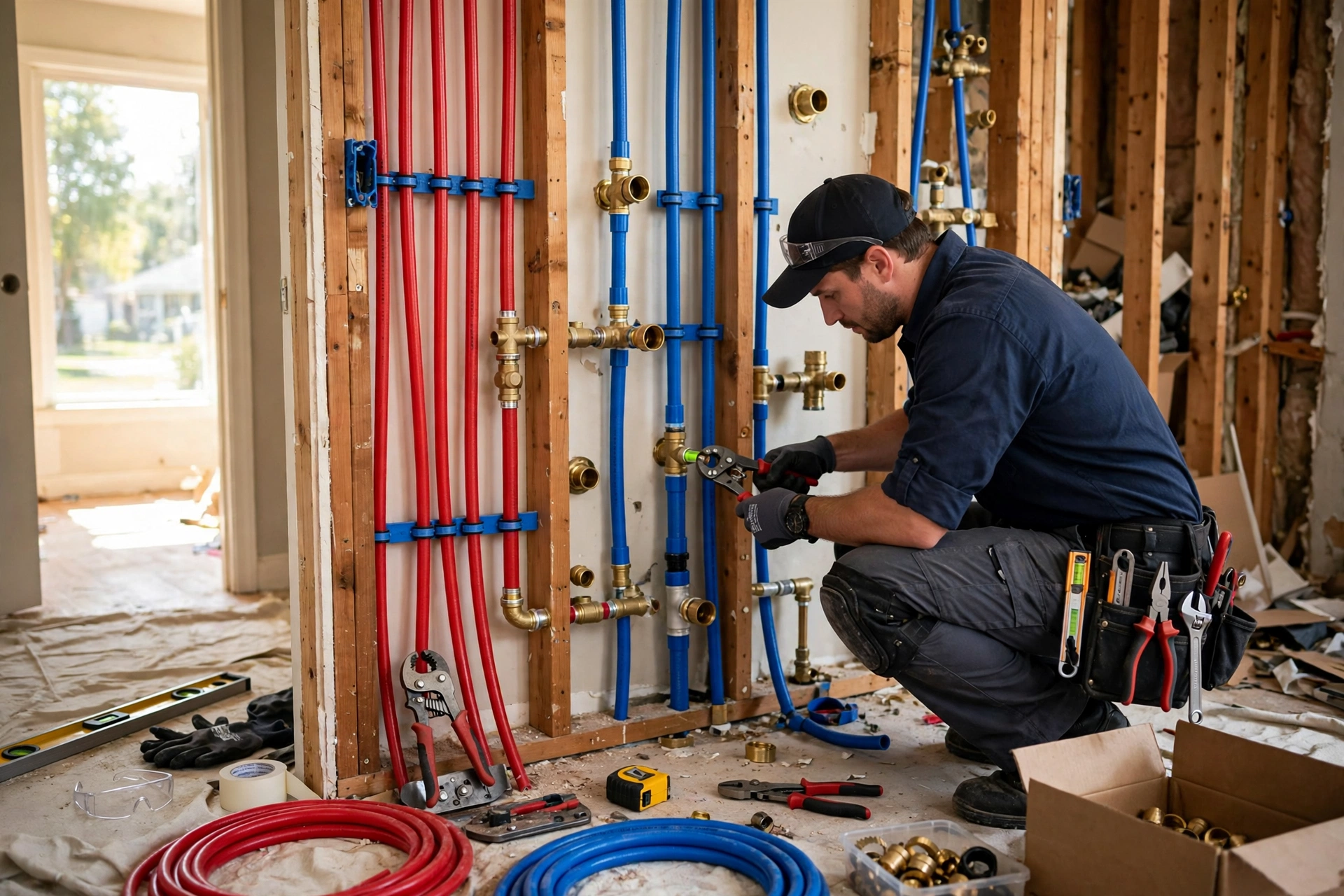
When the shower goes cold every time someone flushes, the tap water runs brown in the morning, or a pinhole leak appears in a copper line for the second time in a year, the problem is rarely one bad pipe. It is the whole system reaching the end of its life. Whole-house repiping replaces every water supply line in the home with new piping, and for most older homes that new piping is PEX, cross-linked polyethylene tubing that is flexible, freeze-resistant, and far cheaper to install than copper. A well-planned PEX repipe takes one to three days for most homes, restores full water pressure, and gives the plumbing another 40 to 50 years of service.
Planning matters more than the pipe itself. A repipe touches walls, ceilings, fixtures, and the water main, and the difference between a smooth project and a miserable one is decided before the first wall is opened: the scope, the material choice, the route the new lines will take, and the plan for putting the house back together. This guide walks through each decision in order, with realistic cost ranges and the warning signs that mean your old pipes should not wait another year.
Signs Your Aging Copper or Galvanized Pipes Are Ready for Replacement
- Water pressure that has faded gradually over the years, especially at fixtures far from the main.
- Brown, yellow, or rusty water when a tap is first opened after sitting overnight.
- Recurring pinhole leaks in copper lines, or damp spots and stains on ceilings and walls.
- Metallic taste, visible rust flakes, or sediment in tap water and aerator screens.
- Galvanized or polybutylene pipe anywhere in the house, regardless of how it looks from outside.
- An insurer that will not renew coverage, or a home inspection that flags the piping as end-of-life.
One leak is a repair. Two leaks in different rooms, or a pattern of falling pressure plus discolored water, is a system telling you it is done. Homeowners who wait for a third or fourth leak usually end up repiping anyway, after paying for water damage repairs in between. If your home still has galvanized supply lines, plan the repipe now, because the corrosion only moves in one direction, and most plumbing inspectors will not approve a partial repipe that leaves galvanized pipe in the remaining branches.
What a Whole-House PEX Repipe Actually Replaces
A whole-house repipe replaces all of the water supply piping, the pressurized lines that carry hot and cold water to every fixture. That means new lines from the main shutoff or the water meter to the water heater, to every sink, toilet, shower, tub, washing machine, dishwasher, and outdoor hose bib, plus new shutoff valves at each fixture. The drain and sewer lines are a separate system and are not part of a repipe, which surprises some homeowners, so confirm the scope in writing before the work starts.
PEX-A, PEX-B, and Copper: Choosing Your Repipe Material
PEX dominates residential repiping because it is flexible enough to snake through walls with far fewer cuts and fittings than rigid pipe, and because it costs 40 to 60 percent less than copper installed. There are two main types. PEX-A, made by brands such as Uponor, uses expansion fittings and has the lowest joint-failure rate of any PEX system. PEX-B, from brands such as SharkBite and Apollo, uses crimp or push-fit connections, costs a little less, and is perfectly sound for an owner-occupant who plans to stay. For a home being sold soon, PEX-A is worth the small premium, since buyers and inspectors recognize it.
| Material | Installed cost | Typical lifespan | Best for |
|---|---|---|---|
| PEX-A | Lowest of the three | 40-50 years | Most single-family homes, freeze-prone climates |
| PEX-B | Lowest of the three | 40-50 years | Budget-conscious repipes, owner-occupants |
| Copper Type L | 40-60% more than PEX | 50-70+ years | Long-term durability, resale value, UV exposure |
| CPVC | Between PEX and copper | 50-70 years | Homes where local code or preference favors rigid pipe |
How Plumbers Plan a PEX Repipe Route Through Your Home
The routing plan is the heart of the project, and a good plumber will walk the house with you before quoting. The new lines usually travel through the attic, basement, or crawlspace, because those spaces give access without opening finished walls, and then drop down inside wall cavities to each fixture. PEX's flexibility is the reason this works: a single length can bend around joists and ductwork without an elbow fitting at every turn, which means fewer joints, fewer potential leak points, and far fewer holes in the drywall.
The PEX Repipe Timeline: What Happens Day by Day
Most single-family homes are fully repiped in one to three days, and the crew works to keep your water off only during working hours. Understanding the sequence helps you plan around it, especially if you have children, pets, or a home office that cannot lose water for a day.
Inspection and quote: the plumber confirms the pipe material, the routing, and the access points, then gives a written estimate with the scope and the patching plan.
Permit filing: the contractor pulls the required municipal plumbing permit before work begins, since most jurisdictions require one for a full repipe.
Water shutoff and access cuts: the main water supply is shut off and small, targeted openings are made in drywall or ceilings where the new lines must pass.
Old pipe removal or capping: failing galvanized, polybutylene, or corroded copper lines are removed where accessible or capped in place.
New pipe installation: new PEX lines are run to every fixture, connected to a manifold or trunk system, and every joint is crimped or expanded.
Pressure testing and inspection: the system is pressurized, checked for leaks, and inspected to local code before the walls are closed.
Restoration: drywall is patched, texture is matched, and every fixture is tested for flow and pressure before the crew leaves.
Water is usually restored each evening, even on a multi-day job, because the crew connects the new system in stages. Plan for a day or two of noise, dust, and workers moving through the house, and keep the rooms with access openings clear. If the quote promises a full repipe in a single day for a large two-story home, ask how, because rushing the pressure test and inspection is the one corner that should never be cut.
Wall Openings, Patching, and Putting Your Home Back Together
The number of wall openings is the part of a repipe that homeowners worry about most, and it is also the part most often underestimated in a quote. A PEX repipe needs far fewer openings than a copper repipe, because the flexible tubing can be fished through walls, but there will still be openings at every fixture drop, at the manifold, and wherever a line must change direction inside a finished wall. A typical two-bathroom home might need a dozen or so small openings, each roughly the size of a sheet of paper or smaller.
What a Whole-House PEX Repipe Costs by Home Size
For most homes, a whole-house PEX repipe costs between 4,000 and 15,000 dollars, with the national average landing near 7,500 dollars. The range is wide because home size, number of bathrooms, number of stories, and access conditions move the price more than the pipe itself. Labor makes up roughly 70 percent of the total, which is why a home with easy attic and crawlspace access costs far less than a slab home with finished ceilings on every floor.
| Home size | PEX repipe range | Copper repipe range |
|---|---|---|
| 900-1,200 sq. ft., 1 bath | $3,700-$5,400 | $6,100-$8,900 |
| 1,300-1,700 sq. ft., 2 baths | $5,300-$7,800 | $8,800-$12,900 |
| 2,500+ sq. ft., 3+ baths | $8,000-$15,000 | $18,000-$30,000 |
| 3,000+ sq. ft., 4+ baths | $11,000-$16,000 | $18,100-$26,500 |
Those figures generally include labor, materials, permits, and basic fixture reconnections, but they do not include drywall repair and painting, or upgrades to the main water line from the street, which are the two most common add-ons. A galvanized-to-PEX conversion often lands at 6,500 to 13,000 dollars for a mid-size home, because removing the old steel adds labor. Get at least two written quotes that break out materials, labor, permits, and patching separately, and be wary of any quote far below the others, since it usually omits the permit, the pressure test, or the patching.
PEX Repipe Decisions That Prevent Future Leaks and Pressure Problems
The third decision is the fixture shutoffs. Every sink, toilet, and appliance should get its own quarter-turn shutoff valve as part of the repipe, so a future repair means turning off one fixture rather than the whole house. Label the manifold clearly, with each line marked for the fixture it serves, and keep a simple sketch of the routing with your home records. Future plumbers will thank you, and so will you, the first time a toilet valve needs replacing at ten at night.
Permits, Inspections, and Water Quality Checks After a PEX Repipe
A full repipe is a permitted job in most jurisdictions, and the permit is not paperwork for its own sake. The inspection verifies the pipe sizing, the support spacing, the pressure test, and the backflow protection, and it creates a record that protects you at resale, since buyers and their inspectors will ask whether the repipe was permitted. If a contractor suggests skipping the permit to save money, find another contractor, because an unpermitted repipe can complicate an insurance claim and a future sale.
Whole-House PEX Repiping Questions Homeowners Ask Before Booking
How long does a whole-house PEX repipe take?
Most single-family homes are completed in one to three days, with water restored each evening. Larger two-story homes or slab homes with difficult access can take three to five days. The timeline depends on the number of fixtures and how much finished wall the crew must open.
Can I stay in my home during a repipe?
Yes, in most cases. Water is off during working hours and restored at night, so you can sleep at home. Expect noise, dust, and workers moving through the house, and plan to keep pets and small children away from the work areas.
Is PEX safe for drinking water?
PEX is approved for potable water throughout North America and is used in the majority of new homes. It is rated for hot and cold supply lines, resists scale buildup, and tolerates freezing better than rigid pipe because it can expand slightly. Follow the manufacturer's guidance on UV exposure, since PEX should not be left in direct sunlight.
Should I replace copper with PEX or with new copper?
For most homeowners, PEX-A is the best balance of cost, durability, and installation speed, and it is the default recommendation of most repiping specialists. Choose copper if you need rigidity, UV resistance for exposed runs, or the long proven track record for resale, and budget roughly double the PEX price.
Will a repipe fix my low water pressure?
Usually, yes, if the low pressure comes from corroded or scaled supply lines, which is the most common cause in older homes. A repipe will not fix low pressure caused by a failing pressure regulator, a restricted main line from the street, or a municipal supply problem, so a good plumber checks those first.
Does repiping increase home value?
A permitted, documented repipe with PEX or copper is a genuine selling point, especially in a home that had galvanized or polybutylene pipe. Buyers and insurers both prefer new supply lines, and a repipe removes one of the most common inspection objections in older homes.
Final Thoughts: Is a Whole-House PEX Repipe the Right Call for Your Home?
A whole-house PEX repipe is one of the few home projects that solves several problems at once: it restores water pressure, clears up discolored water, ends the cycle of pinhole leaks, and removes the galvanized or polybutylene pipe that insurers and inspectors flag. It is not a small job, and the dust and wall openings are real, but for a home whose pipes are past their service life, it is far cheaper than the next leak, and the next one after that. Get the scope in writing, confirm the permit and the patching plan, choose PEX-A unless you have a clear reason for copper, and insist on a pressure test before the walls close. Do that, and your plumbing will quietly do its job for the next forty or fifty years.