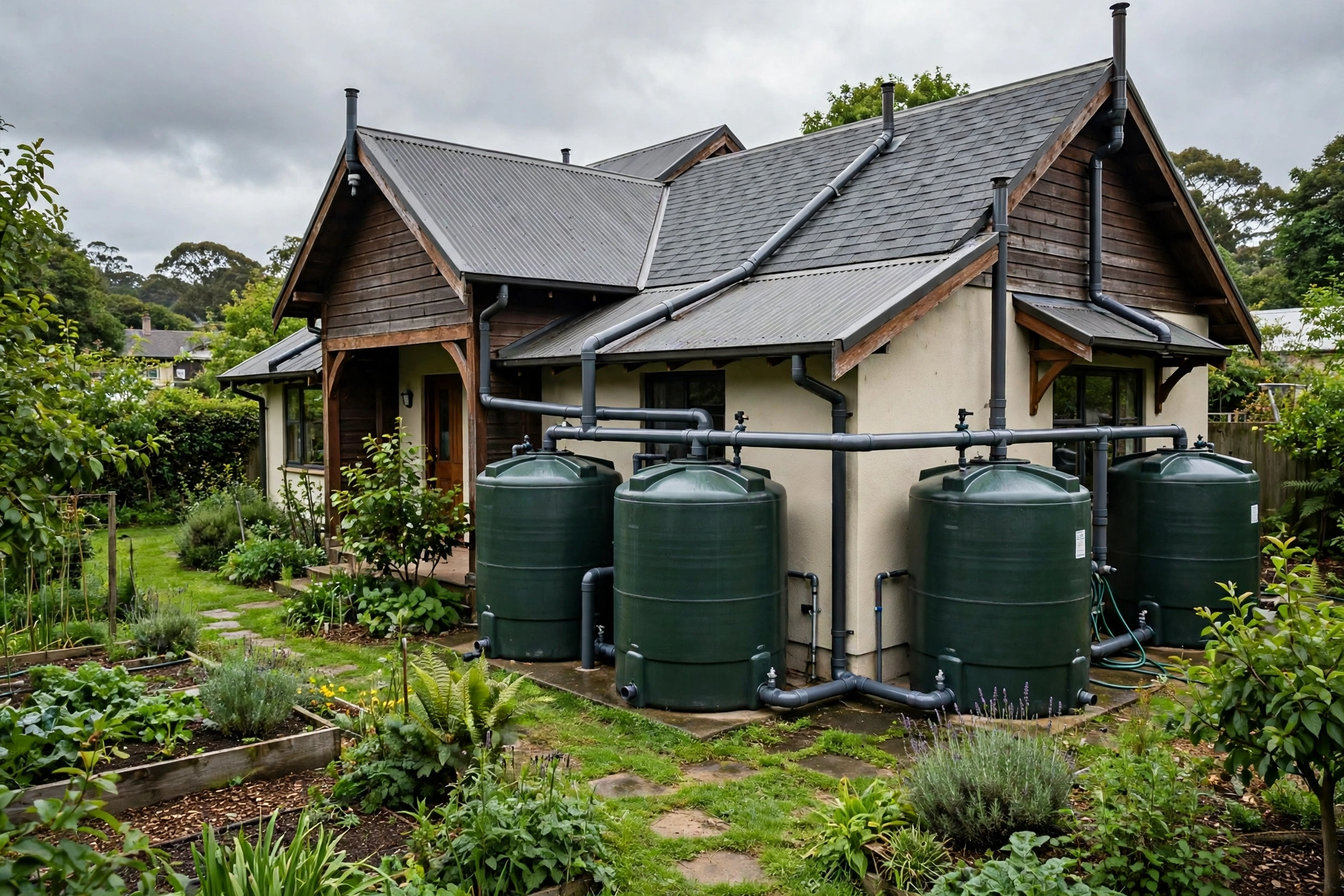
A house with one simple roof needs one simple rainwater tank. A house with a main roof, a garage roof, a rear extension, and a porch roof is a different problem: each section catches rain at a different height, drains to a different downpipe, and produces a different volume of water. Most homeowners still try to force all of it into a single tank beside one downpipe, and the result is predictable.
The direct answer is to stop thinking of rainwater storage as one tank and start thinking of it as a network. A distributed rainwater storage network places a smaller storage node near each roof section, links the nodes together with balanced piping, and lets the whole system fill, filter, and drain as one coordinated unit. Done well, it captures far more of your roof’s total yield.
Why One Big Tank Rarely Fits a Multi-Roof Property
A single central tank works only when every downpipe can reach it by gravity without long underground runs, and that is rarely true on a property with several roof sections at different heights. Water from a low garage roof cannot flow uphill to a tank fed by the main house, and routing it there means long buried pipes holding stagnant water.
There is also a capacity problem. A single tank sized for the whole property is usually too big for the only spot it can sit, or too small to hold a heavy storm’s runoff from every roof at once. When a storm arrives faster than the tank can accept water, the excess overflows at the nearest downpipe, often right beside the foundations.
How a Distributed Rainwater Network Actually Moves Water
At its simplest, a distributed network is a set of tanks that behave like one tank. Each roof section feeds its own local node through its own downpipe, first-flush diverter, and filter. The nodes are then connected at their base by balance pipes, so water levels rise and fall together. A storm that dumps heavily on one roof section spreads across every tank.
The network needs four things to work smoothly:
- A clear fall from every gutter to its local tank, so water arrives by gravity without pumps.
- Balance pipes at the base of each tank, sized generously so levels equalise faster than any single roof can fill.
- Isolation valves on every balance pipe, so one leaking tank can be cut off without draining the rest.
- One shared overflow route, taken from the last or highest tank, that sends excess water safely away from the building.
Where gravity cannot do the job, a small transfer pump moves water from a low node to a higher one, controlled by float switches. Design around how water actually behaves on your roof, not around where a tank happens to fit.
Mapping Roof Sections and Catchment Zones Before You Buy Anything
Before buying a single tank, walk the property in the rain if you can, and map every roof section on paper if you cannot. Record each section’s plan area, pitch, roofing material, and downpipe. A steep metal roof sheds water fast and cleanly; a flat membrane section sheds it slowly and carries more debris. Sections draining onto a lower roof need special attention, because the lower gutter must carry both sections’ water.
This map becomes your catchment plan. Group roof sections into zones that can share a storage node, and note the height of every gutter and downpipe outlet, because those heights decide whether a tank can be fed by gravity or needs a pumped transfer. A careful map now prevents the most common mistake: discovering mid-installation that one roof section cannot reach any tank.
Choosing Between Wet, Dry, and Hybrid Collection Runs
In a dry system, each downpipe runs above ground directly into its local tank, and the pipe empties completely between storms. Dry runs are simple, cheap, and easy to inspect, the right choice where a tank sits close to its downpipe. Their weakness is distance: a long dry run across a property looks unsightly and loses fall.
In a wet system, downpipes connect into buried pipes that run below the tank inlets, so the pipes stay full of water between storms. Wet runs collect from distant roof sections and hide the plumbing entirely, but they cost more and need a way to drain and clean the buried pipework. Most multi-roof properties end up with a hybrid: dry runs where tanks sit near downpipes, and a wet run only for sections that cannot reach a tank any other way.
Sizing Each Storage Node to Its Roof Section
Size each node from the roof section it serves, not from a guess about the whole property. One millimetre of rain on one square metre of roof produces about one litre of water, before losses from splashing, evaporation, and first-flush diversion. Multiply the section’s plan area by local monthly rainfall and by a collection efficiency of roughly 0.8 for a realistic monthly yield. The table below shows what that means for common roof sizes at around 60 millimetres of rain in a typical month.
| Roof section plan area | Monthly yield at 60 mm rain | Suggested node size |
|---|---|---|
| 25 sq m (porch or small extension) | About 1,200 litres | 1,000 to 1,500 litres |
| 50 sq m (garage or single-storey wing) | About 2,400 litres | 2,000 to 3,000 litres |
| 80 sq m (main house half-roof) | About 3,800 litres | 3,000 to 5,000 litres |
| 120 sq m (large main roof section) | About 5,800 litres | 5,000 to 7,500 litres |
Total storage across the network should cover roughly two to three weeks of your intended use, such as garden watering, toilet flushing, or laundry, because rain arrives in bursts with dry spells in between. Oversizing one node while starving another is wasted money: the small node overflows in every storm while the big one sits half empty. Balance sizes to yields; a distributed network lets you add another node later if demand grows.
Linking Tanks So They Fill and Drain as One System
The balance pipe is the heart of a distributed network, and its size matters more than most installers admit. A narrow pipe equalises levels slowly, so a heavy storm can still overflow the tank under the busiest downpipe while the far tank sits half full. Use pipe at least 50 millimetres in diameter for small residential networks, and step up to 90 or 110 millimetres when nodes are far apart or fed by large roof areas. Fit an isolation valve at each tank so any single node can be closed off for cleaning without emptying the rest.
Where tanks sit at different heights, align their overflow levels rather than their bases. A shorter tank on a raised plinth can share the same overflow height as a taller tank at ground level. Every tank still needs its own screened overflow as a safety backup, but in normal operation only the designated final overflow should carry water. If one tank overflows while others are not full, the balance pipe is too small, partly blocked, or valved shut.
Filtration, First-Flush, and Overflow Routing for a Networked Setup
Every roof section needs its own first-flush diverter and leaf screen, because filtering at the tank inlet is far easier than cleaning a network full of silt. The first-flush diverter catches the dirtiest water from the start of a storm, the leaves, dust, and bird droppings washed off the roof, and sends it away before it reaches storage. Size the diverter to the roof area it serves, roughly half a litre to one litre per square metre of roof.
| Component | Where it goes | What it protects |
|---|---|---|
| Leaf screen or gutter guard | Gutter outlet or downpipe head | Stops leaves blocking downpipes |
| First-flush diverter | Each downpipe before the tank | Keeps the dirtiest first rain out of storage |
| Inlet filter or vortex filter | Tank inlet | Removes fine sediment before water enters |
| Calmed inlet | Inside each tank | Stops incoming water stirring up settled sediment |
| Floating intake | Inside the supply tank | Draws the cleanest water from just below the surface |
Overflow routing deserves the same care as the supply side. Every overflow should discharge to a soakaway, a rain garden, or the storm drain, never onto a neighbour’s land and never against your own foundations. Route the final overflow from the tank furthest from the house, and make sure the overflow pipe is at least as large as the largest inlet pipe feeding the system, so a severe storm cannot back water up.
Pumps, Controls, and Smart Level Balancing Across Nodes
Most distributed networks run happily on gravity alone, but a pump earns its place in two situations: lifting water from a low node, such as a garage tank, up to the main supply tank, or pressurising the supply to toilets, laundry, or garden taps. A submersible pump with a floating intake draws the cleanest water and stays quiet. Fit a dry-run cut-off so the pump stops before it sucks air when the network runs low.
Simple controls are usually enough. A float switch in the lowest node can start a transfer pump when that tank fills and stop it when it empties, while a level gauge on the main tank shows at a glance how much water the network holds. Smart controllers add value on larger properties: level sensors in every node and an alert when one node stops responding, which usually means a blocked balance pipe or a stuck valve.
Rainwater Storage Network Upkeep That Keeps Water Clean
A distributed network needs a little more attention than a single tank, but the work is spread across small, easy jobs rather than one big one. The most important habit is keeping every filter and first-flush diverter clean, because a blocked filter starves its whole node and pushes extra water onto the others.
- Clean every first-flush diverter and leaf screen at least twice a year, and after major storms.
- Flush each balance pipe once a year by opening its isolation valves in sequence.
- Inspect tank interiors every two to three years, and remove settled sediment before it reaches the outlet.
- Check overflow screens for insect nests and debris every spring, before the storm season.
- Test transfer pumps and float switches before the dry season, when you will need stored water most.
Watch for warning signs that something has gone wrong: one tank that never fills, water staining below a downpipe, a musty smell from a tap, or a pump that cycles rapidly. Each points to a specific fault, and catching it early keeps a small fix from becoming a full-system cleanout.
Distributed Rainwater Storage Network FAQs for Multi-Roof Homes
Can I connect tanks from roof sections at different heights into one network?
Yes, provided the overflow levels are aligned. Raise a shorter tank on a plinth, or lower a taller one into a shallow excavation, so all tanks share the same overflow height. Balance pipes keep levels equal, and a pump can transfer water from a low node gravity cannot reach.
How do I size storage for each roof section?
Work from each section’s plan area and local rainfall. One millimetre of rain on one square metre of roof yields about one litre of water before losses. Multiply area by monthly rainfall and by a collection efficiency of about 0.8, then size the node to hold two to three weeks of demand.
Do I need a pump for every tank in the network?
No. Gravity and balance pipes do most of the work in a well-planned network. You need a pump only where water must travel uphill, such as from a low garage tank to the main supply, or where you need pressurised water for indoor uses.
What happens when one tank overflows in a distributed system?
In a balanced network it should not happen while other tanks still have room, because the balance pipes spread incoming water across every node. If one tank does overflow, the balance pipe is usually too small, partly blocked, or shut at a valve.
Can harvested rainwater be used inside the house?
Yes, for non-potable uses such as toilet flushing, laundry, and garden watering, which is how most residential systems are used. Potable use needs additional treatment, such as fine filtration and ultraviolet disinfection, and must comply with local regulations, so check the rules in your area first.
How often should a distributed rainwater system be cleaned?
Clean leaf screens and first-flush diverters at least twice a year, flush the balance pipes annually, and inspect tank interiors every two to three years. Properties under overhanging trees need more frequent screen cleaning, especially in autumn and after long dry spells.
Final Thoughts: A Distributed Rainwater Network That Fits Your Roofline
A distributed rainwater storage network is not a more complicated version of a single tank; it is a system designed around the roof you actually have. Map each section, size each node to the water its roof can deliver, link the nodes with generous balance pipes, filter every inlet, and route every overflow somewhere safe. The result captures more of your own rainfall, even when one tank is out of service.