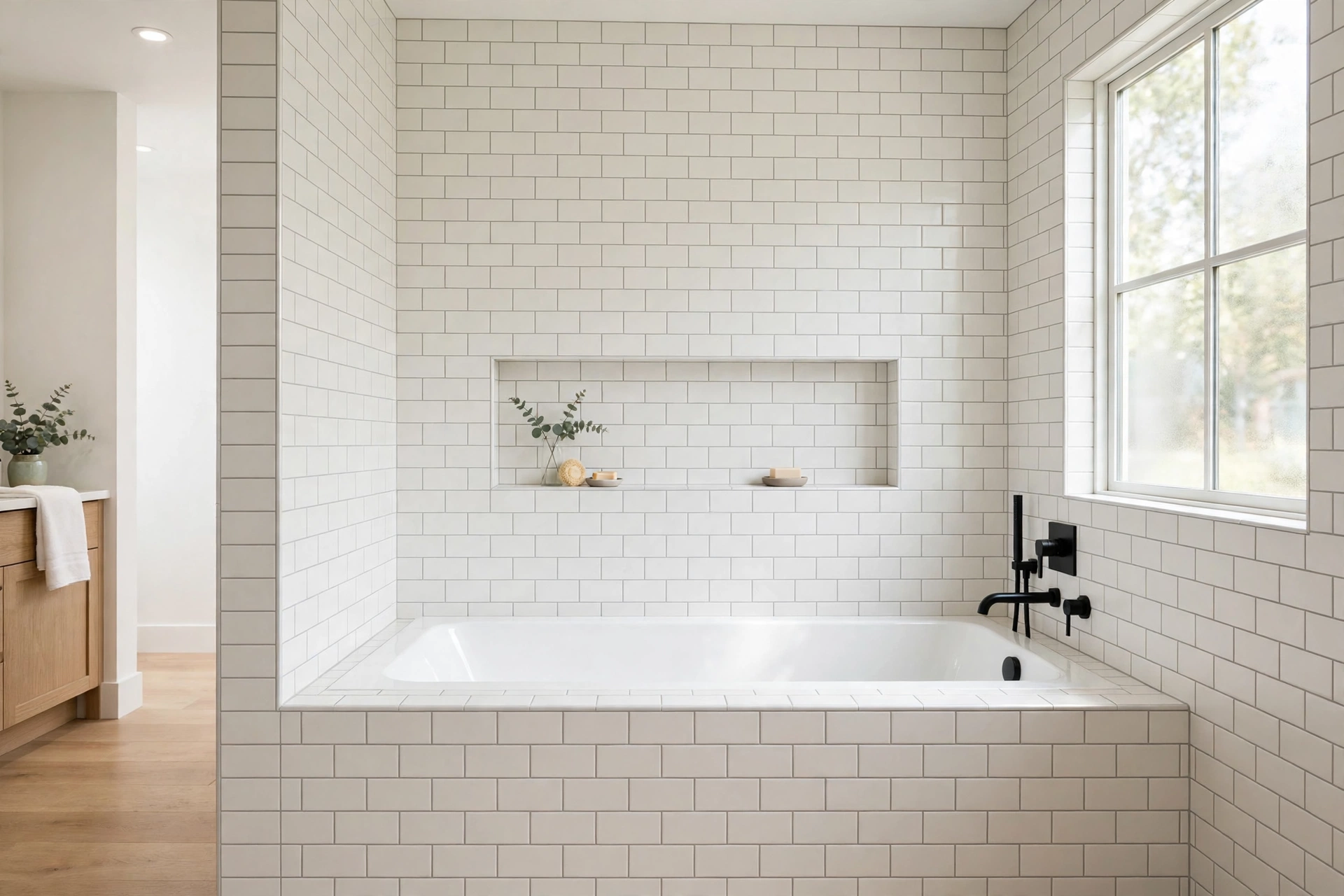
A bathtub surround does a job that is easy to overlook until it fails. Every shower and bath throws water, steam, and soap against the three walls around the tub, and if those walls are not properly protected, moisture works its way behind the surface, into the wallboard, and eventually into the framing. The result is not just a stained wall: it can be softened plasterboard, mould behind a panel, a musty smell that will not go away, and a repair that costs far more than the original surround.
Choosing a surround material is therefore a practical decision as much as a design one. Some materials resist water almost completely and need little more than a wipe, while others look beautiful but demand regular sealing, grout care, and vigilance at every seam. This article compares the main surround materials on water resistance and maintenance, explains what actually protects a wall behind the visible surface, and helps you choose a material that fits your budget, your cleaning habits, and your bathroom.
The Short Answer: Which Bathtub Surround Materials Resist Water Best?
For most bathrooms, a non-porous panel material, such as acrylic or a solid-surface sheet, offers the strongest combination of water resistance and low maintenance. These materials have no grout lines for water to seep through, they do not absorb moisture themselves, and they can be wiped clean in minutes. Their main weakness is not the panel itself, but the seams where panels meet each other and the tub, which must be sealed carefully and re-checked over time.
Porcelain tile, properly installed over a waterproofed backer board, is also highly water-resistant and extremely durable, but it asks more of you in return: grout lines need cleaning and periodic resealing, and a cracked tile or failed grout joint can let water behind the surface. Natural stone can look superb, but it is porous unless sealed on schedule, so it suits a homeowner who is happy to maintain it, rather than one who wants a wipe-and-forget surround.
What a Bathtub Surround Actually Has to Protect
A surround is not just a decorative covering; it is the visible part of a water-management system. Behind it should be a suitable backer, such as cement board or another moisture-tolerant board, and in a shower area, a waterproofing membrane that directs any water that gets behind the tile or panel back toward the tub, rather than into the wall cavity. Standard paper-faced plasterboard is not a suitable backer in a direct wet area, because it softens and can support mould once it gets wet.
Bathtub Surround Materials Compared for Water Resistance and Upkeep
Acrylic panels are popular for a reason: they are light, relatively affordable, warm to the touch, and easy to clean, and they come as three-piece kits that can be fitted over a sound, flat wall. Their surface can scratch if cleaned with abrasive pads, so non-abrasive cleaners are important, and a very cheap, thin panel may flex or feel hollow. Solid-surface sheets, made from resin and mineral fillers, are heavier and more expensive, but they can be joined with almost invisible seams and repaired more easily if scratched, which makes them a strong choice for a long-term family bathroom.
How Water Gets Behind a Bathtub Surround, Even a Good One
Water damage rarely starts with a dramatic leak. More often, it starts with a small, repeated problem: a bead of caulk that has shrunk away from the tub, a grout joint that has cracked in a corner, a showerhead that sprays slightly beyond the surround, or a panel seam that was never fully sealed. Each shower adds a little moisture, and because the wall cavity is dark and poorly ventilated, that moisture can stay there long enough to soften board, feed mould, and stain the wall below.
- Tub-to-wall joint: The seal where the surround meets the tub rim is the first line of defence and the first place to check when you see staining.
- Inside corners: Corners move slightly with the house, so rigid grout there can crack; a flexible sealant is often better in a vertical corner.
- Fixture penetrations: Water can track behind trim plates around taps and shower valves if the openings are not sealed.
- Shower spray beyond the surround: A showerhead aimed at an unprotected wall, or a curtain that does not contain spray, defeats even a good surround.
- Condensation: Steam that condenses on a cold wall or window can run down behind a loose panel edge, so ventilation still matters.
The practical lesson is to inspect the joints, not just the surface. A surround that looks clean can still be failing at a seam, and a surround that looks a little worn can still be watertight if its joints are sound. A few minutes of inspection every few months, looking for cracked caulk, soft grout, discolouration, or a panel that flexes, will catch most problems while they are still a tube of sealant rather than a wall repair.
Choosing a Bathtub Surround for Your Cleaning Habits and Household
The best surround for your home is the one you will actually maintain. A busy family bathroom, used by children and guests, benefits from a material that can be wiped down quickly and does not punish a missed cleaning session. A guest bathroom, used less often, can carry a more decorative tile or stone surround without the same daily burden, provided the grout or sealant is still checked on schedule.
Planning a Bathtub Surround Replacement Without Creating New Water Paths
Remove the old surround carefully and inspect the backer and framing for softness, staining, or mould before covering it again.
Replace any damaged backer with a moisture-tolerant board, and add a waterproofing membrane in the shower area as the system requires.
Dry the wall cavity fully before fitting the new surround; covering damp framing simply traps the problem.
Fit panels or tiles so joints fall where they can be sealed and inspected, not hidden behind a fixture you cannot reach.
Seal the tub joint, corners, and fixture openings with a suitable bathroom sealant, and let it cure before the first shower.
If the old surround is being replaced because of water damage, do not simply cover the damage with a new panel. The source of the moisture, whether it is a failed joint, a leaking valve, or inadequate ventilation, should be found and fixed first, or the new surround will fail in the same place. Where damage extends to framing, or where mould is widespread, a qualified contractor should assess the wall before any new material is fitted.
Bathtub Surround Mistakes That Invite Water Damage and Extra Cleaning
One of the most common mistakes is treating the visible surface as the waterproofing. Tile and grout alone are not a waterproof system; the membrane and backer behind them do the real work, and a surround fitted over ordinary plasterboard in a shower area is vulnerable even if the tile looks perfect. Another mistake is using the wrong sealant, or no sealant, in a corner that moves, which guarantees a crack that water can follow.
Other mistakes are quieter: fitting a panel over a damaged or uneven wall, so the panel flexes and its seams open; using abrasive cleaners on acrylic or fibreglass, which scratch the surface and make it harder to clean next time; and ignoring ventilation, so steam condenses and runs down the wall after every shower. Each of these can be avoided by following the manufacturer’s instructions for the specific material, rather than assuming one method suits every surround.
A Simple Bathtub Surround Care Routine That Keeps Water Out
A surround that is easy to maintain is one you will maintain, and a short routine is more useful than an ambitious one you abandon. After a shower, a quick squeegee or wipe of the walls reduces soap scum and water sitting in joints, and it takes less time than a deep clean once a month. Once a week, clean with a non-abrasive product suited to your material, paying attention to corners and the tub joint, and rinse well so cleaner does not build up.
When you find a cracked joint, remove the old sealant fully before applying new sealant, rather than layering new material over old, because a clean bond is what makes the joint watertight. For tile grout, resealing is not a substitute for replacing grout that has crumbled or come away from the tile; in that case, the joint should be repaired first, then sealed.
Final Thoughts: Picking a Bathtub Surround That Stays Dry and Easy to Live With
If low maintenance is your priority, a non-porous panel or solid-surface surround, fitted over a proper backer and sealed carefully at every joint, is hard to beat. If design flexibility matters most, porcelain tile over a waterproofed system will serve you well, provided you accept grout care as part of the deal. Either way, the material is only half the story: the backer, the membrane, the joints, and a short regular inspection routine are what keep a bathroom wall dry for years, rather than just looking dry for a season.
Bathtub Surround FAQs for Water Resistance and Easy Maintenance
What is the easiest bathtub surround material to maintain?
Acrylic panels and solid-surface sheets are usually the easiest, because they have no grout lines and can be wiped clean with a non-abrasive cleaner. Their seams still need inspection, but the day-to-day cleaning is simpler than scrubbing grout, and there is no resealing schedule for the panel surface itself.
Can I install a new surround over old tile?
Sometimes, if the old tile is firmly attached, clean, and free from damage or mould behind it, a panel surround can be fitted over it with adhesive. If the old tile is loose, cracked, or hiding water damage, removal is the safer choice, because covering a problem does not fix it and can make later repairs much larger.
Does tile need a waterproof membrane behind it?
Yes, in a shower area, tile and grout alone should not be relied on as the waterproof layer. A suitable moisture-tolerant backer and a waterproofing membrane, fitted as a system, manage any water that passes through grout and direct it away from the wall framing. Check local building requirements and the membrane manufacturer’s instructions for your specific installation.
How often should bathtub surround grout be resealed?
It depends on the grout type, the tile, and how the bathroom is used, so follow the product manufacturer’s guidance rather than a single universal figure. As a practical sign, if water no longer beads on the grout and the surface darkens quickly when wet, the sealer may need renewing, and any crumbled grout should be repaired first.
Is natural stone a bad choice for a bathtub surround?
Not necessarily, but it is a high-maintenance choice. Stone is porous unless sealed, it can stain from hard water and some cleaners, and it needs resealing on schedule. If you love the look and are willing to use stone-safe cleaners and keep up with sealing, it can work well; if you want a wipe-and-forget surround, a panel or porcelain tile is usually a better fit.
When should I get professional help with a bathtub surround?
Get professional advice if you find soft or damaged framing, widespread mould, a leaking valve or pipe behind the wall, or if the project involves structural changes, plumbing moves, or a shower system you are unsure about. A qualified contractor can assess the wall, the waterproofing, and the ventilation together, rather than just replacing the visible surface.