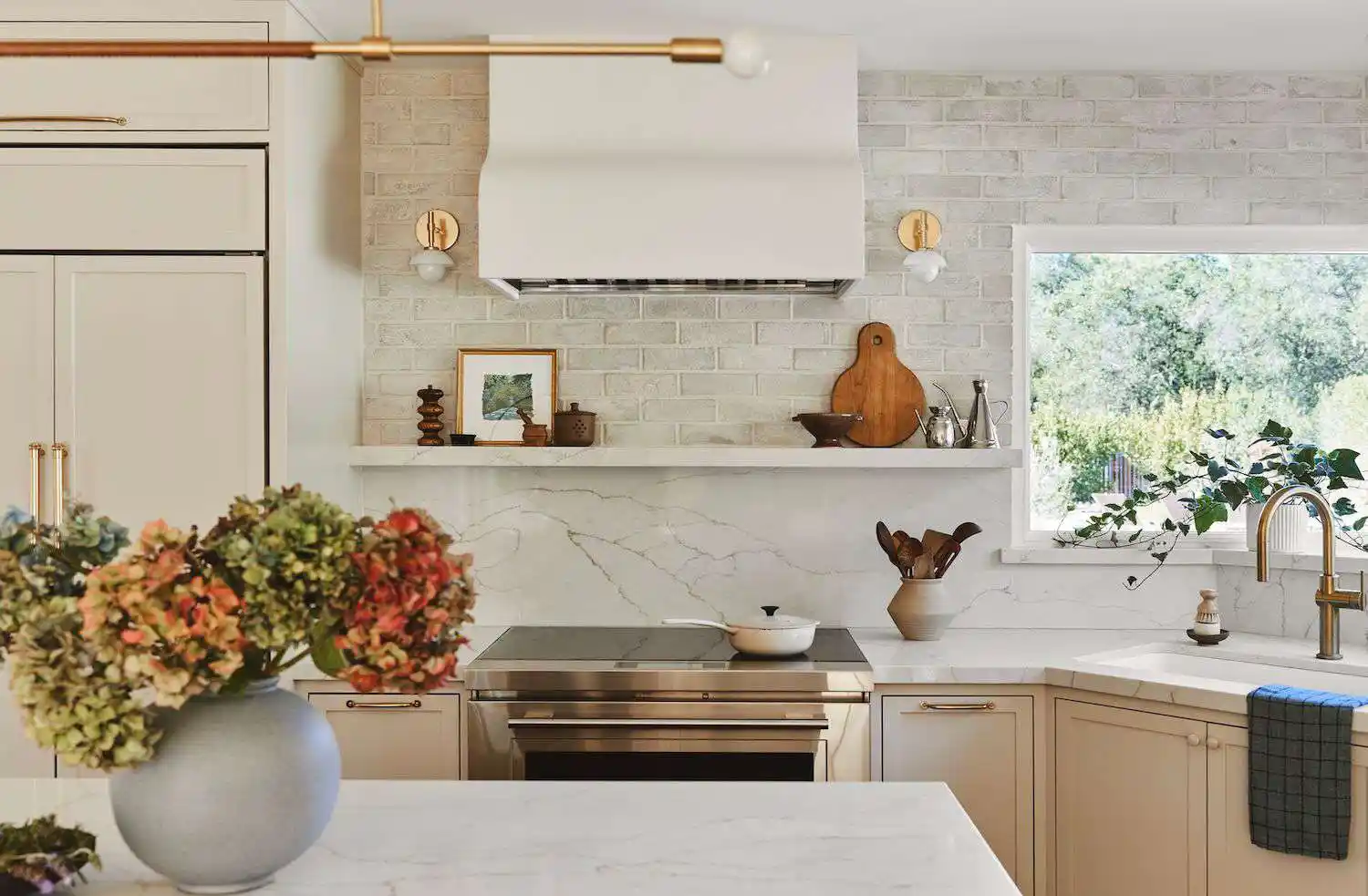
A small kitchen does not need a full remodel to work better and look modern. In most homes, the problem is not square footage alone. It is wasted cabinet space, crowded counters, poor lighting, and finishes that make the room feel darker and smaller than it is. When you fix organization first and appearance second, even a kitchen of 70 to 100 square feet can feel easier to cook in every day.
Most projects here need no permit or wall removal. Many cost under $300, and several under $50. Watch how you use the kitchen for two days first — where groceries land, utensils pile up, and cabinets are hard to reach — and let those frustrations choose your first project.
Layout Tweaks That Make a Small Kitchen Work Harder
Good layout is about clear paths and sensible zones, not copying a large kitchen plan. Group work into three zones: storage near the fridge, washing and prep near the sink, and cooking near the stove. Keep the tools for each zone within one step of where you use them. If the coffee maker sits by the sink but mugs and coffee are across the room, you cross the kitchen every morning for no reason.
Check clearances before buying anything:
- Keep 36 to 42 inches of walkway in front of cabinets and appliances
- Keep at least 24 inches of counter beside the stove for a hot pan
- Replace a bulky island with an 18-inch-deep rolling cart that parks against a wall
- Use a drop-leaf or wall-mounted folding table for extra prep space that disappears after use
Move trash to the end of a run, not the middle of your prep zone. If the fridge door swings into your counter, check whether its hinges can be reversed — free on many models. In a galley kitchen, avoid tall storage on both sides at the entrance; keep the entry low and place tall items at the far end.
Cabinet and Drawer Organization That Doubles Useful Storage
Most small kitchens have enough cabinet volume — it is just badly divided. Empty one cabinet at a time, remove anything expired, duplicated, or unused in the past year, and measure the interior height, width, and depth. Keep those numbers in your phone; they prevent most bad organizer purchases.
Use the full height of each shelf. Adjustable risers, usually $10 to $25, create a second level for bowls, mugs, or cans. In deep base cabinets, pull-out trays or roll-out drawers, typically $40 to $90 per cabinet, bring pots from the dark back to you. For a cabinet you use daily, the saved time is worth the cost.
Treat drawers as prime storage, not junk space:
- Add a divided cutlery tray, knife insert, and bamboo dividers to stop tangled piles
- Store daily utensils in a drawer near the stove instead of a crock crowding the counter
- Fit slim racks inside cabinet doors for lids, spices, and measuring spoons — check the door still closes freely
- Use a tension rod under the sink to hang spray bottles, and stackable bins for packets and snacks
Label shelves lightly if it helps everyone return items to the same place. A system only works if it is maintained without thinking.
Countertop Space Savers That Restore Your Prep Area
Counters disappear fast. Aim to keep one clear stretch of about 24 by 24 inches for chopping and mixing. Everything else must earn its place or move.
Start with an honest edit. Move the bread maker used twice a year, the second knife block, and empty decorative jars to a high shelf or out of the home. Keep out only daily items — typically a coffee maker, kettle, and toaster.
Then go vertical. A magnetic knife strip, about $20 to $35, replaces a bulky block. Wall rails hold utensils, small pans, and mugs. Over-the-sink boards and roll-up racks turn the sink into workspace. Choose dual-purpose tools: nesting bowls, stackable measuring cups, and a board that fits over the sink. Keep a small tray beside the stove for oil, salt, and a spatula, so essentials look intentional.
Lighting and Color Choices That Make the Room Feel Bigger
Light changes how large a kitchen feels more than almost any finish. Many small kitchens rely on one ceiling fixture that leaves counters in shadow under wall cabinets. Fix task lighting first. LED strips or slim puck lights under cabinets, usually $25 to $60 for a run, put light where you chop and read recipes. Choose 3000K to 4000K, and use the same temperature throughout so the room does not look patchy.
For general light, a flush or semi-flush fixture with a wide spread beats a small pendant over an empty center. Keep window treatments minimal — a roller shade or short cafe curtain preserves privacy without blocking daylight.
For color, light does not mean stark white. Soft white, pale warm gray, light sage, and creamy tones reflect light and pair well with wood and steel. Keep cabinets, walls, and backsplash within a few shades of each other, so the eye reads one larger, calmer space. If you paint cabinets, prep matters most: degrease, sand lightly, prime, and allow proper drying. Paint and supplies typically cost $75 to $200 done yourself. Add contrast in small doses — dark hardware or a deeper runner — and avoid a dark accent wall where natural light is low.
Backsplash and Hardware Refreshes With an Outsized Impact
If cabinets and counters are in decent shape, backsplash and hardware give the most visible change for the least disruption. Both sit at eye level, both date a kitchen quickly, and neither requires replacing cabinets.
Classic backsplash choices age best. Light subway tile with light gray grout keeps the wall bright and costs about $2 to $5 per square foot for basic ceramic, plus setting materials. Large-format tiles mean fewer grout lines and a calmer look. Peel-and-stick tile, roughly $30 to $60 for a small area, can work behind a prep counter, but check heat and moisture limits and avoid it directly behind a gas burner unless rated for that use. Measure first, order about 10 percent extra for cuts, dry-lay the pattern, seal grout, and caulk the counter joint with kitchen-and-bath silicone.
Hardware is simpler. Clean bar pulls or rounded knobs in matte black, brushed nickel, or warm brass instantly modernize cabinet fronts, at $3 to $10 each. Measure the screw-hole distance — the center-to-center size, commonly 3, 3-3/4, or 5 inches — before ordering. A $10 template jig makes new holes far easier to align. Keep the finish consistent with your faucet.
Appliance Choices Made for Small Spaces
Replacing a worn appliance is the moment to correct its size. An 18-inch dishwasher, instead of a standard 24-inch model, suits one or two people and frees six inches of cabinet storage. Counter-depth fridges, around 24 to 28 inches deep, reduce how far the fridge projects into the walkway. Apartment-size ranges at 20 or 24 inches wide are enough if you rarely cook for a crowd.
Multi-function models save the most space. A microwave that also convection-cooks or air-fries can replace a countertop oven. A pressure cooker that sautes, slow-cooks, and steams can replace two or three single-purpose machines. Confirm it does your weekly jobs well, rather than ten jobs poorly.
Measure width, height, depth, doorways, and door swing, and allow required ventilation. An 18-inch dishwasher often starts around $600 and a counter-depth fridge around $1,100, plus $100 to $300 for delivery or installation. If current appliances work well, do not replace them for looks alone — a deep clean and new filter can refresh them.
Budget-Friendly Weekend Upgrades You Can Finish Fast
You can refresh a small kitchen in one weekend for $150 to $400 if you work in the right order:
- Saturday morning: Empty, clean, and line cabinets; fit risers, dividers, and door racks
- Saturday afternoon: Install under-cabinet lights and a magnetic knife strip; clear and re-set counters
- Sunday morning: Swap all cabinet hardware using a template jig; touch up paint and caulk
- Sunday afternoon: Add a runner, a small tray by the stove, and open-shelf styling kept deliberately sparse
Buy everything beforehand, including screws and cleaning supplies, so you do not lose hours on store trips. Keep receipts until organizers are fitted.
What Not to Do in a Small Kitchen
Avoid mistakes that quietly shrink the room:
- Do not buy oversized appliances, sinks, or carts before measuring clearances and door swings
- Do not use dark cabinets, dark counters, and dark flooring together in a low-light room
- Do not add open shelves everywhere — they collect grease and look cluttered unless kept half-empty
- Do not store rarely used items at eye level; reserve the easiest reach for daily tools and food
- Do not block the only window or light fixture with tall storage or bulky decor
- Do not start tiling or painting before organization is solved — new finishes will not fix a layout that frustrates you
Final Thoughts
A better small kitchen comes from small, deliberate choices. Clear the counters, make every cabinet easy to reach, add light where you work, and update the details people see first. Do one zone at a time, live with it for a week, and adjust. That approach costs less and leaves a kitchen that feels organized, modern, and pleasant to cook in.
Frequently Asked Questions
What is the cheapest way to make a small kitchen look modern?
Change hardware, add under-cabinet lighting, and clear the counters. Together they often cost under $150, need no demolition, and change both how the kitchen looks at eye level and how it works every day.
How do I add storage without adding cabinets?
Use cabinet-door racks, shelf risers, pull-out trays, wall rails, and a magnetic knife strip. Measure each space first, remove unused items, and store daily things at waist to eye level, with rare items highest.
Should I use open shelves in a small kitchen?
Use them sparingly — one short run is usually enough. Keep shelves about half-full with matching everyday dishes, clean them often because of cooking grease, and keep closed cabinets for the rest.
What colors work best in a small kitchen?
Soft white, pale warm gray, light sage, and creamy tones work well because they reflect light. Keep walls, cabinets, and backsplash close in tone, then add contrast through hardware, a runner, or accessories.
When is a small appliance upgrade worth the cost?
Upgrade when an appliance is failing, blocks the walkway, or wastes cabinet space you need daily. An 18-inch dishwasher or counter-depth fridge is worth considering then — not purely for looks if your current model works well.