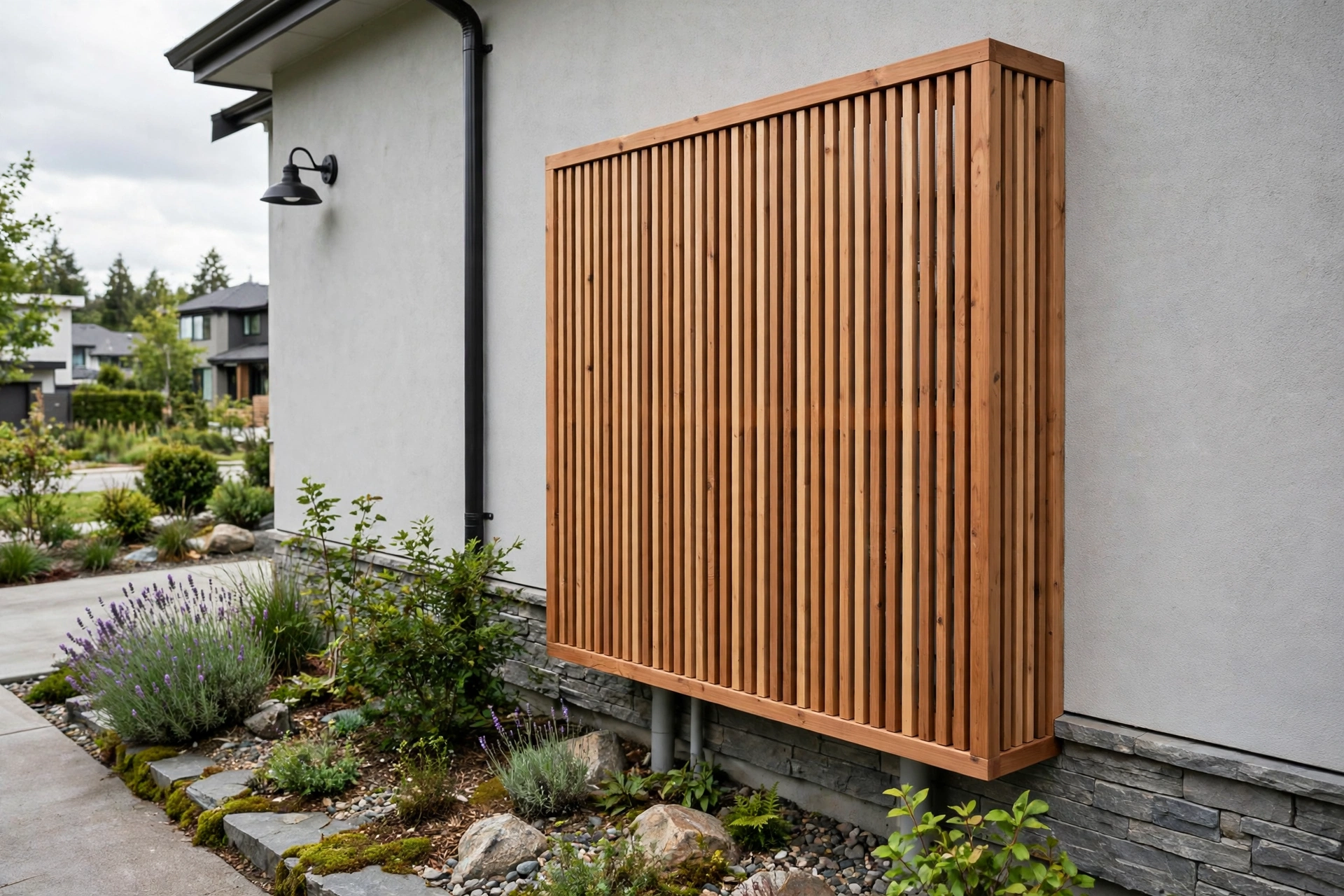
A gas or electric meter bolted to a house wall is rarely a selling point. It breaks up clean siding and draws the eye in every photo of the property. When the house also sits on a narrow lot, a tight side passage, or a paved frontage with almost no planting bed, the usual advice — plant a hedge in front of it — simply does not fit. But a meter does not need a garden to disappear, only a screen designed for a wall, not for a yard.
The Short Answer: A Screen That Hides the Meter Without Blocking It
- Direct answer: The best screen for a meter on a wall with restricted landscaping space is a thin, wall-hinged or freestanding panel that sits in front of the meter, leaves the meter face readable, and can be swung aside or lifted away in seconds.
For most homes that means a louvered panel hinged beside the meter, a narrow slatted screen in weighted planters, or a ventilated faux-stone cover. It never means a sealed box screwed over the meter, a bed dug against the pipes, or anything a reader must dismantle.
Why a Tight Wall Space Makes Meter Screening Trickier Than a Big Garden
With a deep front garden, screening is forgiving. A restricted space removes all of that slack — a side passage may be only 900 millimetres wide, a frontage may be paved to the boundary, and the soil strip beside the wall may be barely wide enough for a trowel. Tight spaces also concentrate the risks: a screen squeezed against the wall traps moisture, a planter jammed against gas piping can damage a joint when dragged for access, and a climber in a narrow passage reaches the meter far faster than in an open bed. The designs that succeed here are thin, movable, and modest in size, with a visible gap between screen and meter.
The Clearance Box Your Meter Screen Must Respect
Before choosing any screen, understand the clearance zone around the meter. Utility companies and electrical codes require a clear working space so technicians can read, maintain, and shut off a meter safely. The widely referenced electrical standard calls for at least 36 inches (about 91 centimetres) clear in front of the meter and service panel, about 30 inches (76 centimetres) wide, and headroom of at least 6 feet 6 inches (about 2 metres). Gas meters need roughly 3 feet of radial clearance from ignition sources and openings, plus continuous ventilation — a sealed enclosure can trap leaking gas. Figures vary by utility and local code, so confirm the exact clearance with your provider before building. Never fix a screen to the meter or piping, and never dig deep post holes beside it.
Flat-to-the-Wall Meter Screens That Need Almost No Ground
When there is no ground to work with — a paved frontage, a concrete path, or a passage barely wider than a person — the screen has to live on the wall itself. The most practical design is a hinged louvered or slatted panel mounted beside the meter, not over it. On exterior-grade hinges, it swings open like a shutter for one-movement access, with louvers or slat gaps for airflow. A second option is a slatted panel on short standoff brackets, leaving a finger-width gap that stops moisture being trapped against the siding and lets the panel lift off without tools; painted to match the siding, it reads as an architectural detail. For renters, freestanding shutter screens are the equivalent — hinged shutters that lift away entirely, weighted at the base against wind.
- Measure first. Measure the meter assembly and add 75 mm on each side.
- Fix to the wall only. Fix hinges or brackets to the wall, never to the meter or piping.
- Test the swing. Test the access: one hand, no tools, full access in seconds.
- Finish to blend. Finish with paint matched to the siding, meter face left visible.
Weighted Planters and Narrow Trellis Panels for a Strip of Soil
Where a narrow strip of soil exists — even 30 to 45 centimetres wide — the classic three-sided screen can be shrunk to fit by replacing dug posts with weighted planters as the screen's feet. A slatted panel fixed between two heavy planters stands securely without a post hole and slides aside as one unit for full access. Narrow balcony trellis panels suit here: often under 5 centimetres deep, sold as no-dig units. Plant choice is where small-space screening most often goes wrong: fast climbers such as vigorous ivy cover a meter in a single season in a narrow passage, and their stems work into joints and behind conduit. Slow and controllable beats fast and lush — choose compact plants you can prune from the path, keep stems 30 centimetres from the meter and piping, and cut back anything touching the assembly.
Living Camouflage Without a Garden Bed: Wall Pockets, Climbers and Faux Stone
When the ground is paved, the wall itself can still carry the greenery — provided planting stays beside the meter, not over it. Wall-mounted pocket planters, rail planters, and small troughs fixed on either side of the meter create a green frame that distracts the eye without covering the equipment; plants should sit to the sides and below the meter face, never draped across it, and planters must be fixed to sound masonry or studs, since wet soil is heavy. Climbers in pots offer more height: a compact clematis in a tall narrow pot beside the meter, trained up a slim trellis offset from the equipment, softens a bare wall in one season if pruned back from the meter zone twice a growing season. Ventilated faux-stone covers are another no-ground option: lightweight, lift-off by hand, with ventilation openings so gas cannot accumulate — but check any cover is genuinely ventilated, since a heavy sealed imitation rock is exactly what utilities object to.
Choosing Between Timber, Composite, Metal and Vinyl for a Meter Screen
Timber is the most forgiving DIY material: cedar and pressure-treated boards resist decay, take paint well, and cut to an exact fit around an awkward meter position, but timber in a damp passage needs restaining every couple of years. Composite boards cost more but hold colour and shape with almost no upkeep. Metal screens — powder-coated aluminium or galvanised steel — are the thinnest and most durable option, but cost most per square metre and need cut edges finished. Vinyl lattice is the budget option: light, weatherproof, and easy to cut, but it rattles in wind unless framed.
Meter Screening Blunders That Get Screens Removed
Most meter screens are not removed because they look bad; they are removed because they break an access rule the homeowner did not know existed. The most common blunder is enclosing the meter on all four sides with a solid box: it blocks ventilation for gas meters, hides the meter face, and forces a technician to dismantle the enclosure. The compliant shape is always open — three sides at most, an open top or back, and a front that swings or lifts away. A subtler blunder is a screen that complies technically but fails practically — too heavy to open one-handed, or positioned so the gate cannot open past it. Before calling a screen finished, walk the technician's test: approach, open one-handed, read the meter, close it again.
- Airtight boxes. Sealing a gas meter in an airtight box, trapping any leaking gas instead of letting it disperse.
- Planting against the pipes. Planting shrubs or climbers against the meter so stems or soil press on piping and hide the dial.
- Fixing to the equipment. Screwing a screen or planter into the meter box, conduit, or gas piping instead of the wall.
- Digging blind. Digging post holes beside the wall without checking for buried electric, gas, or water services.
- Locking access away. Locking a screen shut, or blocking it with bins, so a reader cannot reach the shut-off.
What a Meter Screen Costs When the Footprint Is Tiny
Small-space screening is one of the cheaper exterior improvements, because the quantities are small: one panel, two planters, or one ready-made cover. A DIY slatted timber panel with hinges and paint typically falls in a modest weekend-project budget, while a ready-made metal panel or ventilated faux-stone cover costs more but arrives finished. The hidden cost is maintenance, and it is worth pricing honestly: timber needs restaining, planters need replanting, climbers need pruning, and a screen in a narrow, damp passage weathers faster than the same screen on an open wall. Budget a small annual allowance for pruning and stain.
Keeping a Meter Screen Safe Through Storms, Readers and Resale
A meter screen is not a fit-and-forget project. Twice a year, in spring and autumn, check hinges for rust, confirm the panel still swings or lifts freely, cut back growth within 30 centimetres of the meter, and clear debris behind the screen. After a storm, check wind has not shifted a freestanding screen onto the meter or its piping. These five-minute checks keep a screen compliant year after year. Some moments call for help rather than improvisation: if you smell gas near the meter, if the meter or piping is damaged, or if your utility says the meter must be moved or upgraded, that is a job for the utility company or a qualified tradesperson. Never open a meter box, break a seal, or work on live service equipment.
Meter Screening Questions Homeowners Ask When Space Is Tight
Can I cover a gas meter completely if I leave the front openable?
No — not with a solid, sealed cover. A gas meter screen must stay ventilated at all times, with slats, louvers, or an open back so gas cannot accumulate, and the front must swing or lift away instantly. A three-sided ventilated screen is the compliant pattern; a sealed box is not, even with a door.
How close can a screen sit to an electric meter?
The screen can sit close to the wall, but the working space in front of the meter must stay clear — about 36 inches (91 centimetres) deep, 30 inches (76 centimetres) wide, and 6 feet 6 inches (2 metres) high. Your utility's own rules take precedence, so confirm the exact clearance before building.
What if my meter is in a passage too narrow for a freestanding screen?
Use the wall: a hinged louvered panel, a standoff slatted panel, or a shutter screen needs no floor space at all. These add only a few centimetres of depth and keep the passage fully usable.
Can I plant a climber to hide a meter on a small wall?
Yes, with discipline. Grow it in a pot beside the meter, train it on a trellis offset from the equipment, and keep every stem at least 30 centimetres from the meter and piping. If you cannot prune it twice a growing season, choose a static screen instead.
Will my utility company remove a screen I build?
Only if it blocks access, ventilation, or visibility — the three things utilities protect. A ventilated, movable screen that leaves the meter face readable and the shut-off reachable is routinely accepted. When in doubt, ask your provider before you build.
Your Next Step: Measure the Wall, Then Pick the Thinnest Screen That Works
Start with a tape measure, not a shopping list. Measure the meter assembly, photograph it from the street and from the path, and confirm the clearance rules with your utility provider. Then choose the thinnest screen that solves the street view: a hinged panel for a paved wall, a weighted-planter trellis for a soil strip, or a ventilated cover for a bare frontage. Build it to swing or lift away in seconds, keep plants and fixings clear of the equipment, and give it a five-minute check each spring and autumn. Done that way, the meter disappears from the street view while staying fully available to the people who need it.