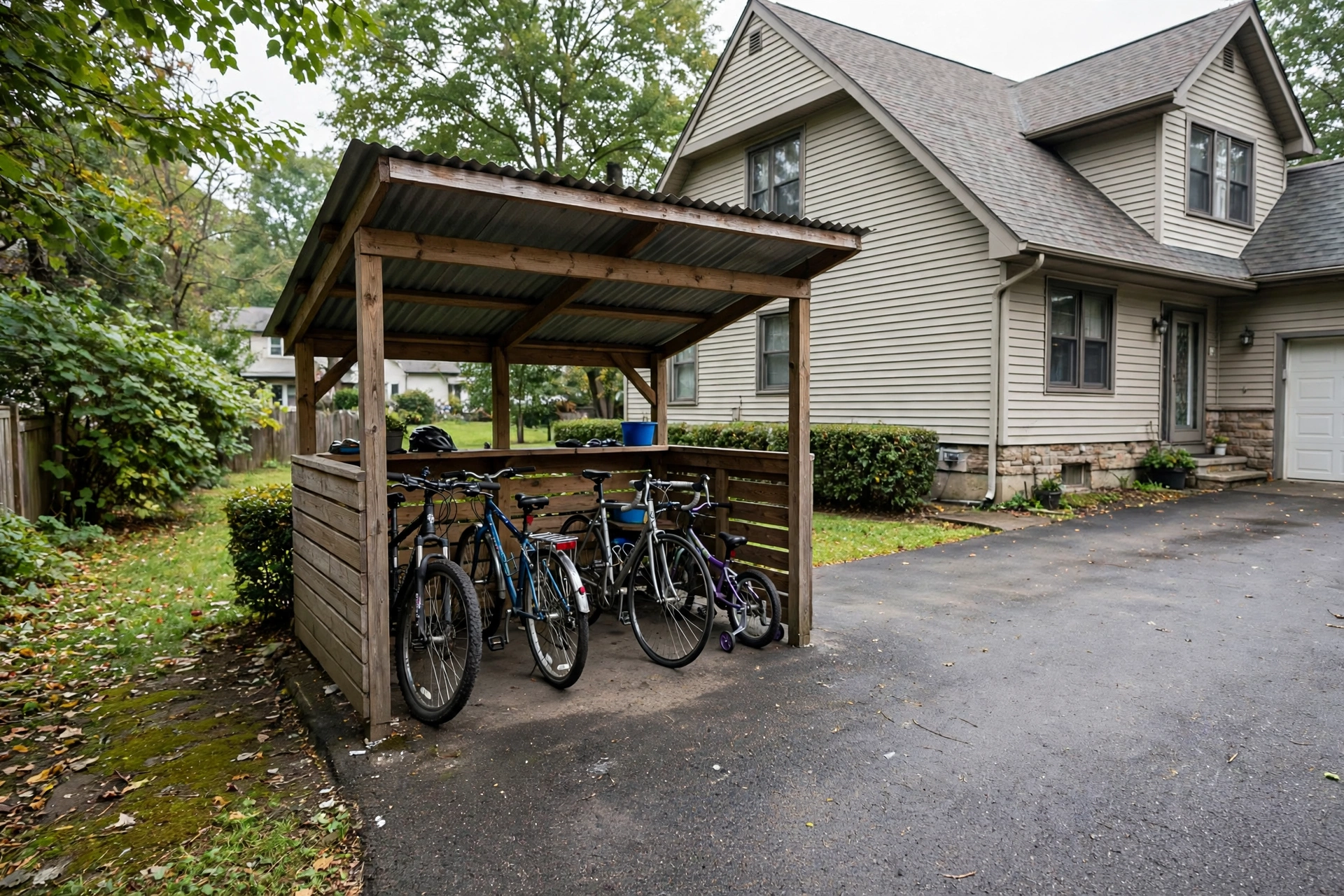
A bicycle left out on an uncovered driveway has a short, unhappy life. Rain works into the chain and bearings, sun fades paint and perishes tyres, and a bike in plain sight is an easy target for a thief with a few unwatched minutes. Many homes have no garage and no spare garden corner — only a driveway that already holds a car. A well-chosen bicycle shelter solves that problem without taking over the drive, and for far less than building a shed.
The Straight Answer: What Kind of Bicycle Shelter Fits a Tight Driveway Best
For most homes with a cramped driveway and no covered storage, the best starting point is a narrow, lockable, wall-hugging shelter — either a lean-to canopy fixed to the house wall or a slim enclosed bike store against a boundary fence. Both keep bikes dry and out of sight while leaving the car space usable, and both fit in a strip as narrow as about 90 centimetres. An open canopy suits daily riders who want the fastest access; a fully enclosed store suits higher-value bikes and e-bikes, where security matters more than speed.
Measuring the Driveway Gap Before You Shop for a Bicycle Shelter
Driveway shelters fail most often on measurements, not on quality. A store that looks compact online can still block a car door or leave too little room to wheel a bike out.
Mark the real footprint. Mark the strip you can genuinely spare with chalk, with the car parked normally, and check every door still opens.
Measure the longest bike. An adult bike is roughly 1.8 metres long; add handlebars, mudguards, and any child seat or basket. Cargo bikes can run well over 2 metres.
Check the roll-out path. You need height to roll a bike in upright, and about a bike length of clear driveway in front of the door to pull it out.
Note slopes and services. Water must drain away from the shelter, not pool under it, and never cover inspection covers, gas meters, or stopcocks you need to reach.
Manufacturers quote external dimensions, so allow for roof overhangs and door swing.
Open Canopy, Lean-To, or Fully Enclosed: Which Driveway Bicycle Shelter Suits Your Household
The right shelter depends on how often the bikes are used, how valuable they are, and how exposed the driveway is.
- Open canopy. A roof on posts or a wall bracket, open on the sides. Cheapest and quickest to fit, ideal for daily riders. Wind-driven rain still reaches the bikes, and security depends entirely on the lock and anchor.
- Lean-to shelter. A sloped roof fixed to the house or garage wall, with one or two side panels. The classic tight-driveway solution: it uses dead wall space, sheds rain away from the house, and gives far better weather cover than a canopy for little extra cost.
- Fully enclosed store. A lockable box with walls, roof, and doors in timber, steel, or resin. The best weather protection and security, and the only option that truly hides bikes from view. It needs the most space, and its doors must be wide enough to wheel bikes straight through.
Timber, Steel, or Resin: How Driveway Bicycle Shelter Materials Weather the Years
Timber looks most at home against a house and can be painted to match, but needs treating every few years and will rot if it sits in standing water. Galvanised steel is strong, low-maintenance, and hardest to break into, though cheaper panels can dent and condensation can form on bare metal in cold weather. Resin panels are light, rust-proof, and easy to clean, but can feel less secure and may fade in strong sun. Whatever the material, the base matters as much as the walls: a level, well-drained base of paving slabs, concrete, or compacted gravel stops the shelter rocking and keeps doors aligned. Anchor the shelter to that base or to the wall.
Sizing the Shelter to Your Fleet: From One Commuter Bike to a Family of E-Bikes
As a rough guide, a 6-foot by 3-foot store holds two adult bikes comfortably, a 6-foot by 4-foot store holds three, and a 7-foot by 3-foot store holds four with a little gear space — but those rules assume standard adult bikes parked side by side. Plan by bike, not by headline capacity: allow roughly 4 to 8 square feet of floor per bike plus a clear path to roll the front bike out without moving the back one. E-bikes need a ramp or low threshold so a 25-kilogram bike is not lifted over a lip every morning.
Keeping Driveway Bikes Dry Without Turning the Shelter Into a Damp Box
A shelter that keeps rain out but traps damp air inside can rust a chain faster than no shelter at all. Moisture from wet tyres and humid air condenses on cold metal overnight in a sealed box with no ventilation, then sits there. The fix is airflow: look for built-in vents, a small gap under the eaves, or louvred panels, and keep the inside organised so air moves around the bikes. Bring bikes in dry when you can, and keep a moisture absorber inside an enclosed store through winter. Never store a bike under a tight plastic tarp inside a shelter.
Locking Down Driveway Bikes: Anchors, Locks, and Shelter Security That Actually Works
A shelter's walls slow a thief down; the lock and anchor are what stop one. The strongest setup layers three things: a shelter that locks, a ground or wall anchor bolted through the base, and each bike locked to that anchor with a good lock. A hardened U-lock or heavy chain through the frame and rear wheel, fixed to a ground anchor, beats any door latch on its own — a thief who defeats the door still faces a locked bike. Bolt anchors into concrete rather than loose paving, and keep the lock off the ground where it is harder to attack with tools.
E-Bikes Under a Driveway Shelter: Charging and Battery Care Outdoors
E-bikes change the shelter brief: the bike is heavier and longer, the battery is the most expensive single part, and charging outdoors needs care. If you can, take the battery indoors to charge — it is the safest option, it keeps the battery at a stable temperature, and it removes the most stealable part from the bike overnight. If outdoor charging is unavoidable, use only the manufacturer's charger and a properly installed weatherproof outdoor socket fitted by a qualified electrician — never a trailing extension lead through a gap in the door. Most manufacturers suggest keeping a battery roughly half charged for long storage rather than full or flat. Never charge a battery that is swollen, cracked, smells odd, or feels hot.
Driveway Bicycle Shelter Slip-Ups That Cost Owners Twice
- Guessing the size. Buying by headline capacity, then finding the longest bike does not fit or the door is too narrow.
- Skipping the base. Putting the shelter on bare soil or uneven lawn, so doors stick and water pools inside.
- Sealing out the air. Choosing a shelter with no vents, then wondering why chains rust faster inside than outside.
- Trusting the latch alone. Relying on a flimsy door latch and no anchor, so one weak point loses every bike at once.
- Ignoring the front-garden rules. Building forward of the house's front wall without checking the rules, then facing an enforcement letter.
- Blocking the bike you ride most. Forgetting daily use: a shelter that needs three bikes moved to reach the commuter bike will be abandoned within a month.
What a Driveway Bicycle Shelter Costs, From a Canopy to a Custom Timber Store
Costs vary with size and material, so these figures are estimates for planning, not quotes. A simple canopy or fabric shelter starts at the low end, a good enclosed resin or steel store for two bikes sits in the middle range, and a custom-built timber store with a proper base, anchor, and lighting sits at the top. DIY building saves on labour but adds a weekend of work; a professionally built timber shelter buys a neat finish and a warranty. Budget separately for the base, anchor, lock, and any electrical work.
When a Driveway Bicycle Shelter Needs Permission, a Pro, or a Different Spot
Planning rules are the one part of this project where guessing can be expensive. In England and Wales, an outbuilding placed forward of the wall that forms the principal elevation of the house — in practice, in the front garden — generally falls outside permitted development, so a bike store there usually needs planning permission regardless of how small it is. A store at the side or rear is far more likely to fall within permitted development, provided it stays within the usual height limits — typically no more than 2.5 metres high within 2 metres of a boundary — and does not cover more than half the land around the original house. Listed buildings, conservation areas, and Article 4 directions tighten the rules further, so check with the local planning authority before buying.
Bicycle Shelter Questions Driveway Owners Ask Before Buying
Can a bicycle shelter sit on a driveway without blocking the car?
Yes, if it sits in a strip the car does not use — against the house wall, along a boundary fence, or beside the parking bay. Measure with the car parked normally and keep the door swing and roll-out path clear.
How wide should a driveway bicycle shelter be for two adult bikes?
Around 6 feet by 3 feet is the usual starting point for two adult bikes side by side, but check against your own bikes: wide handlebars, baskets, child seats, and fat tyres all add width, and a cargo bike may need a longer unit.
Does a bicycle shelter on a driveway need planning permission?
It depends on where it sits. At the side or rear, a modest shelter often falls within permitted development if it respects height and boundary limits. Forward of the house's front wall, it generally needs planning permission in England and Wales, however small it is.
Will my bikes rust inside a closed bicycle shelter?
They can, if the shelter traps damp air. Condensation forms when warm, humid air meets cold metal, and a sealed box with wet bikes inside is an ideal rust factory. Choose a shelter with vents, bring bikes in as dry as you can, and keep a moisture absorber inside through winter.
What is the most secure way to lock bikes in a driveway shelter?
Layer the protection: lockable doors, a ground or wall anchor bolted into concrete, and each bike locked to that anchor with a hardened U-lock or heavy chain through the frame and rear wheel. Keep the lock off the ground and hide bikes from street view.
Can I charge an e-bike inside a driveway bicycle shelter?
It is safer to charge the battery indoors, where the temperature is stable and the charger stays dry. If you must charge outdoors, use only the manufacturer's charger and a weatherproof socket fitted by a qualified electrician — never a trailing extension lead.
How do I stop a driveway bicycle shelter looking like an eyesore?
Keep it low, tidy, and matched to the house: a colour that echoes the fence or brickwork, a pent or lean-to roof rather than a tall box, and a planter to soften the edges.
Final Call: Picking the Driveway Bicycle Shelter You Will Actually Use Every Day
The best driveway bicycle shelter is not the biggest or most expensive — it is the one that fits the strip of ground you actually have, holds the bikes you actually own, and is easy enough that you use it every single ride. Measure the space and the bikes, choose enclosed security for valuable bikes and quick-access cover for daily riders, insist on ventilation and a proper anchor, and check the planning position before building at the front of the house. Start with the tape measure, and let the numbers choose the shelter.