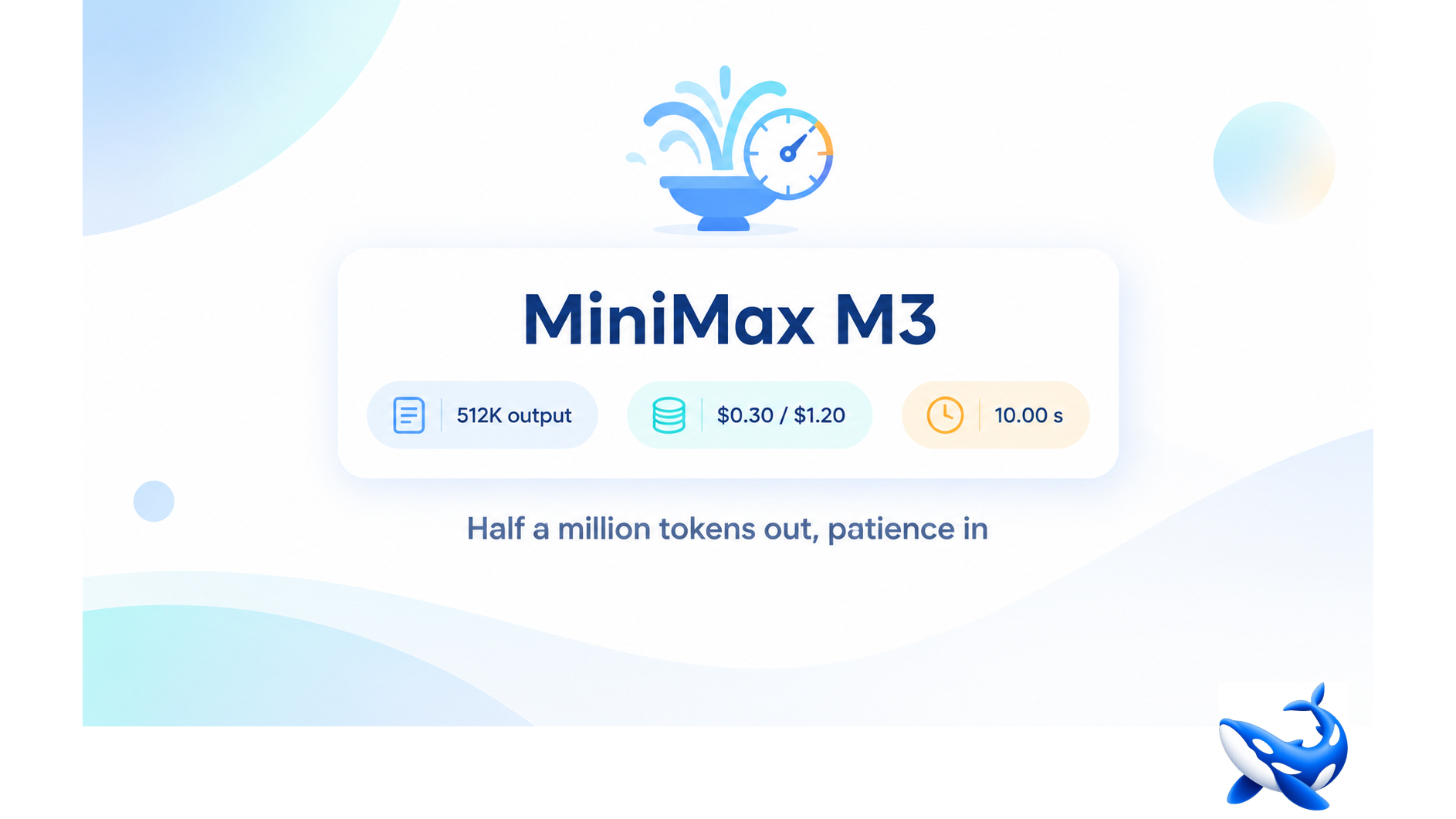
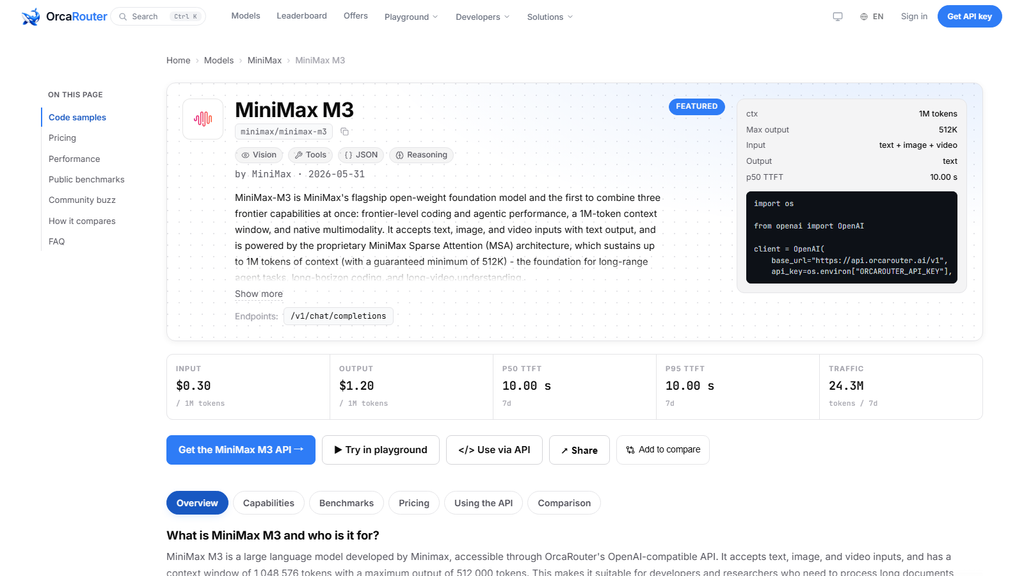
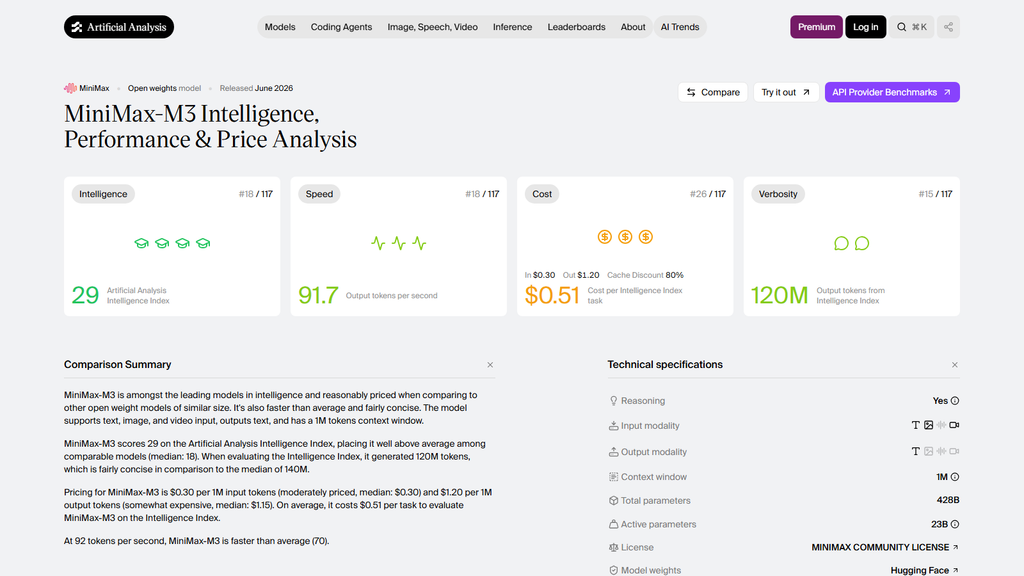
On OrcaRouter we host the MiniMax M3 model — MiniMax’s general-purpose flagship, shipped on May 31, 2026, priced at $0.30 per million input tokens and $1.20 per million output, with a 1M-token context window and a 512K maximum output — among the largest output ceilings of any model we serve. Artificial Analysis scores it 29 at 91.7 tokens per second and $0.51 per task. In production its p50 time-to-first-token is 10.00 seconds, the slowest of any card on the linked platform. It is carried at list price on the same key as every other MiniMax model, with the live telemetry on the linked page.
A card that can generate half a million tokens in one pass while making you wait ten seconds for the first one is a card built for the long generation — and this article is about the workloads that trade that way.
What a 512K output ceiling changes
The 512K maximum output is the number that changes what a single request can be. For most models, a long output is a pipeline problem — chunk the generation, reassemble the pieces, handle the seams. MiniMax M3 accepts the whole job in one call: a book-length draft, a full codebase’s worth of generated files, a year of documentation, an entire corpus transform — anything that fits in 512,000 output tokens comes back in one pass, with one request ID and one bill. That is the headline capability, and it is the reason a team picks this card over cheaper and faster ones.
The honest pairing is the price of that capability: $0.30 / $1.20 is a mid-fleet rate for the input side and a bargain for the output side when the output is large. A 200,000-token generation — beyond the ceiling of most cards — costs $240 at list output price on M3, a sum that only exists because the card is willing to produce the tokens at all. The ceiling is the product; the rate is the value of the product.
The long-generation card on the board
| model | context | max output | input / output | AA index | output speed | per-task cost | p50 TTFT |
| MiniMax M3 | 1M | 512K | $0.30 / $1.20 | 29 | 91.7 tok/s | $0.51 | 10.00 s |
| Qwen3.7 Max | 1M | 64K | $1.25 / $3.75 | 29 | 199.8 tok/s | $1.15 | 1.27 s |
| Kimi K3 | 1M | not listed | $3 / $15 | 44 (max) | 41.7 tok/s | $2.00 | 8.38 s |
Context windows, output ceilings and rate cards are what the vendors list; the index scores, output speeds and per-task costs are Artificial Analysis’ live readings; the TTFT column is production telemetry from the linked pages. The table lays the trade bare: M3 costs four times less per task than the Kimi flagship and a fifth of the price per token of the fast premium card, in exchange for a first token four-to-eight times slower. Every row in the table is a different bet on where the time should go — M3 bets it all on the size and cost of the finished generation.
The ten-second wait, honestly
The p50 first token of 10.00 seconds is the slowest on the linked platform, and this article will not dress it up: for interactive use, it is disqualifying. No chat, no customer-facing agent, no request-response loop should sit behind a ten-second silence before the first token arrives — that is the wait that reads as broken. The number is real production telemetry, measured on the real endpoint, and anyone who plans interactive workloads on M3 should plan to be disappointed.
But the wait is the honest mirror of the capability. A model that spends its compute clearing a path to a half-million-token output does not answer in a second — the first token is the moment the whole pipeline commits. For batch and pipeline workloads the wait is amortized across the job: a queue submits, waits once, and then spends an hour watching a single continuous generation that no other card in the table could have produced in one pass. That is the trade M3 is built on, and it is worth taking for exactly one reason.
The single-pass workload
The workloads that fit M3 are the ones where the output ceiling is the point. Whole-codebase code generation, book and report drafting, long-form document assembly, corpus-scale transformations — each is a job that other cards must chunk, seam and reassemble, and each becomes a single request on M3. The 91.7 tokens per second output speed means that 512K ceiling is not theoretical: a full-length generation completes in under two hours of continuous streaming, and the $0.30 / $1.20 rate keeps the bill smaller than a chunked pipeline’s orchestration overhead alone.
The 36.0 million weekly tokens on the linked page show the market running exactly this shape of work, and the recommendation follows the shape: if the job fits in one long generation, M3 is the cheapest single-pass tool on the board; if the job is interactive or chat-shaped, the ten-second first token is the honest reason to look elsewhere. The linked page shows both the capability and the wait, and the article’s rule is simply to match the workload to the meter.
One more number deserves a check before the verdict, because it is easy to read the wrong way: the $0.51 per-task cost. That figure is Artificial Analysis’ standard-task reading, and standard tasks are short — a typical task on the board is a few hundred tokens out, a fraction of M3’s ceiling. It means the per-task cost understates the card’s economics for its own shape of work; a 200,000-token generation, the kind of job only this card can do in one pass, costs $240 on the output side, and there is no cheaper way to get that output as a single request. The honest comparison is not M3 versus the fast card on standard tasks — the fast card wins that trivially. It is M3’s $240 single-pass bill versus a chunked pipeline’s orchestration, seam-handling and reassembly cost on the same output, and on that comparison the long card is the one built for the job. Standard-task pricing is a useful yardstick for a fleet; it is not the right ruler for a card whose entire product is non-standard length.
The takeaway
MiniMax M3 is MiniMax’s general-purpose flagship: $0.30 / $1.20, a 1M context window, a 512K maximum output that is among the largest in this fleet, and an independent score of 29 at 91.7 tokens per second and $0.51 per task. Its p50 first token of 10.00 seconds — the slowest on the linked platform — is real production telemetry and disqualifying for interactive work. It is a single-pass machine: book-length outputs in one request, at a rate that makes the long generation cheaper than chunking it. If the workload is a long output, this is the card — live at list price, with the telemetry on the linked page.