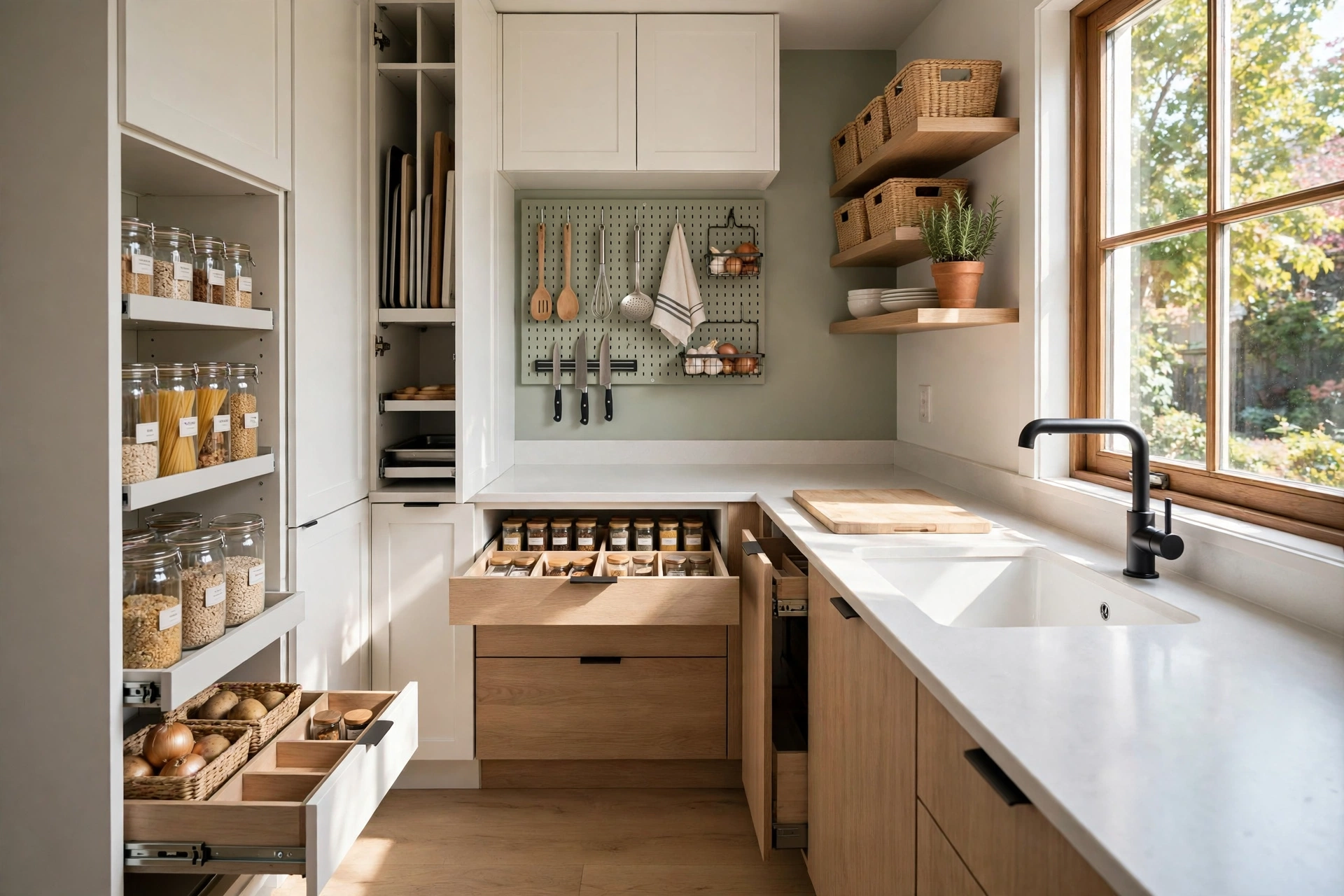
In a small kitchen, countertop space is the scarcest resource in the room. Every appliance left out and every utensil crock shrinks the patch of worktop where you chop, mix, and plate food. A good remodel does not ask you to choose between storage and workspace. It moves storage into places the counter never used.
The short answer: The short answer: the best small kitchen remodeling features for storage without losing countertop workspace are full-extension drawer bases, an appliance garage, narrow pull-outs for filler gaps, toe-kick drawers, and ceiling-height wall cabinets. Together they move counter clutter into cabinet interiors, so the worktop stays free for cooking.
Start With a Counter Audit Before You Order a Single Cabinet
Before choosing features, notice what actually sits on your counter. Most small kitchens hold the same repeat offenders: a coffee maker, a toaster, a knife block, a utensil crock, and cooking oils. Sort them into three groups. Daily-use items deserve a dedicated home close at hand, not a permanent spot on the worktop. Weekly items, like the blender or stand mixer, belong in a drawer base or an appliance garage. Rarely used gadgets belong in the highest cabinets or another room entirely.
This audit decides which features are worth paying for. A household that never bakes does not need a mixer lift, while a household that cooks nightly needs deep drawers and a spice pull-out far more than another open shelf. The kitchens that feel biggest after a remodel are the ones where every item has a place that is not the counter.
Deep Drawers That Swallow Pots Without Stealing a Single Inch of Counter
The most effective storage upgrade in a small kitchen is replacing deep lower cabinets with full-extension drawer bases. A standard base cabinet hides its back half: pots migrate to the rear and lids vanish. A drawer rolls its entire contents out to you, so nothing hides.
Plan drawer depths around what you own. Deep drawers suit pots, pans, and mixing bowls; shallow top drawers suit cutlery, wraps, and cooking tools. A drawer-in-drawer insert, a shallow tray riding inside a deeper drawer, gives one drawer two jobs, and a lid rack inside a drawer keeps pot lids vertical instead of rattling under their pans.
Drawer bases cost more than plain cabinets with doors, because full-extension slides and heavier drawer boxes are pricier hardware. Converting a run of base cabinets to drawers typically adds a few hundred dollars per cabinet as an estimate, but it is the upgrade homeowners use every single day, which makes it the best value in this article.
The Appliance Garage: Hiding the Toaster, Blender, and Coffee Maker Behind a Door
An appliance garage is a countertop-height cabinet, usually in a corner or at the end of a run, with a door that closes over the small appliances parked inside. The appliances stay plugged in and ready, but they stop occupying the open worktop.
Door style matters in a tight kitchen. A tambour, or roll-up, door disappears into the cabinet and never swings into your workspace, but it can be fiddly to repair. A lift-up door stays open above head height while you work. A pocket door slides back into the cabinet sides and vanishes, but it needs precise installation and costs more. Measure the tallest item, usually a stand mixer or blender, plus a couple of inches of clearance, and confirm the outlet sits inside the cabinet so cords never trail across the counter.
Where an Appliance Garage Earns Its Keep, and Where It Wastes a Corner
An appliance garage earns its keep beside the fridge or at the end of a run, where it holds two or three daily appliances without breaking the main prep stretch between sink and stove. It wastes space when it lands in the middle of your best prep counter, because the cabinet itself then eats the worktop it was meant to protect. Put the garage where you stand least, and keep the sink-to-stove stretch open.
Narrow Pull-Outs for the Gaps Your Cabinets Ignore
Almost every small kitchen has a filler gap: the 3-inch strip beside the stove or the 6-inch sliver next to the fridge. A narrow pull-out turns that dead strip into one of the most useful spots in the room. A 3-inch pull-out beside the range holds spice jars in two visible rows, a 6-inch pull-out beside the fridge holds oils and tall bottles upright, and a tall, narrow pull-out pantry fits a surprising amount of canned goods into a footprint barely wider than a cutting board.
Measure twice before ordering one. Contents must be shorter than the pull-out is deep or jars will tip when you slide it shut, and a tall pantry pull-out loaded with cans is heavy, so specify full-extension, soft-close slides rated for the load rather than the cheapest hardware on offer.
Toe-Kick Drawers: Flat Storage Under Your Feet
The recessed strip at the bottom of your base cabinets, the toe-kick, is dead space in almost every kitchen. A toe-kick drawer converts it into a shallow drawer about 3 to 4 inches tall, ideal for flat items that otherwise pile up on the counter: baking sheets, cutting boards, placemats, and large platters.
Toe-kick drawers are cheapest when ordered with new cabinets, since the drawer is built into the cabinet box. Retrofitting them means a carpenter must cut the kick panel and fit slides, which adds labour cost. Published estimates for a professionally fitted toe-kick drawer generally run a few hundred dollars per drawer. Reserve them for occasional-use items: bending to floor level every day gets old fast, so baking sheets and holiday platters are perfect, while daily tools are not.
Corners That Finally Earn Their Keep
Corner cabinets are where small-kitchen storage goes to disappear. A blind corner with fixed shelves holds a great deal, but reaching the back means crouching and groping. Three pieces of hardware fix this:
Lazy Susan turntables: round shelves that spin everything to the front. Best for spices, cans, and small bowls.
Blind-corner pull-outs: a shelf system that swings the back shelves out to you. Best for pots and heavier cookware.
Corner drawers: drawers shaped to the corner that pull straight out, with no dead zone. Best when ordering new cabinets.
Going Up: Ceiling-Height Cabinets and the Shelf Above the Door
Small kitchens waste the top foot of wall more than any other space. Cabinets that stop a foot short of the ceiling leave a dust-collecting ledge that stores nothing. Running wall cabinets to the ceiling adds a full row of storage for rarely used items such as holiday serving dishes and the big stockpot.
One caution: do not replace too many wall cabinets with open shelving in the name of airiness. Open shelves look spacious in photographs, but they often reduce usable storage, since only neatly stacked items can live there and everything is exposed to grease. Keep closed cabinets for the bulk of storage.
The Under-Sink Cabinet, Rebuilt Around the Pipes
The cabinet under the sink is the most awkward storage in the kitchen, because the drain trap and supply lines cut right through it. A remodel can do better with hardware designed around the pipes: a U-shaped pull-out tray that wraps around the trap, a door-mounted caddy for sponges and dish soap, and a small pull-out bin for recycling beside the main trash drawer.
Measure around the trap and the garbage disposal before ordering anything for this cabinet. The most common under-sink mistake is buying a standard organizer that collides with the pipes and refuses to slide shut.
Which Storage Feature Pays Off Most in a Small Kitchen
Not every feature suits every kitchen. The table below compares the main options on what they store, what they cost in rough terms, and how much counter space they protect.
Costs here are broad estimates drawn from published remodeler and retailer guidance, and they vary by region and cabinet brand. Get a local quote before budgeting.
What These Storage Upgrades Tend to Cost, in Rough Terms
Spend in this order if the budget is tight. First, drawer bases and inserts, because they change daily life the most for the least money. Second, an appliance garage or a narrow pull-out, because they directly clear the counter. Third, toe-kick drawers and ceiling-height cabinets, because they add capacity without changing how you cook. A storage-focused refresh fitted into existing cabinets generally lands in the low thousands of dollars, while a fuller remodel with new cabinets runs far higher.
Ask your cabinet supplier to price each feature separately rather than accepting a single lump sum. Itemised pricing lets you drop the lowest-value feature without redesigning the whole kitchen. Save cosmetic upgrades, such as new door fronts, for last: a beautiful kitchen that still has no place for the blender will clutter up again within a week.
Storage Remodel Slip-Ups That Leave a Small Kitchen More Cramped Than Before
The most common slip-up is adding storage that blocks the work. An appliance garage planted in the middle of the best prep stretch, a tall pantry that swallows the only landing space beside the stove, or a bulky island in a kitchen too narrow for one all trade counter space for cabinet space, which is the wrong trade in a small room. Keep one uninterrupted stretch of counter, ideally 24 to 36 inches, between the sink and the stove.
The second slip-up is ordering hardware before measuring. Pull-outs that collide with pipes, drawers that hit the dishwasher door, and toe-kick drawers blocked by a floor vent all come from skipping a careful measure. Sketch the kitchen, mark every pipe, vent, and outlet, and check each new feature against it. The third slip-up is overfilling the new storage: fresh drawers invite fresh clutter, so pair the remodel with a clear-out of duplicates and anything unused for a year.
When a Small Kitchen Storage Job Belongs With a Cabinet Maker or a Contractor
Many storage features are straightforward do-it-yourself work: drawer dividers, door-mounted racks, and pull-out trays that fit an existing cabinet need little more than a drill and a tape measure. Others deserve a professional. Call a cabinet maker or contractor when the work involves cutting into cabinet boxes, fitting toe-kick drawers, or installing a pocket-door appliance garage.
For anything involving new electrical outlets inside a cabinet, moving plumbing, or adding a gas line, use a licensed electrician or plumber: kitchens combine water and electricity, and mistakes there are expensive and dangerous. In homes built before the late 1970s, check for lead paint and asbestos before sanding, cutting, or demolishing painted or suspect surfaces.
Small Kitchen Storage Remodel Questions Homeowners Ask Before Ordering Cabinets
Can I add these storage features without replacing my cabinets?
Yes, most of them. Drawer conversions, pull-out shelves, door-mounted racks, countertop appliance garages, and under-sink trays all retrofit into existing cabinetry.
Will an appliance garage make my kitchen look smaller?
No, if it is placed well. A garage at the end of a run or beside the fridge reads as part of the cabinetry, and by hiding appliances it makes the kitchen look tidier. It only shrinks the room visually when it breaks up the main prep run.
Are deep drawers really better than cabinets with doors?
For lower cabinets, yes, in most small kitchens. Drawers bring the whole contents to you, so you stop losing items at the back of a deep cabinet. Doors still suit tall pantries and the sink cabinet.
How much counter space should I protect during a remodel?
Protect at least one uninterrupted stretch of 24 to 36 inches between the sink and the stove for prep.
Do toe-kick drawers hold up to daily use?
They hold up well for light, flat items such as baking sheets and platters on quality slides. They are not suited to heavy items like cast iron.
Should I choose open shelving or closed cabinets for a small kitchen?
Choose closed cabinets for the bulk of storage. Open shelving suits a short run of everyday dishes or cookbooks, but it reduces usable storage and exposes everything to grease.
A Small Kitchen That Stores More and Still Leaves Room to Cook
A small kitchen remodel succeeds when the counter stays clear without a daily battle. Drawer bases, an appliance garage, narrow pull-outs, toe-kick drawers, and ceiling-height cabinets together move storage off the worktop and into the structure of the room. Start with the counter audit.