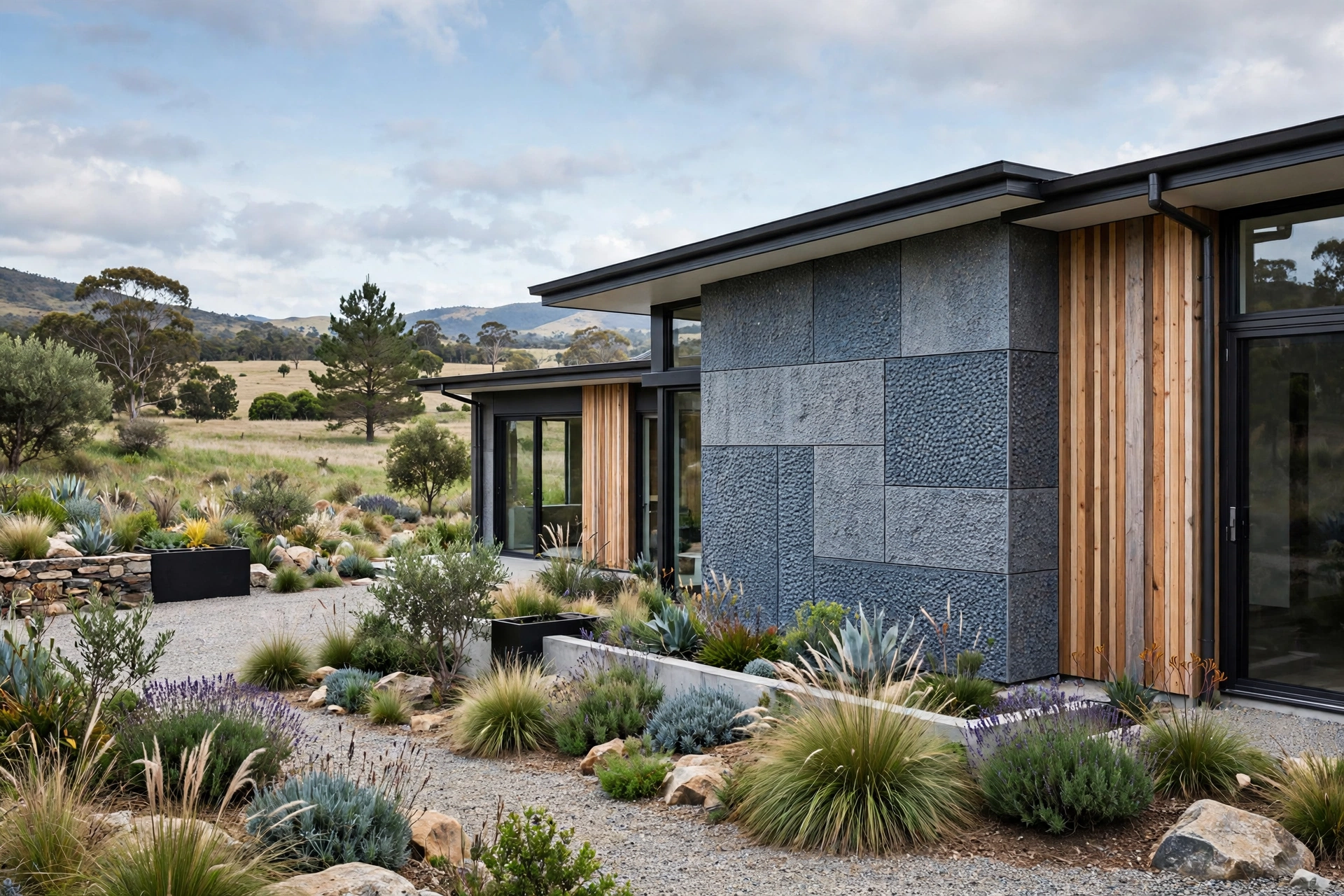
A plain painted wall rarely does a contemporary home justice. Add texture — a fine sand render, a ribbed fibre-cement panel, a band of stacked stone — and the facade gains depth, shadow and character that flat paint cannot deliver. Texture is what makes a modern exterior look designed rather than merely finished, and it also helps the wall itself stand up to rain, sun and seasonal movement.
The short answer: the best contemporary exterior wall designs pair a decorative texture with a finishing material proven for your climate — textured render or fibre-cement panels for most homes, stone or brick veneer for high-impact zones, and timber or metal cladding where a crisp, linear look matters. Choose the texture for the look, but choose the finish system behind it — primer, base coat, sealant and detailing — for the weather it must survive.
What a Decorative Exterior Finish Actually Has to Survive
Before falling for a sample board, remember what an exterior wall endures every year. Driving rain pushes water into hairline cracks and joints. Summer sun breaks down binders and fades pigments. Freeze-thaw cycles expand trapped moisture and split brittle coatings. Wind-blown dust grinds at soft surfaces, and in coastal areas salt settles into every groove. A decorative finish that ignores these forces looks tired within a few seasons, no matter how striking it seemed on day one.
Matching Texture and Finish to Your Climate, Not Just Your Mood Board
Design magazines show the same facades everywhere, but weather does not behave the same everywhere. The finish that thrives in a hot, dry climate can fail in a wet, freezing one. Use local conditions as the first filter, then pick the texture you love from the survivors. Orientation matters too: a south-facing wall takes the hardest ultraviolet punishment and benefits from UV-stable pigments and lighter colours, while a north-facing wall stays damp longer and needs breathable, anti-fungal finishes so moisture can escape rather than feeding mould.
Textured Renders and Stucco: The Sculpted Plaster Look
Render remains the most flexible way to add decorative texture, because the same base material can be finished a dozen ways. A fine sand finish gives a soft, matte wall that suits minimalist architecture. A dash or pebble-dash finish throws bolder shadows and hides imperfect blockwork completely. A scraped or combed texture adds fine linear rhythm, while smooth stucco reads as pure and architectural, letting the building’s form do the talking.
Stone, Brick and Slate Effects Without Full Masonry Weight
Nothing grounds a contemporary facade like stone, but full-depth masonry is heavy, slow and expensive. Stone veneer — thin slices of natural stone or manufactured concrete cast from real stone moulds — delivers the same rugged texture at a fraction of the weight and cost, fixed to a framed or block wall with adhesive and mechanical fixings. Manufactured stone has become remarkably convincing, with varied colour, depth and edge profiles that avoid the repeating-pattern giveaway of early faux stone.
Timber, Metal and Fibre-Cement Panels for a Crisp Contemporary Profile
Where render and stone feel organic, panel systems feel precise, and that precision is exactly what many contemporary designs want. Vertical timber battens, spaced with narrow shadow gaps, make a facade look taller and more structured; cedar and thermally modified timber weather to silver-grey if left untreated, or hold a rich tone with regular oiling. The trade-off is maintenance: timber needs recoating every few years and must be kept clear of ground contact and persistent damp, or it will rot from the bottom up.
The Layered Look: Combining Two or Three Textures Without Clutter
The most admired contemporary facades rarely use a single material across the whole house. A typical winning combination is pale textured render for the main volume, a stone veneer base that anchors the building to the ground, and a timber or metal accent around the entrance or upper storey. The layering works because each texture has a job and a territory: heavy materials low, light materials high, warm materials near the entrance where people touch them, crisp materials on the planes seen from the street.
From Bare Wall to Finished Facade: The Sequence That Keeps Texture Intact
Most premature facade failures trace back to sequence, not material. Whether you are rendering, cladding or veneering, the order below protects the finish from the moisture and movement that destroy it.
Inspect and repair the substrate: fill cracks, replace damaged blocks, and check the wall is plumb, dry and free of loose paint.
Detail water out first: fit flashings, drip edges, window sills with a proper overhang, and a damp-proof course at ground level.
Install the weather-resistant barrier or base coat, with mesh reinforcement at corners, openings and material changes.
Fix battens, rails or adhesive beds precisely, keeping cladding clear of the ground and ventilated behind rainscreen panels.
Apply the texture or fix the panels in consistent conditions — avoid frost, heavy rain or blazing sun, which spoil the cure.
Seal joints with compatible flexible sealant, then apply any water repellent or topcoat only after full curing.
Walk the finished facade in raking light and rain, and fix defects while scaffolding is still up.
Comparing Decorative Finishes Side by Side
Costs and lifespans vary widely by region and installer, so treat the figures below as broad planning estimates, not quotes. Material-only prices sit at the lower end of each range; installed prices, which include labour, battens, fixings and finishing, sit higher, and complex detailing or scaffolding can push any project beyond these bands.
Texture Slip-Ups That Age a New Facade Fast
Most disappointing facades fail in predictable ways. Skipping the base coat mesh is the classic one: render applied straight over blockwork cracks along every joint within a year or two. Trapping moisture is another — sealing a wall with an impermeable coating over damp masonry forces water out through the weakest point, blistering paint and blowing render off in sheets. Confirm that your finish system is vapour-permeable enough for your wall construction, or that a ventilated cavity sits behind impermeable cladding.
What a Textured Exterior Costs, and Where the Money Actually Goes
Homeowners are often surprised that the decorative finish itself is only part of the bill. On a typical recladding or re-rendering project, scaffolding and access can account for a fifth or more of the total, substrate repair and preparation for another significant share, and the finish material and its application for the rest.
Keeping a Textured Facade Looking New Through the Seasons
Textured walls reward light, regular care and punish neglect, because dirt and algae settle into grooves that smooth walls shed. A gentle annual wash with a soft brush and low-pressure water keeps most finishes bright; avoid high-pressure washing on render and timber, which strips coatings and drives water into joints. Keep gutters flowing and trim plants that trap moisture against the surface.
- Spring: wash the facade, check for winter cracks, and clear debris from the wall base.
- Summer: inspect sealant joints and recoat timber before the hottest weeks, when coatings cure badly.
- Autumn: clean gutters, check flashings and drip edges, and treat algae or moss before winter damp sets in.
When a Facade Job Belongs With a Specialist, Not a Weekend Crew
Many decorative finishes are genuinely DIY-friendly at small scale — painting a garden wall, oiling timber battens, or re-rendering a low, sheltered panel. A full facade is a different proposition. Working at height, tying cladding into roof and window details, and guaranteeing a weather-tight system all demand experience, and mistakes made two storeys up are expensive to revisit. If your project involves scaffolding, structural fixings, changes to insulation or the wall build-up, or work near power lines, hire a specialist facade or cladding contractor and ask to see comparable completed projects.
Exterior Wall Texture Questions Homeowners Ask Before Ordering Samples
Which decorative texture lasts longest on an exposed exterior wall?
Stone veneer, brick slips and fibre-cement panels generally outlast softer finishes, often serving fifty years or more with modest maintenance, because they resist impact, fire and moisture. High-quality silicone render also performs well, typically lasting twenty years or more before recoating, provided the base coat and detailing were done correctly. Timber looks wonderful but demands the most upkeep, so its lifespan depends almost entirely on how faithfully it is recoated and kept dry.
Does a textured finish really protect the wall, or is it only decorative?
It does both, but the protection comes from the system, not the texture alone. A textured render hides minor cracks and adds a weather-resistant skin, while a ventilated cladding system adds a drainage cavity that keeps the structural wall dry. Texture without proper priming, sealing and joint detailing is decoration only, and in wet climates it can even trap moisture, so judge any product by its full system specification, not its surface pattern.
Can I apply a decorative texture over my existing painted or rendered wall?
Often yes, but only after preparation. Sound, well-bonded existing render can usually be over-coated with a compatible new render or clad over with battens, while flaking paint, hollow render or active damp must be stripped and repaired first. A compatibility check matters: some new coatings will not bond to old silicone or oil-based paints, and adding a heavy veneer to a weak substrate can overload fixings, so get the wall assessed before committing.
How do I choose a texture that will not date quickly?
Favour textures with a quiet, natural character — fine sand render, restrained stone, simple vertical battens — over bold geometric patterns tied to a single trend cycle. Neutral, nature-derived colours age far better than fashionable brights, and a facade that relies on proportion and material quality rather than novelty tends to look deliberate for decades. If you love a bold pattern, confine it to one accent wall so the rest of the house can carry it gracefully.
Will a textured exterior increase my home’s value?
A well-executed, well-maintained facade generally improves kerb appeal and can support a stronger sale price, because buyers read it as evidence of a cared-for home. The uplift is hard to quantify and depends on your market, the quality of the work and whether the style suits the neighbourhood. A mismatched or poorly installed finish can have the opposite effect, so spend on detailing and workmanship first and treat resale value as a bonus, not a guarantee.
How much maintenance does a textured facade actually need?
Most systems need an annual wash and a visual check of joints and sealants, plus recoating on a cycle that depends on material: timber every two to five years, painted fibre-cement every ten to fifteen, limewash every five to ten, and stone or brick largely left alone beyond cleaning and occasional repointing. The cheapest finish to buy is rarely the cheapest to own, so compare lifetime maintenance, not just installation cost, when choosing.
A Facade That Still Looks Deliberate in Ten Years
The contemporary exteriors that age best share one trait: every texture on them was chosen for a reason beyond novelty. A stone base because the ground floor takes knocks and splashback. A fine render because the architecture is about form, not ornament. Timber battens because the entrance deserves warmth. Metal panels because the upper storey needs crisp, maintenance-free lines. When each material earns its place, the facade reads as coherent rather than decorated, and coherence is what survives changing trends.
Start with your climate and your wall, shortlist two or three finishes that genuinely suit both, and test large samples on the real wall in real light. Price the whole system, not just the sample you fell for. Do that, and the texture you choose today will still be doing its two jobs a decade from now: making the house look considered, and keeping the weather exactly where it belongs — outside.