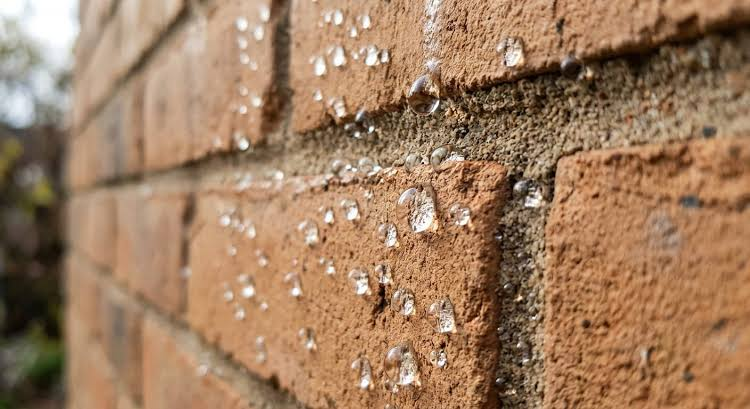
A brick wall can look perfectly solid and still drink rainwater like a sponge. Every brick, stone block and mortar joint contains tiny capillaries, and wind-driven rain is pulled into them by capillary action. Over time that water causes penetrating damp, frost damage, salt staining and heat loss. Modern hydrophobic exterior wall treatments tackle this problem at its source: they line the pores with a water-repelling chemistry, so rainwater beads up and rolls off while water vapour still escapes.
The short answer is that a good hydrophobic treatment cuts rainwater absorption by a very large margin without sealing the wall shut. Silane and siloxane impregnation and modern masonry creams penetrate a few millimetres into porous brick, stone, render and concrete, with independent tests showing absorption reductions of around 90 percent or more. The wall keeps its appearance, stays breathable and dries out naturally after wet weather. This article explains which treatments suit which masonry, how to test your wall, how to apply a treatment, and where these products reach their limits.
Why Porous Masonry Soaks Up Rainwater
Masonry is porous by nature. Fired clay bricks, natural stone, concrete blocks, lime render and cement mortar all contain microscopic voids left behind when water evaporated during manufacture or curing. Softer materials absorb far more water: a soft handmade brick or limestone block can take up several times more water than a dense engineering brick. Painted masonry is not exempt: standard acrylic paints absorb moisture, and hairline cracks give rain a direct route in.
Wind makes it worse: wind-driven rain is pushed against the wall, forcing water deeper into the pores. Once inside, three kinds of damage follow. In cold weather the water freezes, expands by about nine percent, and prises off brick and render faces, called spalling. Dissolved salts crystallise near the surface as white efflorescence, and a saturated wall conducts heat far better than a dry one, so the home loses warmth.
- Soft, handmade or under-fired bricks absorb the most water.
- South-west and west-facing walls usually take the worst wind-driven rain.
How Hydrophobic Treatments Line Masonry Pores Without Sealing Them
A hydrophobic treatment is not a waterproof coating in the ordinary sense and forms no film on the surface. Instead, the active ingredient, usually a silane or siloxane compound, is carried into the capillaries and bonds to the mineral surfaces. Water droplets then sit at a steep contact angle instead of being drawn inward, so rain beads off while the pores stay open.
That open-pore structure is the whole point. A sealed wall would trap moisture entering from other routes, such as a leaking gutter or rising damp, with nowhere to go. A hydrophobic impregnation lets water vapour diffuse outwards almost as freely as untreated masonry, with an Sd value of around 0.01 to 0.03 metres, comparable to limewash. The wall therefore dries after rain, which suits solid-walled and heritage buildings.
Silane, Siloxane and Masonry Cream Treatments Compared
Most modern hydrophobic treatments belong to one of three families, and the differences matter more than the brand name. Silane liquids are small molecules that penetrate deepest, suiting engineering brick and dense concrete. Siloxane products are larger molecules that suit open, porous substrates such as soft brick, stone and render. Masonry creams are thick emulsions that sit on the surface longer, so one cream coat can replace two liquid coats on very absorbent walls.
| Treatment family | Best suited masonry | Typical penetration | Application |
| Silane liquid | Dense brick, dense concrete | Deepest | Spray or brush, two coats |
| Siloxane liquid | Soft brick, stone, render | A few millimetres | Spray, brush or roller |
| Silane/siloxane cream | Very porous brick, render | Deep, slow release | Brush or roller, one coat |
| Super-hydrophobic paint | Painted or rendered walls | Surface film, pore lining | Brush or roller, two coats |
| Nano-technology coating | Brick, stone, concrete | Nano-scale pore lining | Spray or roller, one or two coats |
Super-hydrophobic masonry paints add a colored finish as well as water repellent, suiting walls that need both protection and a new appearance, while a clear cream or liquid suits brick or stone that should stay visible. Whatever the family, check the data sheet for absorption reduction, Sd value and service life, and buy from a maker that publishes independent test results.
Reading Your Wall Before Choosing a Hydrophobic Treatment
A hydrophobic treatment only works when the wall is sound, absorbent and dry enough to take it in. Start with a water-drop test: flick water onto the wall on a dry day. If it soaks in within a minute or two and darkens the masonry, the wall is absorbent. If the water already beads, the wall may be sealed or coated, and a new treatment will have nothing to bond to. Walk the whole elevation for problems a treatment cannot fix: cracked pointing, spalled brick faces, detached render and leaking gutters need repair first.
It is equally important to identify what kind of damp you have. A hydrophobic treatment stops penetrating damp from wind-driven rain. It does nothing for rising damp, condensation from poor ventilation, or water leaking from a pipe or gutter. If the wall is damp at low level only, or the damp appears in winter with black mould in corners, the cause is probably rising damp or condensation, and treating the outside will waste money and delay the real repair. A damp surveyor can confirm the diagnosis first.
- Test absorption on several spots; one wall can vary a great deal.
Applying a Hydrophobic Treatment to Exterior Masonry Walls
Application is straightforward for a careful DIYer, but the details decide whether the treatment lasts ten years or two. Choose a dry, mild spell: the wall must be dry, the temperature above about five degrees Celsius, and no rain forecast for 24 hours, because rain washing the treatment off before it cures is the commonest cause of failure. Clean the wall with a stiff brush and a biocide wash, then rinse and let it dry for several days. Mask windows, doors and glass, and wear gloves and eye protection, because solvent-borne products are flammable and irritating.
Brush down the wall, remove dust, loose mortar, moss and algae, then let it dry.
Apply the first coat from the bottom upward with a brush, roller or sprayer, keeping the surface wet.
On very porous walls, apply the second coat while the first is still damp, or after the stated interval.
Work in manageable sections and keep a wet edge, so you leave no dry patches that show later as uneven repellency. With liquids, the wall should look uniformly damp; with creams, the white film disappears as the active ingredient soaks in. Do not apply in direct hot sun, which dries the carrier before the active ingredient penetrates, and never apply to a wall still wet from cleaning. Two people, one applying and one checking coverage, avoid missed strips.
Hydrophobic Treatments and Heritage Brickwork: What Changes
Older solid-walled buildings are where hydrophobic treatments earn their reputation, and also where they demand the most care. Traditional brick, stone and lime-render walls were designed to absorb a little rain and dry out again, and a breathable impregnation supports that cycle. That is why conservation officers often accept clear silane or siloxane treatments on listed buildings. Even so, never treat a listed building without checking with the local planning authority first, because some treatments count as an alteration needing consent.
Heritage walls need more preparation. Lime mortar joints are softer than cement and must be repointed in matching lime mortar first. Salt-contaminated brickwork should dry and be brushed free of efflorescence, since treatment over heavy salt deposits underperforms. On very soft or friable brick, test a patch and check after a few weeks that the surface is not shedding, and choose a cream or siloxane product for open-textured masonry.
How Long Hydrophobic Masonry Treatments Last and What Wears Them Out
Service life varies with product, substrate and exposure, but honest figures cluster in a useful range. Good silane and siloxane impregnations typically protect for ten years or more on a sheltered wall, and several makers offer ten- or twenty-five-year guarantees on masonry creams. Harsh exposure shortens that life: a south-west facing wall in a wet, windy climate works harder than a sheltered north wall, and copings wear faster than vertical faces because water sits on them longer.
| Factor | Effect on service life | What to do |
| Wind-driven rain | Shortens life on exposed elevations | Use cream or two liquid coats |
| UV and weathering | Slow surface erosion | Re-test beading every two to three years |
| Freeze-thaw cycles | Attacks untreated patches first | Keep coverage even, repair spalls early |
| Pollution and dirt | Masks repellency over time | Wash the wall gently when soiled |
The simplest maintenance check is the water-drop test repeated every two or three years: if water still beads and runs off, the treatment is working. If water starts soaking in again on one elevation, re-treat that elevation rather than the whole house. Re-treatment is easy because the old treatment needs no stripping; the new coat refreshes the pore lining. Note the product name, date and coats, so the next re-treatment uses a compatible product.
Hydrophobic Treatment Limits That Homeowners Often Miss
The most expensive mistake is expecting hydrophobic treatments to cure damp they were never designed to fix. They do not stop rising damp, fix a leaking roof or gutter, cure condensation, or rescue a wall whose render has detached or whose bricks have spalled badly. A treatment over a leaking downpipe joint keeps the surface dry for a few weeks while water pours in behind it, and the eventual damage is worse for the delay. Fix the source of the water first, then treat the wall.
There are practical limits too. Treatments cannot penetrate paint, bitumen or silicone sealant, so any existing coating must be compatible or removed. They struggle on dense, glazed or engineering brick, where little pore structure carries the active ingredient in. And they are no substitute for good detailing: a wall without a drip edge, with a failed cavity tray or with ground level built up against the brickwork still gets wet. If the wall shows structural cracking, bulging or widespread spalling, or the damp is severe and the cause unclear, bring in a surveyor or damp specialist first.
- Never treat a wall to hide damp while a leak, gutter fault or rising damp is active.
- Keep solvent-borne products away from flames and ventilate the area well.
- Wear gloves, eye protection and a mask when spraying, and keep children and pets away.
Hydrophobic Masonry Treatment Questions Homeowners Ask Most
Will a hydrophobic treatment change the colour of my brickwork?
A good clear treatment should be invisible once cured and not darken the masonry. Some cause slight temporary darkening while wet, which fades as the carrier evaporates. Coloured super-hydrophobic paints obviously change the appearance, so choose those only when a new finish is wanted, and test a patch first.
Can I paint over a wall treated with a hydrophobic product?
Usually not with ordinary masonry paint, because the water-repellent surface stops paint bonding properly. If a painted finish is planned later, treat after painting with a compatible product, or choose a treatment the paint maker confirms as a suitable primer base.
Does a hydrophobic treatment stop condensation inside the house?
No. Condensation is caused by warm, moist indoor air meeting a cold surface, and it is fixed by ventilation, heating and insulation, not by treating the outside wall.
How soon after treatment can rain fall on the wall?
Most products need at least 24 hours of dry weather to cure; some creams need longer on very porous masonry. Rain during curing washes the active ingredient out before it bonds, so the area needs re-application. Plan the job around a settled forecast.
Can I apply a hydrophobic treatment myself or should I hire a contractor?
A careful homeowner can treat a single-storey wall with a brush or roller. Hire a contractor for high walls, large elevations, heritage buildings, or any job needing scaffolding or spray equipment, and get the product name and guarantee in writing.
Final Thoughts: Keeping Porous Masonry Dry With Hydrophobic Treatments
A modern hydrophobic treatment is one of the most cost-effective ways to protect a porous masonry wall, provided it is used for the right problem. Diagnose the damp first, repair the wall, choose a silane, siloxane or cream product matched to your brick or stone, and apply it in dry, mild weather. Done that way, the wall keeps its appearance, stays breathable and sheds rain for a decade. The next step is simple: run the water-drop test on your wettest elevation this week, and if the water soaks straight in, your wall is ready for treatment.