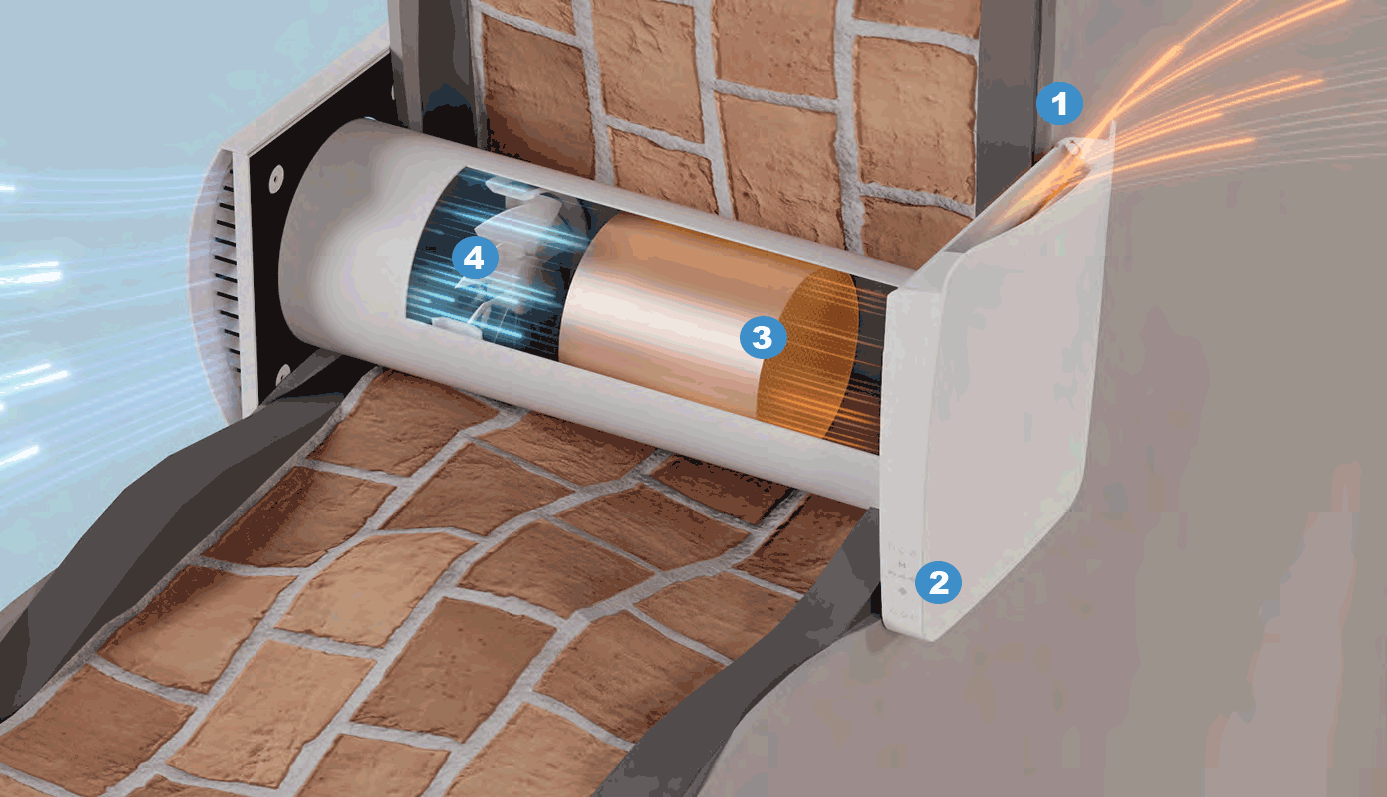
Older homes were built to breathe through gaps and droughts. Once you add insulation, new windows and air tightness measures, that accidental ventilation disappears, and the stale air, moisture and cooking smells stay inside. A decentralized heat recovery ventilation unit solves the problem without tearing the house apart: a compact, wall-mounted device that brings in fresh, filtered air, throws out stale air, and recovers most of the heat.
The short answer is that you fit one small unit per room, usually a bedroom or living room, through a single core-drilled hole in an outside wall. No ductwork is needed, installation takes a few hours per unit, and heat recovery of around 80 percent keeps the fresh air comfortable. This article explains how the units work, how to choose and size them, how to install them, and what they cost.
Why Older Homes Struggle With Fresh Air After Air tightness Upgrades
A draughty old house ventilates itself, wastefully. Air leaks in around windows, doors, floorboards and loft hatches, carrying out moisture and indoor pollutants and bringing in cold air that the heating must warm. When a retrofit seals those leaks with insulation, drought-proofing and double glazing, the house becomes warmer and cheaper to heat, but the fresh air supply collapses, and moisture from showers, cooking and breathing has nowhere to go.
The symptoms appear gradually: condensation on windows, musty smells, black mold in corners, and stuffy bedrooms by morning. Mechanical ventilation with heat recovery is the standard answer in new builds, but running ducts through an existing home is disruptive and expensive, which is where decentralized units earn their place.
How a Decentralized Heat Recovery Unit Works in a Single Room
A decentralized unit is a self-contained ventilator on an inside wall, connected outside through one or two small holes. At its heart is a heat exchanger, most often a ceramic regenerative core. The unit runs in alternating cycles of about a minute: first it extracts warm, stale room air, heating the ceramic core, then it reverses and draws in cold fresh air, which picks up the stored heat before entering the room.
That alternating cycle is what makes the device efficient without ducts. Incoming air arrives pre-warmed, typically recovering 70 to 85 percent of the heat that would otherwise be lost, and a filter keeps out dust and pollen. Many units run continuously at low speed and boost automatically when humidity rises, for example after a shower.
Decentralized Versus Central MVHR for Existing Homes
The choice between decentralized and central heat recovery ventilation comes down to ductwork. A central system has one large unit, usually in the loft, connected to every room by ducts. It ventilates the whole house evenly and quietly, but the ducts must be threaded through ceilings, cupboards and floor voids, which in an existing home means lifting floors and redecorating. A decentralized system skips all of that: each room gets its own unit, and the only building work is a core hole in the outside wall.
| Feature | Decentralized units | Central MVHR |
| Ductwork | None needed | Full duct network required |
| Installation | Hours per unit, one wall hole | Days, disruptive, needs design |
| Rooms covered | One room per unit | Whole house |
| Heat recovery | Typically 70-85 percent | Typically 85-95 percent |
| Best for | Retrofits, flats, single rooms | New builds, full renovations |
| Running cost | Very low per unit | Low overall |
Central systems recover slightly more heat and serve the whole house from one set of filters, but for an existing home that is not being gutted, disruption and cost usually rule them out. Decentralized units let you start with the worst rooms, one or two bedrooms for example, and add more later. That staged approach fits a retrofit budget and lets you judge the benefit before committing further.
Choosing Rooms and Unit Sizes for a Decentralized HRV Retrofit
Start with the rooms where people spend the most time and where moisture is worst: bedrooms first, then the living room and home office. Bedrooms matter most because we spend a third of our lives there with the door closed, and carbon dioxide and moisture build up overnight. Bathrooms and kitchens need extraction too, but a heat recovery unit is no substitute for a proper extractor fan above a cooker or shower; the two systems work side by side.
Sizing follows the room, not the house. Manufacturers rate units by airflow, often 30 to 60 cubic metres per hour at normal speed, and a unit should change the room’s air roughly once an hour at its working speed. One unit suits a bedroom or small living room, while a large open-plan space may need two units on opposite walls. Check the noise rating at working speed: a good unit runs at around 25 decibels on low, about as quiet as a whisper, and anything much louder will be switched off at night, defeating the purpose.
- Bedrooms first: stale air and moisture build up fastest where people sleep with doors closed.
- Living rooms and home offices next: long hours spent in one room need steady fresh air.
- Bathrooms and kitchens: keep dedicated extractor fans; HRV units complement them, not replace them.
Retrofitting Decentralized HRV Units Step by Step
A single-room retrofit is a half-day job for a competent installer, and a confident DIYer can do much of it with hired core-drilling equipment. The critical step is position: the unit needs an outside wall, ideally away from the bed head and clear of curtains and furniture, with a power socket nearby. Check the wall construction first, because solid stone, thick brick and timber-framed walls each need a different drilling approach, and always check for pipes and cables before drilling.
Survey the room and mark the unit position on an outside wall, away from bed and furniture.
Check the wall for hidden pipes, cables and lintels, and confirm the thickness suits the unit.
Core-drill one or two holes through the wall, usually 100 to 160 millimetres in diameter.
Mount the indoor unit, connect the duct sleeve and fit the filter and heat exchanger core.
Wire the unit to a fused spur or socket, test all speeds, and set the humidity boost level.
The details decide the result. The external grille must slope slightly outwards so rain runs off, and the hole should be sealed with a flexible sealant. Inside, the unit must sit level so condensation drains correctly, and the filter must be accessible. After installation, run the unit on boost for an hour and check for draughts around the wall penetration, then leave it on automatic and let it settle for a week before judging noise or airflow.
Pairing Units, Controls and Filters for Balanced Ventilation
A single unit improves one room, but a home works better when units are planned as a system. Two units installed as a synchronised pair, one supplying while the other extracts, create balanced ventilation across a floor, with fresh air moving gently from living spaces towards the wetter rooms. Some manufacturers sell paired kits with a wireless link, and pairing is worth it when two rooms sit on opposite sides of the house.
Controls are simple but worth setting properly. Most units offer a low continuous speed, a boost triggered by humidity, and a night mode that drops the fan to its quietest. Set the humidity boost to trigger at around 60 to 65 percent relative humidity so the unit responds to showers and cooking without running at full speed all day. Filters need cleaning every few months and replacing every six to twelve months; a clogged filter quietly strangles airflow and makes the unit noisy.
Running Costs, Noise and Maintenance of Single-Room HRV Units
Running costs are small. A single decentralized unit typically draws 3 to 8 watts on its normal setting, costing only a few pounds or dollars a year in electricity, and the heat it recovers saves far more than it consumes. The real running cost is the filter: budget for one or two replacements per unit per year, and check the manufacturer sells them at a reasonable price before buying. Some units also need an occasional wipe of the heat exchanger core.
| Item | Typical figure | Notes |
| Unit purchase | Broad estimate, a few hundred per unit | Varies by brand |
| Installation per unit | Broad estimate, a few hundred | Core drilling included |
| Electricity use | 3-8 watts at normal speed | A few units per year |
| Filter replacement | Every 6-12 months | Check price before buying |
| Noise at low speed | Around 25 decibels | As quiet as a whisper |
| Heat recovery | 70-85 percent | Ceramic core |
Maintenance is a ten-minute job: remove the cover, wash or replace the filter, wipe the core if the manual allows it, and check the external grille for leaves or insects. Do it at the start of autumn, when the heating season begins, and again in spring. A neglected unit gets louder and less effective, and in a home with allergies a dirty filter can make air quality worse, so put the dates in the calendar when the unit goes in.
Decentralized HRV Retrofit Pitfalls and When to Bring in a Specialist
The commonest pitfall is installing a unit in a leaky house and expecting it to work like a sealed one. Heat recovery ventilation works best when the building is reasonably airtight; if the house still leaks badly, most air bypasses the unit and the benefit shrinks. That does not mean the unit is useless, only that draught-proofing and insulation should come first or alongside. The second pitfall is position: a unit mounted over a bed, behind a curtain or above a radiator will be noisy, blocked or short-circuited.
Bring in a specialist when the job goes beyond a single wall. Listed buildings and conservation areas may need consent for external grilles, and drilling through thick stone or a structural wall needs a contractor with the right equipment. A ventilation designer is worth hiring when several units are planned, to balance the system, match extract and supply, and confirm that bathrooms and kitchens still get the extraction they need. Electrical work should always follow local regulations, and in many regions a qualified electrician must make the final connection.
- Seal the big air leaks first, or the unit’s recovered heat is wasted through bypass droughts.
- Never mount a unit where curtains, furniture or a radiator can block its airflow.
- Check listed-building consent before fitting external grilles on protected properties.
Decentralized Heat Recovery Ventilation Questions From Homeowners
Can I install a decentralized HRV unit myself?
A confident DIYer can install one with hired core-drilling equipment, but the drilling is the hard part, especially through stone or thick brick. Most people hire an installer for the drilling and mounting, then change filters themselves. Electrical connection should follow local rules and may need a qualified electrician.
How many units does a typical house need?
Most homes start with two or three: the main bedroom, a second bedroom or living room, and possibly a home office. One unit per lived-in room is the rule of thumb, with pairs on opposite walls for large open-plan spaces.
Will a decentralized HRV unit make my home colder?
No, it should make it feel warmer and fresher. The heat exchanger recovers most of the heat from outgoing air, so incoming air arrives close to room temperature. The unit replaces cold draughts with controlled, pre-warmed fresh air, which is more comfortable and cheaper to heat.
Do decentralized HRV units stop condensation and mould?
They help a great deal, but they are not a cure on their own. By replacing moist indoor air with drier outdoor air, they lower indoor humidity and reduce condensation. If the home has a leak, rising damp or missing insulation, fix those first, because ventilation cannot dry a wall that water keeps wetting.
How noisy are decentralized HRV units?
A good unit runs at around 25 decibels on its low setting, about as quiet as a whisper, and should not disturb sleep. Noise rises on boost, so check the sound level at working speed before buying, and avoid mounting the unit directly over a bed.
Do I need planning permission for a decentralized HRV retrofit?
Usually not for an ordinary house, since the only external change is a small grille. Listed buildings and conservation areas are the exception: check with the local planning authority before drilling, because the grille can count as an alteration needing consent.
Final Thoughts: Fresh Air Without Ductwork in Existing Homes
A decentralized heat recovery ventilation retrofit is the pragmatic answer to the airtight-home dilemma: fresh, filtered air and most of the heat kept, with no ducts, no redecoration and a half-day installation per room. Start with the bedrooms, choose a quiet unit with affordable filters, seal the worst draughts first, and let the system run continuously. The next step is simple: pick the stuffiest bedroom, check that its outside wall can take a core hole, and get a quote for a single unit. One room will tell you whether the rest of the house should follow.