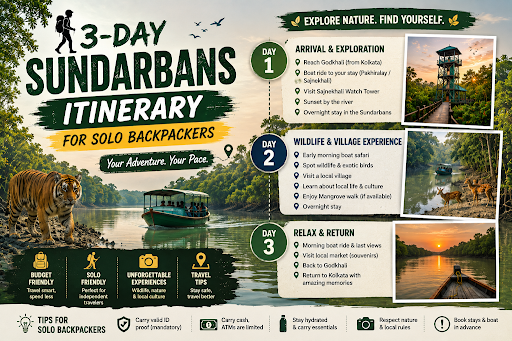
Most “Sundarbans itineraries” you’ll find online are written for families booking a resort-style package—air-conditioned coaches, fixed group tours, and prices quoted for a couple sharing a cabin. That’s not much use if you’re one person, traveling on a backpacker budget, trying to figure out how to actually do this alone without overpaying or ending up somewhere unsafe.
This is a real day-by-day plan, an honest cost breakdown in actual numbers, and a solo-specific safety protocol — not just “be careful.”
Both India (via Kolkata/Canning) and Bangladesh (via Khulna/Mongla) offer access to the Sundarbans, and a solo-budget version of this trip is possible on either side. This itinerary follows the Bangladesh route via Khulna because it’s the larger half of the forest, it’s generally the cheaper side per day for a solo traveler once you’re past the entrance fee, and the multi-day live-aboard boat format suits solo travelers well—you get a bunk, meals, and a built-in small group without having to organize any of it yourself. If you’re coming from Kolkata instead, the same safety logic applies, but your day-by-day structure will look more like short day-safaris than a live-aboard cruise.
Is the Sundarbans Actually Safe to Visit Solo?
Yes, but not independently
Here’s the distinction that matters: traveling solo to the Sundarbans is completely normal and safe. Traveling unguided inside the forest is not possible at all, and not just for safety reasons, it’s illegal. Both Bangladesh and India require a Forest Department permit and a licensed guide/boat to enter the reserve; Bangladesh additionally requires an armed forest guard on board. So “solo” here means you show up alone, not that you wander the mangroves alone. You’ll always be part of a boat crew and a guided group once inside.
The real risks solo travelers face
The dangers aren’t tigers, it’s the logistics around the edges. Unlicensed touts at the Khulna or Mongla jetty targeting a foreigner traveling alone and offering an “unofficial” boat at an inflated price. Getting talked into paying more than a group rate because you’re negotiating solo instead of splitting costs. Wandering off a marked watchtower trail for a better photo. Losing phone signal deep in the mangrove channels and not having told anyone your plan. Misjudging tide timing, which affects when boats can actually move through certain channels. None of these are exotic risks, they’re the same ones that catch out solo travelers everywhere, just with a jungle setting.
How solo travelers actually do it safely?
Two realistic paths: join a small shared-cost group tour (you show up alone, get grouped with other travelers on a live-aboard boat, this is by far the most common way solo backpackers do the Sundarbans) or hire a private licensed guide and boat if you want full control over your schedule and don’t mind paying more per day for it. For a first-time solo visit, joining a shared group tour is the easier, cheaper, and safer default.
Before You Go — Planning Essentials
Permits and documentation
As a foreign national, you need a Forest Department entry permit, which almost every registered tour operator arranges for you as part of the Sundarban Tour Package Price, you generally don’t need to visit the Divisional Forest Office in Khulna yourself. Bring your passport (and a couple of photocopies), since operators need your details to file the permit application, and Bangladesh entry visa requirements depend on your nationality, confirm current rules before you fly in, as these do change.
Best time of year for a solo budget trip
November through February is both the best weather window (cool, dry, calm water) and, generally, the most reliable season for boat availability and group tours actually running on schedule, since this is peak tourist season for the Sundarbans. Shoulder months (October, March) can be slightly cheaper and less crowded if you’re flexible, though weather is less predictable.
What a realistic 3-day solo budget looks like?
Expect somewhere in the range of $150–320 total for a 3-day/2-night trip as a foreign solo traveler once you include the foreigner entrance fee, a shared-boat package, and Dhaka–Khulna transport. The full itemized breakdown is further down this page, don’t just take “affordable” for granted, source current numbers from your operator before booking since pricing shifts year to year.
What to pack
- Strong insect repellent (DEET-based; mangrove mosquitoes are relentless, especially at dusk)
- A headlamp or torch (boats have limited lighting after dark)
- Cash in small denominations—no ATMs anywhere near the forest, and jetty towns have limited options
- A dry bag or waterproof pouch for your phone, passport, and cash
- Photocopies of your passport and visa, kept separate from the originals
- Lightweight long sleeves and trousers (sun and insect protection, more practical than shorts on a boat)
- A basic first-aid kit and any personal medication—the nearest real pharmacy is back in Khulna
How to Get to the Sundarbans Alone, Cheaply?
The budget route, step-by-step
- Dhaka to Khulna: Take the Sundarban Express train (roughly 7–8 hours) or an intercity bus—both are dramatically cheaper than a private car and are the standard way independent travelers make this leg.
- Khulna to the jetty: Most live-aboard tours depart directly from Khulna’s boat terminal (Jahaj Ghat), so you often don’t need separate local transport—check your specific operator’s departure point when booking.
- Jetty to the forest: Board your shared tour boat, which handles the rest—Mongla, Harbaria, Kotka, and Kochikhali are typical stops on a standard 3-day route.
How to avoid overpaying as a solo traveler?
Boat charters usually have fixed rates, no matter if it is for 1 or 20 passengers, which is why solo travelers get charged premium prices for sharing the boat – they basically pay for everyone. The solution is obvious – do not charter the boat yourself and pay the per-person rate for a shared group charter, which most agencies offer precisely because it is much cheaper than private charters. It is always best to confirm directly with the organization if the rate you are quoted is a private charter price or a per-person shared charter price before paying any deposits.
When it’s worth paying more for a small-group tour instead of going fully independent?
If your time is limited, and the next shared charter boat is not an option, or you want particular stops along the way (say, visiting Kotka Beach instead of another smaller stop at Karamjal), or this is your first time in Bangladesh, and you do not want to deal with the permits yourself, paying more for a private small group charter is a better option. Basically, unless you can find someone to share the boat with you and split the costs, going independent is significantly more expensive.
Day-by-Day 3-Day Itinerary
Day 1 — Arrival & First Safari
- Morning: Arrive in Khulna (overnight train/bus from Dhaka, or a same-morning departure if you arrived the night before). Transfer to Jahaj Ghat / your operator’s departure point.
- Midday: Board your boat, complete permit formalities (handled by the operator), and set off. First short boat ride into the outer channels while you settle in.
- Afternoon: Stop at Harbaria Eco-Tourism Center — a good introductory forest-walk site with a caged/fenced trail, spotted deer, and your first real look at the mangrove canopy.
- Evening: Overnight aboard the live-aboard boat, anchored inside or near the reserve. Dinner is typically included and cooked on board.
Day 2 — Deep Forest Safari Day
- Early morning: The best wildlife-activity window of the whole trip — an early safari through the narrower channels toward Kotka or Kochikhali.
- Midday: Stop at a second watchtower or eco-zone; some routes include a stop at a village along the way for a look at daily riverine life outside the strict forest boundary.
- Afternoon: Boat safari through the narrower creeks, where wildlife sightings (crocodiles, dolphins, birdlife, and — with luck — deer or a tiger track) are most likely.
- Evening: Local Bengali food aboard the boat, conversation with your guide and fellow travelers, and the mangrove night sounds once the engine cuts. Some operators offer an optional supervised night activity at anchor — never a solo night walk.
Day 3 — Final Safari & Return
- Early sunrise safari: One last short excursion at dawn, often the quietest and most atmospheric part of the trip.
- Midday: Pack up and hit a final stop — commonly the Karamjal wildlife/crocodile breeding center or, depending on route and season, a honey-collector village if you’re traveling in that window.
- Afternoon: Return journey to Khulna by boat, then onward transport to Dhaka.
- Practical note: Build in a buffer of at least a few hours between your boat’s expected return time and any onward train, bus, or flight booking — tidal timing and river traffic routinely push arrivals later than planned, and this is the single most common scheduling mistake solo travelers make.
Realistic Cost Breakdown for a Solo Backpacker
Treat the numbers below as a planning range—always confirm current pricing directly with your operator before booking, since forest fees and boat rates are revised periodically.
| Cost item | Low end (USD | Comfortable end (USD) |
| Dhaka ↔ Khulna transport (train/bus, return) | $8–12 | $15–25 |
| Foreigner forest entrance fee | $85 | $85 |
| Shared-boat 3D/2N package (transport, boat, guide, forest fees bundled by some operators) | $80–100 | $150–190 |
| Food (if not fully bundled — snacks, extra drinks) | $5–10 | $15–20 |
| Guide/crew tip | $5–10 | $10–15 |
| Estimated 3-day total | $180–220 | $280–320 |
Note that many operators bundle the forest entrance fee directly into the package price rather than charging it separately — always ask what’s included before comparing quotes, since a “cheaper” package that excludes the entrance fee may not actually be cheaper.
Safety Tips Specifically for Solo Travelers
Never go off-boat or off-trail alone, even briefly
This is the single rule that matters most. Marked watchtower trails exist because they’re fenced or otherwise protected from wildlife incursion, stepping past that boundary for a better photo, even for thirty seconds, is where nearly every serious incident in the Sundarbans starts.
Share your daily plan with someone
Tell your boat operator or lodge contact your rough schedule if you’re doing any part of this trip independently, and share your itinerary with someone back home before you lose signal. Once you’re deep in the mangrove channels, phone signal disappears entirely for stretches of a day or more—plan around that rather than assuming you can check in whenever you like with Tracts trip with Green Belt Bangladesh.
Tiger-zone protocol
Groups stay together on forest walks specifically because a group is far less likely to be approached by a tiger than an isolated individual, this isn’t superstition, it’s basic predator behavior. Guides typically carry sticks and sometimes whistles as standard practice, not because an encounter is expected, but because the protocol exists for the rare case it happens. If you do spot a tiger, the guidance is always the same: stay silent, stay grouped, do not run, and follow your guide’s instructions immediately, running or making sudden noise is what can trigger a chase response.
Money and valuables safety
Split your cash across at least two locations (money belt and dry bag, for instance) rather than carrying it all in one wallet. Keep a digital backup of your passport and visa — photograph them and email the photos to yourself, or save them somewhere accessible offline. Download an offline map of the Khulna–Mongla–Sundarbans area before you lose signal, since real-time GPS is unreliable once you’re in the channels.
Solo female traveler notes
If you’re a woman traveling solo, book with an operator that has a track record with solo female travelers and can confirm cabin/bunk arrangements in advance rather than leaving it to be sorted on the day. Reputable operators are used to this question—ask directly about sleeping arrangements on shared boats before you pay a deposit. General precautions that apply anywhere in Bangladesh (dressing modestly, being cautious about photos with strangers, and trusting your instincts about a tout or operator) apply here too.
Should You Join a Group or Go Fully Independent?
Joining a small shared-cost group tour
Pros: Cheapest realistic option for a solo traveler, permit and guide logistics fully handled, built-in social group, fixed and predictable schedule. Cons: Less control over exact route and stops, fixed departure dates may not match your travel window, group pace isn’t always what a solo traveler would choose.
Arranging everything independently
Pros: Full control over route, timing, and stops; can go slower or faster than a fixed group. Cons: Solo chartering a boat is expensive (you’re covering the full boat cost alone); more logistics to manage yourself; harder to verify operator legitimacy without local contacts.
The middle-ground option
A pattern many solo backpackers miss entirely: book your own transport to Khulna independently (cheaper than a bundled Dhaka-departure package that includes a private coach you don’t need), then join a scheduled shared-boat tour once you arrive in Khulna or Mongla. You get the cost savings of a group boat without paying for transport you could have arranged yourself for less.
Common Mistakes Solo Backpackers Make in the Sundarbans
- Booking with unlicensed jetty touts instead of a registered operator, always verify registration before paying anything.
- Not carrying enough small cash, there are no ATMs near the forest, and jetty towns have limited banking options.
- Underestimating travel time to the gateway town, Dhaka to Khulna alone can eat most of a day; don’t plan a tight connection immediately after.
- Skipping travel insurance, a genuinely bad idea for remote-area travel with limited nearby medical facilities.
- Not checking tide or forest permit timing in advance, some channels are only passable at certain tide states, which affects both your schedule and your return time.
Frequently Asked Questions
Is 3 days enough for the Sundarbans?
Yes, for a solid introduction, a standard 3-day/2-night live-aboard covers the main watchtower zones and gives you two proper safari windows. Longer trips (4–5 days) push further into remoter zones if you have the time.
Can a solo traveler go into the Sundarbans without a guide?
No. Forest entry legally requires a permit and a licensed guide/boat on both the Bangladesh and India sides, this applies whether you’re traveling solo or in a group.
How much does a 3-day solo Sundarbans trip cost?
Budget roughly $180–320 all-in for a foreign solo traveler on the Bangladesh route, covering transport, the foreigner entrance fee, a shared-boat package, food, and tips, confirm current rates with your operator before booking.
Is it safe for a woman to travel solo to the Sundarbans?
Yes, with the same precautions that apply to solo travel anywhere: book with a reputable, registered operator, confirm sleeping arrangements in advance, and stay with your group at all times inside the forest.
What’s the cheapest way to see the Sundarbans?
Arrange your own transport to Khulna, then join a scheduled shared-boat departure rather than chartering privately or booking an all-inclusive Dhaka-departure package that bundles transport you don’t need.
Do I need a permit as a foreign solo traveler?
Yes, every foreign visitor needs a Forest Department entry permit, which your tour operator will almost always arrange on your behalf as part of the booking.
Final Thoughts
“Solo” doesn’t mean unguided—every trip into the Sundarbans, alone or in a group, runs through a licensed guide, a permitted boat, and (on the Bangladesh side) an armed forest guard. What “solo” does mean is that you can travel lean: book your own transport to Khulna, join a scheduled shared-boat departure instead of an inflated private charter, and you can see the world’s largest mangrove forest properly for a few hundred dollars over three days,as long as you plan the logistics right and never step off a marked trail alone.
Want help matching your travel dates to an actual scheduled departure or building a custom solo-friendly itinerary? Get in touch, and we’ll put one together for you.