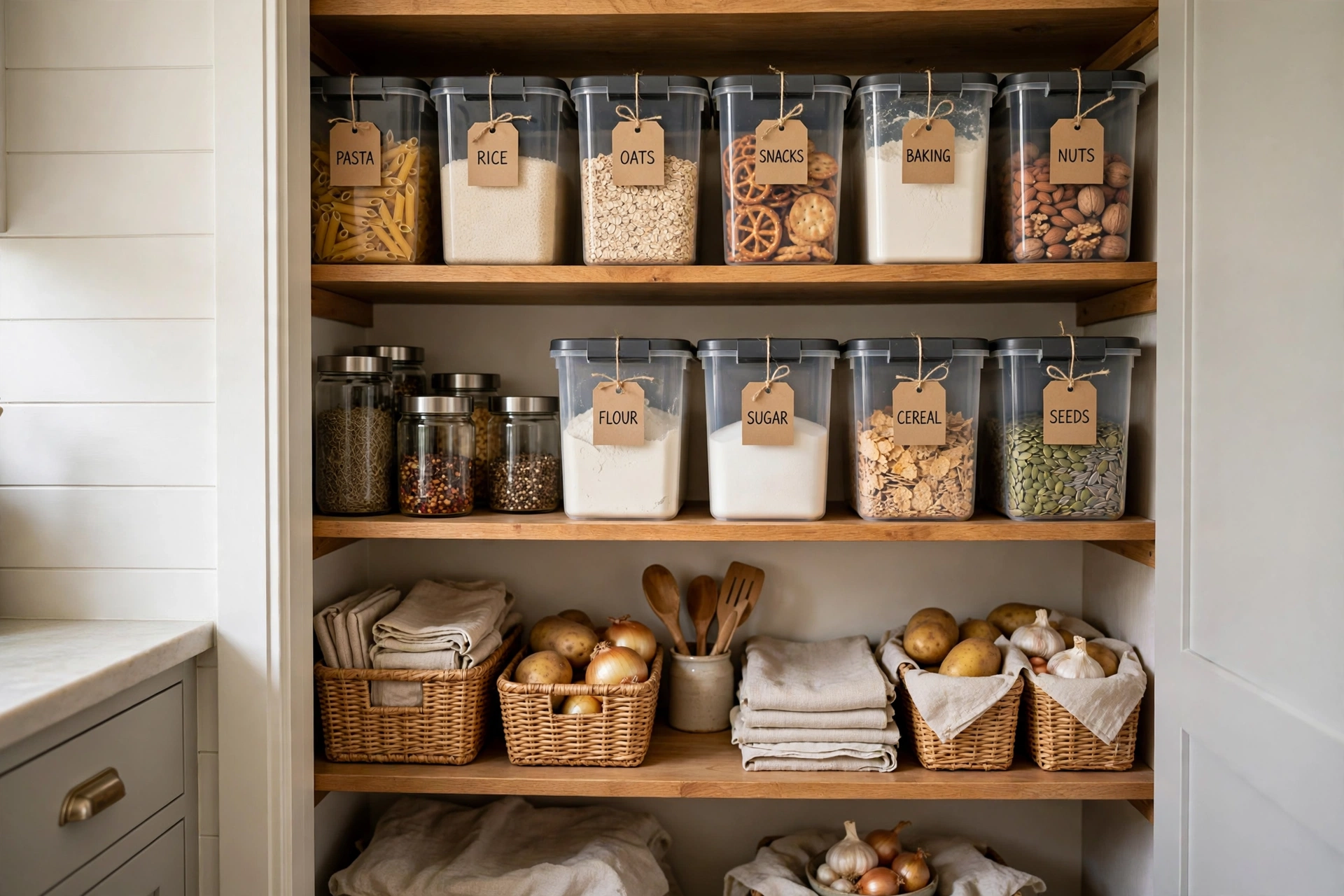
Deep pantry shelves look generous until you actually try to cook from them. The front row hides everything behind it, so cans get bought twice, half-open packets drift to the back, and a busy family ends up living on the same few visible items while perfectly good food expires out of sight. The problem is rarely a lack of space. It is a lack of flow: nothing in a deep shelf naturally brings the back forward, so the system has to do that job for you.
The short answer is to stop treating each deep shelf as one flat surface. Divide it into pull-out zones by category, put the most-used food at eye level, keep heavy items low, and make the back visible with bins that slide out, risers, or turntables. Start with one shelf, measure before you buy anything, and only add a container when it solves a specific reaching problem. A pantry that a tired parent can use with one hand will stay organised far longer than a pretty pantry that needs two hands and a torch.
Why Deep Pantry Shelves Swallow Food in a Busy Kitchen
A shallow shelf shows everything at a glance, but a deep shelf creates a front zone and a hidden back zone. Every time you shop, the new item goes in front, pushing the older item further back. Over weeks, that back zone becomes a graveyard of duplicates, opened packets and things nobody remembers buying. For a busy family, the cost is not just wasted food — it is also wasted time, because someone has to move half a shelf to find one ingredient.
Children and other household members make the problem worse, not because they are careless, but because a system that only works when everything is returned to an exact spot will fail under real-life pressure. If snacks are hard to reach, they get pulled out and left on a counter. If breakfast items are buried, a different box gets opened. A good deep-pantry system therefore needs to be forgiving: broad categories, containers that can be pulled out whole, and a place for half-used packets that is easy to see.
A One-Hour Deep Pantry Audit Before You Buy a Single Bin
Empty one shelf completely, check dates, and be honest about what your family actually eats. Expired, stale or damaged food goes out, and unopened food nobody wants can be donated if it is in date and your local food bank accepts it. Wipe the shelf, then sort what remains into broad groups — breakfast, pasta and grains, cans, baking, snacks, drinks and backstock — rather than dozens of tiny categories that will not survive a school-week morning.
While the shelf is empty, measure it properly: depth, width, height between shelves, and the clearance of the pantry door. Many deep-shelf solutions fail simply because a bin is too tall to slide out under the shelf above it, or too wide to pass the door frame. Write the measurements down and take them with you, or keep them on your phone. Buying bins first and measuring later is the most common reason a pantry project stalls halfway through.
Turning Each Deep Shelf Into Pull-Out Zones
The single most useful change for a deep shelf is to make the whole category move. A long, sturdy bin with handles acts like a drawer: pull it out, take what you need, push it back. Give each bin one clear category, and keep the bin shallow enough that you can see into it without lifting it. Rectangular bins use depth far better than round ones, and bins with low fronts let you see labels without pulling the bin fully out.
For lower shelves, consider a fitted pull-out drawer or a wire basket on runners if your budget allows it. These are more expensive, but they are worth it on the shelf that holds heavy cans or bulk packets, because they remove the need to lift weight out of a deep space. On upper shelves, avoid heavy pull-outs — a light bin for snacks or baking supplies is safer and easier to handle at height. Keep the heaviest categories low, where a slip will not drop a can from head height.
Risers, Turntables and Door Space for a Small Kitchen Pantry
Risers work best for cans and small jars, because they lift the back row so it can be seen over the front row. Use them only where the shelf height allows it; a riser that forces you to stack cans two high will undo its own benefit. Turntables suit bottles, sauces and small jars in a corner or at the front of a deep shelf, where a spin brings the back bottle to the front. They suit round containers best, and they waste space with rectangular boxes, so do not use them everywhere by default.
The pantry door is free storage that many small kitchens ignore. A shallow rack on the inside of the door can hold spices, small packets, wraps and measuring tools, provided it does not overload the hinges and does not block the door from closing. Keep door storage light and shallow. Heavy cans, oils and large glass bottles belong on a shelf, not on a door that swings several times a day.
Where Breakfast, Cans and Backstock Belong in a Family Pantry
Place the food your family reaches for every day at eye level and within easy arm's reach. For most busy families, that means breakfast items and snacks in the middle of the pantry, where children can also reach them safely without climbing. Cans and heavier staples belong lower, where they are stable and easy to lift. Light, rarely used items — special baking supplies, seasonal food, large backstock — belong higher, where a little extra reaching does not slow down a weekday morning.
Separate backstock from daily food. If unopened duplicates sit in front of the opened packet, the opened packet gets buried and a second one gets opened. Keep a small backstock zone, ideally on a different shelf or at the back of a clearly labelled bin, and move one item forward only when the daily item runs out. This one habit, more than any container, stops the classic deep-pantry problem of three half-open bags of pasta.
Labels That Survive a School Week in a Small Kitchen
Labels help, but only if they describe categories, not individual products. A bin labelled “pasta” will still be useful when the brand changes; a bin labelled with a single product name will not. Label the front of the bin, not the top, so the label is visible when the bin is pushed back. If you live with children, involve them in choosing where snacks go — a system they helped create is far more likely to be used than one imposed on them.
Do not label everything on day one. Live with the new layout for a week, notice which categories stay put and which ones drift, and then label the stable ones. Over-labelling a pantry that has not been tested yet usually means relabelling it a week later. A few clear, large labels beat a wall of tiny ones that nobody reads in a hurry.
Keeping a Deep Pantry Working When Life Gets Busy
A deep pantry does not stay organised by itself; it stays organised because the weekly shop has a routine. When shopping comes home, put new items behind older ones in the same bin, and move the “use first” items to the front. That takes less than a minute per bin and prevents the slow build-up that turns a tidy pantry into a hidden mess over a month.
Do a quick scan once a week — not a full clean, just a check for anything that has migrated, any packet that has been opened and forgotten, and any bin that is overflowing. Once every few months, do a fuller audit of dates and categories. If a category keeps overflowing, it is a sign to buy less of it, not to buy a bigger bin. The goal is a pantry that fits how your family actually cooks, not a pantry that stores everything it is possible to buy.
Empty one shelf, check dates, and sort food into broad categories.
Measure depth, width, shelf height and door clearance before buying anything.
Give each deep shelf one pull-out bin per category, with daily food at eye level.
Add a riser or turntable only where it solves a specific visibility problem.
Separate backstock from daily food, and put new shopping behind older items.
Deep Pantry Mistakes That Make a Small Kitchen Harder to Use
The most common mistake is buying a matching set of small containers before measuring. Small containers waste depth, because they leave dead space behind them and cannot be pulled out as a group. Another mistake is decanting everything into matching jars on day one. Decanting looks tidy, but it hides how much food you actually have, it takes time to maintain, and it can make it harder to check dates. Decant only the dry goods you use often and in large amounts, such as flour, rice or oats.
A second mistake is putting snacks where children cannot reach them, then wondering why counters fill up with half-open packets. If snacks are meant to be accessible, give them a low, clearly labelled bin that children can use independently. If certain food is not for everyday use, say so and put it higher, rather than hiding it behind other food. A pantry system that fights the household's habits will always lose to those habits.
Final Thoughts: A Deep Pantry Your Family Can Actually Cook From
A well-organised deep pantry is not about buying the most containers. It is about making the back of every shelf reachable, putting daily food where hands naturally go, and keeping backstock separate from what is already open. Start with one shelf, measure first, use pull-out bins for categories, and let the layout prove itself for a week before you label it or buy more. Done that way, a small kitchen pantry stops swallowing food and starts saving time — which, for a busy family, is the whole point.
Deep Pantry Organization FAQs for Busy Families
What is the best way to organize deep pantry shelves?
Divide each shelf into pull-out zones by category, so the whole bin slides out and the back becomes visible. Combine that with daily food at eye level, heavy items low, and backstock kept separate from opened food.
Should I use bins or pull-out drawers for deep shelves?
Bins are cheaper, flexible and easy to start with, and they work well for packets and snacks. Fitted pull-out drawers are better for heavy cans on low shelves, but they cost more and may not suit a rented kitchen.
How do I stop food expiring at the back of a deep pantry?
Put new shopping behind older items in the same bin, keep a clear “use first” front zone, and do a quick weekly scan for opened packets. Separating backstock from daily food stops duplicates from burying the item already in use.
Are turntables worth it for deep pantry shelves?
Yes, for bottles, sauces and small jars, especially in a corner. They are less useful for rectangular boxes or heavy bulk containers, which waste the circular space and can become unstable when spun.
How should I organize a pantry for children?
Give snacks and breakfast items a low, clearly labelled bin that children can reach and return independently. Keep heavy, glass or rarely used items higher, and involve children in choosing where their snacks go so the system is actually used.
Do I need to decant everything into matching containers?
No. Decant only dry goods you use often in large amounts, such as flour, rice or oats. For most food, a labelled pull-out bin is faster to maintain and makes it easier to check dates and quantities.