When rain falls on a property with poor soil permeability, the water has nowhere to go. Dense clay and silt absorb it so slowly that it pools on the surface, runs toward the house, and presses against the foundation — sometimes for days after a storm. Standard drainage advice often fails here, because a system designed for free-draining soil cannot collect water that never reaches it. The effective answer is layered: reshape the surface so water runs away, intercept what remains with curtain drains, and protect the wall with footing drains and drainage mats that carry water away before it builds pressure.
This guide explains how low-permeability soil behaves, how to confirm it is the real cause of your wet basement or soggy yard, and which exterior drainage solutions actually work when the ground will not absorb water. Costs are broad planning estimates — treat any figure as a starting point for quotes, not a fixed price.
Why Poor Soil Permeability Turns Rain Into a Foundation Problem
Soil permeability is simply how fast water moves through the ground. Sandy soils drain in hours; dense clays can take days or weeks. When rain outpaces that rate, water ponds on the surface and flows sideways — usually toward the lowest point, which is often the foundation. Expansive clays make it worse: they swell when wet and shrink when dry, so the soil around a house is rarely still, and one side of a yard can stay saturated while another dries out.
That standing water creates hydrostatic pressure against foundation walls. Water pushing on a wall finds every crack, mortar joint, and the footing joint, and over time forces moisture through concrete pores. It also feeds the wet-dry cycle that moves clay, stressing slabs and footings unevenly. The result is familiar on clay lots: damp basements after heavy rain, efflorescence on walls, and floors that feel cold and clammy even when nothing is visibly leaking.
How to Tell Your Soil Is the Problem, Not Your Gutters
Before spending money on drainage, confirm the soil is actually the cause. Gutters, grading, and plumbing leaks can mimic a soil problem, and fixing the wrong thing wastes the budget. Walk the property during and after heavy rain and watch where water goes. If it sheets across the yard and stands in low spots for a day or more, the soil is not absorbing it, and the foundation zone is being overloaded.
A simple test helps: dig a small hole about a foot deep, fill it with water, and time how long it takes to drain. In free-draining soil it disappears in an hour or two; in heavy clay it may still be there the next morning. Also look for these signs:
- Water pooling against the foundation wall long after rain has stopped.
- Deep cracks opening in dry soil in summer, then closing when it rains.
- A basement that is damp only after sustained rain, not after a single shower.
- Soggy patches in the yard that never dry, even in warm weather.
If several of these match, your drainage plan must assume the soil will not help. Every part of the system has to move water itself — across the surface, through gravel, or inside a pipe.
Grading and Swales: The First Line of Defence
The cheapest and most effective drainage work on a low-permeability lot is reshaping the surface. A widely used guideline is to slope the ground away from the house at roughly six inches of fall over the first ten feet. On clay lots this matters most, because water that reaches the wall will sit there. Use compacted, low-permeability soil — clay or heavy loam — for the grading itself, so the surface sheds water rather than soaking it in next to the house.
Where the yard is flat or slopes toward the house, a shallow swale — a broad, gently sloped channel — can carry water around the building to a lower discharge point. Swales work well on clay because they move water across the surface, where it can actually flow, instead of asking it to sink in. Keep swales clear of debris and mow them short so water does not stall. Extend downspouts at least six to ten feet from the foundation, or connect them to solid pipe that carries roof water to a daylight outlet or storm drain.
Curtain Drains That Intercept Water Before It Reaches the House
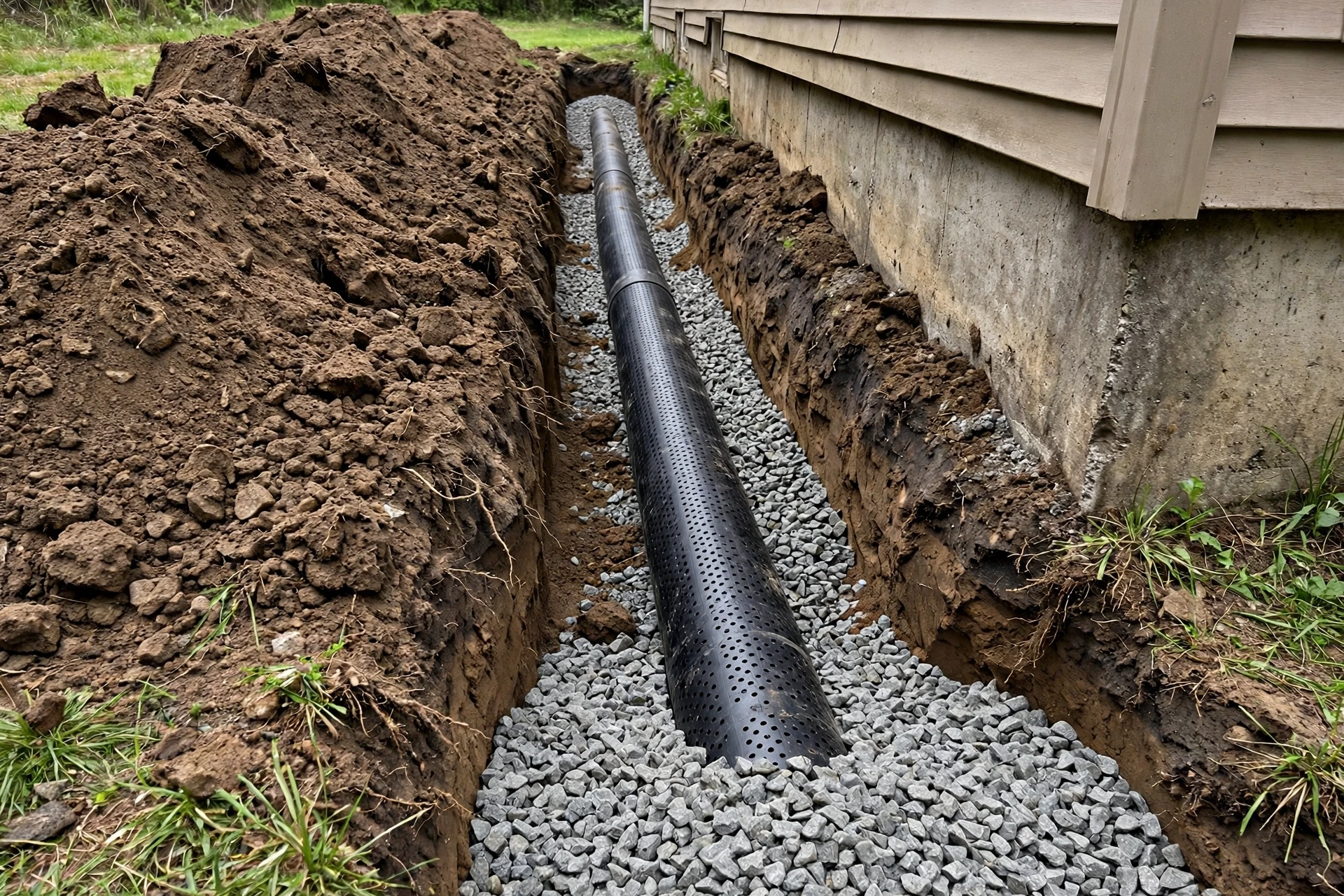
A curtain drain — also called an intercepting drain — is a shallow gravel-filled trench with a perforated pipe, installed uphill of the house or across a slope to catch water moving laterally through the top few inches of soil. In clay, this is often more effective than a deep footing drain, because most lateral flow in clay happens near the surface, where the soil cracks when dry and water runs along the top once it is wet. The drain catches that flow before it reaches the foundation.
A typical curtain drain is 18 to 36 inches deep and 12 to 24 inches wide, lined with filter fabric, filled with washed gravel, and carrying a four-inch perforated pipe sloped at least an eighth of an inch per foot toward its outlet. The critical detail on clay lots is the backfill: never cap the trench with the same excavated clay, because that creates a dense lid that stops surface water reaching the drain. Backfill with clean gravel up to near the surface, then restore only the top few inches with topsoil and seed. Add cleanouts at bends so the pipe can be flushed if silt builds up.
Footing Drains and Drainage Mats Along the Foundation Wall
When water still reaches the wall, the footing drain — the exterior drain tile — is the workhorse. It is a perforated pipe installed at the base of the footing, bedded in washed stone and wrapped in filter fabric, that collects water at the lowest point and carries it to daylight or a sump basin. On clay lots, excavate to the footing, repair the wall, apply a waterproof membrane from footing to grade, then install the drain with at least six inches of washed stone around the pipe.
A dimpled drainage mat fixed over the membrane completes the system. The dimples create an air gap between the membrane and the soil, so water runs down the wall face to the footing drain instead of pressing against it, and the mat protects the membrane during backfilling. Backfill the trench with granular material, not the excavated clay, and restore the surface grade so it still slopes away from the house. Interior drainage and a sump pump can manage water that gets inside, but they treat the symptom — the exterior system is what relieves the pressure on the wall.
Choosing the Right Drainage Combination for Your Lot
No single system solves a clay-lot drainage problem. The right plan depends on where water starts, how it travels, and where it can safely go — and most lasting plans combine two or more of the systems below. A lot that floods after every storm needs surface work first; a seeping basement needs the footing drain and membrane; a hillside lot needs the curtain drain uphill. Match the system to the water path, not to the catalogue.
| System | Where it works | Depth | Best for clay lots? |
|---|---|---|---|
| Regrading and swales | Surface, around the house | Surface | Yes — first step on every lot |
| Curtain drain | Uphill of the house, across slopes | 18–36 inches | Yes — catches shallow lateral flow |
| Footing drain (drain tile) | Along the foundation base | At footing depth | Yes — with membrane and mat |
| Drainage mat | On the foundation wall face | Full wall height | Yes — relieves wall pressure |
| Dry well | Low area away from the house | 3–4 feet | Limited — clay absorbs slowly |
| Interior drain + sump pump | Inside, at the floor-wall joint | Below slab | Backup only — manages symptoms |
Two mistakes undo more clay-lot drainage work than anything else. The first is backfilling a drain trench with the excavated clay, which caps the system and starves it of water. The second is discharging a drain where the water simply flows back toward the house — always confirm the outlet is lower than the drain and stays clear. A drainage contractor can survey the lot and confirm falls before you dig, which is money well spent where gravity has little room for error.
What Foundation Drainage Costs on Low-Permeability Lots
Costs depend on access, depth, length, and how much excavation the lot needs, so treat these as broad planning estimates. Regrading a yard and extending downspouts is the cheapest work, often in the low hundreds to a few thousand dollars. A curtain drain typically runs a few thousand dollars for a standard residential run, while a full exterior footing drain with membrane and drainage mat is the most expensive option, often running into the high thousands or more on a large house.
Interior drainage with a sump pump is usually cheaper than exterior work, which is why it is often proposed first — but on a clay lot it manages water after it has already reached the foundation, and it does nothing about the pressure on the wall. If the budget forces a choice, spend first on grading and surface water, then on the curtain drain, and treat the footing drain as the long-term fix. Many homeowners stage the work over two seasons, so they can see how much each step helps before committing to the next.
Keeping a Clay-Soil Drainage System Working Year After Year
A drainage system on clay soil needs more attention than one on sandy ground, because silt and fabric clogging are the main failure modes. Inspect it twice a year: after spring snowmelt and after autumn leaf fall. Check that downspout extensions are connected, swales are clear, and outlets run freely during rain. Flush the pipe through its cleanouts every year or two, and watch for water standing over a drain line — it usually means the system is backing up.
Also watch the soil itself. Clay shrinks in dry summers and can open gaps around drain trenches and foundations; those gaps let the next rain run straight down to the footing, so re-check grading after a dry spell and top up settled areas. Keep trees with aggressive roots away from drain lines, and never pave over a drain trench without providing access. A system inspected and flushed on schedule can serve for decades; one installed and forgotten on clay usually loses capacity within a few years.
Foundation Drainage FAQs for Poor-Permeability Properties
Will a French drain work in clay soil?
It can, but only if it is designed for clay. A French drain in heavy clay collects water slowly, so it needs clean gravel backfill to the surface, filter fabric, and a position that intercepts shallow flow. A deep pipe buried under a clay cap will starve, so the backfill detail matters more than the pipe.
How deep should a curtain drain be on a clay lot?
Most residential curtain drains go 18 to 36 inches deep, placed uphill of the house where they can intercept water moving downslope. The exact depth depends on the slope and the soil profile, so a site survey is worth doing before digging.
Is exterior drainage better than an interior system?
Exterior drainage is better for the foundation itself, because it intercepts water before it reaches the wall and relieves hydrostatic pressure. Interior systems manage water that has already entered, which is useful as a backup but does not protect the wall or the soil around it.
Do I need a permit for foundation drainage work?
It depends on your area. Simple regrading and downspout work usually needs no permit, but excavation near a foundation, work that alters stormwater flow, or discharge to a public right-of-way may need approval. Check with your local building department before digging.
How long does a foundation drainage system last?
A well-built system with clean gravel, fabric, and maintenance access can last decades. On clay, the limiting factor is usually clogging: without periodic flushing and inspection, fabric and pipe can lose capacity within three to ten years.
Can I fix clay soil drainage by adding sand or compost?
Not at foundation scale. Amending the top few inches helps a lawn, but it does not change how water moves around a foundation. Drainage on clay has to move water with grading, gravel, and pipes — the soil itself will not do the work.
Final Thoughts: Drainage That Works With Clay, Not Against It
Poor soil permeability is not a reason to give up on a dry foundation — it is a reason to design for it. Clay will not absorb your water, so your drainage has to carry it: across a graded surface, through a gravel-filled curtain drain, and down a protected wall to a footing drain that has somewhere to go. Get the surface right first, intercept water before it reaches the house, and keep the system maintained, and even the heaviest clay lot can stay dry for decades.