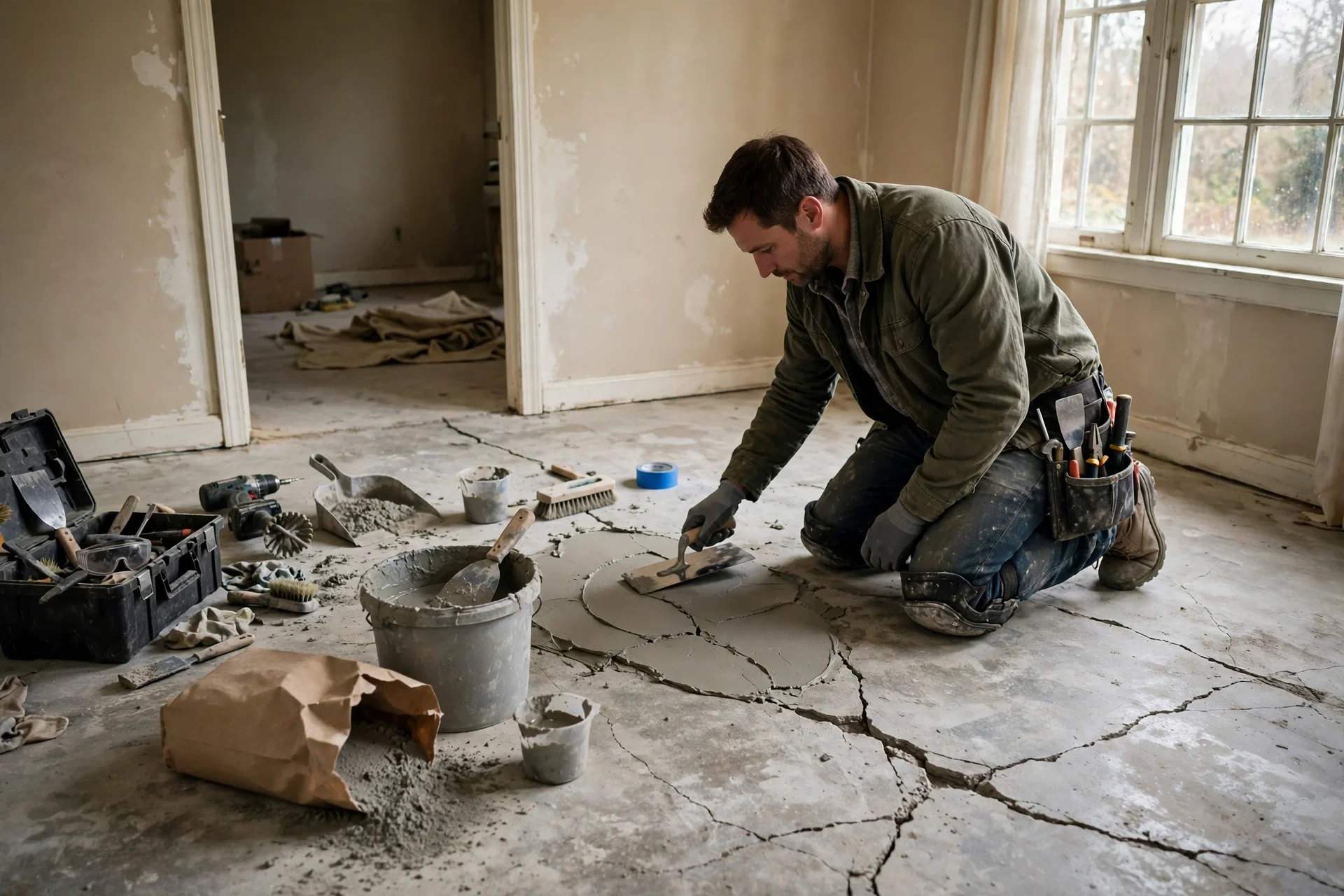
Uneven floor settlement in a home on a concrete slab is usually repaired by lifting the slab back to grade — most often with polyurethane foam injection for precision work, or mudjacking where a heavy cement slurry suits the soil — after the cause of the settlement has been identified. Cracks are then sealed or stitched, and the water or soil problem underneath is corrected so the slab does not settle again. Replacement is the last resort, reserved for slabs that are badly broken, heaved, or undermined beyond lifting.
A slab floor that has gone uneven is easy to live with for a while and expensive to ignore for long. Doors start to stick, tile cracks along a line, furniture rocks, and water begins to pool where the floor has dropped. The concrete itself is rarely the problem. Slabs settle because the soil beneath them moves — washing out, drying and shrinking, or consolidating under load — and the slab simply follows the ground down. Any repair that lifts the concrete without addressing the ground is a temporary fix.
Reading What an Uneven Slab Floor Is Telling You
The pattern of the damage is the first diagnostic tool, and it costs nothing. A slab that has settled evenly across one corner usually points to a localized soil problem — a leaking pipe, a downspout dumping water at the corner, or a pocket of poorly compacted fill. A floor that dips along one wall suggests water running along the foundation. Cracks that run across the whole slab with one side higher than the other indicate differential settlement, where one part of the slab has dropped while the rest stayed put.
Crack width and movement matter more than crack length. Hairline cracks under a sixteenth of an inch are common in residential slabs and usually mean shrinkage rather than settlement. Cracks between a sixteenth and a quarter inch wide deserve monitoring: mark the ends with a pencil line and a date, and check whether they grow over a few months. Cracks wider than a quarter inch, or any crack with vertical displacement where one side sits higher than the other, signal active settlement and need professional evaluation before any cosmetic repair.
What Causes a Concrete Slab to Settle Unevenly
Settlement has a short list of usual causes, and identifying the right one decides the repair. Poorly compacted fill is the most common: if the soil beneath the slab was not compacted in lifts during construction, it consolidates under the slab’s weight over years, and the slab follows it down. Expansive clay soils shrink during dry spells and swell when wet, so the slab moves with the seasons and eventually cracks at the stress points. Erosion is the third cause — water from a leaking drain, a broken supply line, or poor surface drainage washes fine soil out from under the slab, leaving voids that the concrete bridges until it drops.
Diagnosing Settlement Before Choosing a Repair
A proper diagnosis has three parts, and skipping any of them risks repairing the wrong problem. First, map the floor: use a long level or a laser level to record where the slab has dropped and by how much, and photograph the crack pattern with a tape measure in the frame for scale. Second, look for the water story: check gutters, downspouts, grading, and any history of plumbing leaks, and look for soil erosion or damp patches around the foundation. Third, check whether the movement is still active by monitoring cracks over several weeks or months — a slab that has stopped moving is a different repair than one that is still sinking.
- Map the drop: level readings and photographs establish the pattern and the amount of settlement.
- Trace the water: gutters, grading, and plumbing history usually reveal the cause.
- Test for voids: probe holes or radar confirm what is actually missing under the concrete.
- Check for movement: dated crack marks show whether the slab is still settling or has stabilized.
Slab Lifting Methods Compared: Mudjacking, Foam, and Replacement
Three options cover almost every residential slab repair, and they differ mainly in weight, precision, speed, and cost. The table below compares them on the factors that matter to a homeowner, so the choice can be made on evidence rather than on whichever method the first contractor sells.
| Method | How it works | Weight added | Cure time | Best fit |
|---|---|---|---|---|
| Mudjacking (slabjacking) | Cement, sand, and water slurry pumped under the slab through 1–2 inch holes | About 100 lb per cubic foot | 24–72 hours before full loading | Large driveways and garage slabs on firm soil |
| Polyurethane foam lifting | Two-part foam injected through 5/8-inch holes; expands to fill voids and lift | 2–4 lb per cubic foot | 15–30 minutes to traffic | Interior floors, precise lifts, weak or sandy soils |
| Partial replacement | Broken section cut out, base rebuilt, new concrete poured | New slab weight | Days to cure | Slabs too broken or heaved to lift |
| Full replacement | Entire slab removed and repoured on corrected base | New slab weight | A week or more | Widespread failure or a failed foundation design |
Mudjacking: The Heavyweight Classic for Large Slabs
Mudjacking is the oldest slab lifting method and still the right choice for many large exterior slabs. A cementitious slurry — typically Portland cement, sand, and water, sometimes with soil or fly ash — is pumped under the slab through holes drilled in the concrete. The slurry fills voids first, then builds hydraulic pressure and raises the slab in small, controlled increments. It is inexpensive relative to foam, it uses simple materials, and the finished lift is strong in compression.
Polyurethane Foam Lifting for Precision Slab Raises
Polyurethane foam lifting, often called polyjacking, injects a two-part foam that expands to many times its liquid volume, filling voids and raising the slab with controlled force. The foam is hydrophobic, so it does not absorb water or wash out, and at two to four pounds per cubic foot it adds almost no load to the soil. Holes are small — typically five-eighths of an inch — and the foam cures in fifteen to thirty minutes, so a floor can be walked on almost immediately.
The precision is the real advantage for interior floors. The operator injects in stages, watching the slab rise a fraction of an inch at a time, and can stop at the exact grade. That control matters where a floor meets door thresholds, tile, or built-in cabinetry, because overshooting a lift cracks finishes. The trade-offs are cost — foam generally runs higher per square foot than mudjacking — and the need for trained operators and specialized equipment, since the foam generates heat as it cures and must be injected correctly. For a home with uneven interior floors, foam is the method most specialists reach for first.
Crack Stitching, Epoxy Injection, and Partial Replacement
Lifting fixes the level; it does not by itself repair the cracks. Stable, non-moving cracks can be sealed with epoxy injection, which bonds the concrete back together and restores much of its tensile strength. Cracks that cross a high-stress area, or that have opened and closed with seasonal movement, benefit from stitching — carbon fiber staples or steel bars set across the crack in slots cut into the slab, bonded with epoxy, which hold the two sides together against future movement.
Partial replacement is the right call when a section of slab is too broken to lift — shattered into pieces, heaved upward by roots or frost, or undermined so badly that no injection material can support it. The broken section is saw-cut out, the base is excavated and rebuilt with compacted aggregate, and new concrete is poured and tied into the remaining slab with dowels. It costs more than lifting and takes longer, but it is the only honest repair for a slab section that has lost its integrity.
Fixing the Water and Soil Problems Underneath
Every slab repair should end with the cause addressed, or the settlement returns. The most common fixes are unglamorous: extend downspouts at least six feet from the foundation, regrade soil so it slopes away from the house, and repair any leaking drain or supply line found during diagnosis. Where surface water concentrates against the foundation, a shallow French drain or a swale can intercept it before it reaches the slab edge.
For expansive clay soils, moisture control is a long-term discipline rather than a one-time fix. Consistent watering of the soil near the foundation during dry spells, root barriers for large trees, and maintaining the grade all reduce the seasonal shrink-swell cycle that moves slabs. In severe cases, a geotechnical engineer may recommend soil stabilization — lime treatment or deep injection — before any lifting work. That sounds expensive, and it is, but lifting a slab on untreated expansive clay is simply paying twice.
Slab Settlement Repairs That Need an Engineer, Not a Contractor
A lifting contractor can level a floor; a structural engineer decides whether the floor is safe and what the house needs. Bring in an engineer when the settlement is severe — more than an inch or two of drop — when cracks run through the foundation walls as well as the floor, when doors and windows across the house have gone out of square, or when the slab is part of the foundation system itself rather than a floor poured inside foundation walls. The engineer can also rule out the rare but serious causes, such as a failing pier, a sinkhole, or a broken main drain undermining the slab.
Uneven Slab Settlement: Questions Homeowners Ask
Can an uneven concrete slab floor be fixed without replacing it?
Yes, in most cases. Mudjacking or polyurethane foam injection can lift a settled slab back to grade at a fraction of replacement cost, provided the slab is not shattered or heaved. Replacement is only needed when the concrete itself has failed structurally.
How much does slab lifting cost?
As a broad guide, mudjacking commonly runs a few dollars per square foot, while polyurethane foam lifting runs higher, roughly in the mid-single digits to the mid-teens per square foot depending on the depth of the void and the amount of lift. A small interior lift is usually far cheaper than replacing the floor and its finishes.
How long does a lifted slab stay level?
Foam lifting is generally considered permanent, because the foam does not erode or absorb water. Mudjacking typically lasts five to ten years in demanding conditions, because the slurry can erode if water keeps reaching it. Either method fails early if the water or soil cause is left uncorrected.
Will lifting the slab damage my tile or hardwood?
A careful, staged lift usually does not, and it often closes gaps that settlement opened. A fast or overshot lift can crack rigid finishes, which is why interior floors favor foam lifting with its precise, incremental control — and why the contractor should discuss finish risk before starting.
What if only one corner of the slab has settled?
Localized settlement is the easiest case: the cause is usually a single water source or a pocket of bad fill at that corner. Fix the source, lift that section, and monitor it. A whole-house drop is a different problem and needs an engineer.
Should I fill slab cracks before or after lifting?
After. Lifting moves the slab and can open or close cracks, so sealing or stitching first wastes the work. Lift to grade, let the slab settle into its new position, then inject or stitch the cracks that remain.
Final Thoughts on Fixing an Uneven Slab for Good
A settled slab is a soil problem wearing a concrete disguise, and the repairs that last are the ones that treat it that way. Diagnose the cause, lift with the method that suits the soil — foam for precision and weak ground, mudjacking for large slabs on firm soil — repair the cracks after the lift, and fix the water that caused the settlement in the first place. Done in that order, a lifted slab stays level, and the floor above it stops telling the story of what went wrong underneath.