A customer of a mid-sized private bank in Pune recently received a message asking them to verify their net banking details after a routine security update. The sender domain looked close enough to the real one. The layout matched the bank’s usual correspondence. Within four hours of entering credentials and an OTP, the customer had lost close to two lakh rupees, and investigators later found the fraudulent domain had already been used against seventeen other customers before anyone flagged it. None of this touched the bank’s servers, firewalls or endpoints. The attack happened entirely outside the perimeter, using the bank’s own name as the weapon.
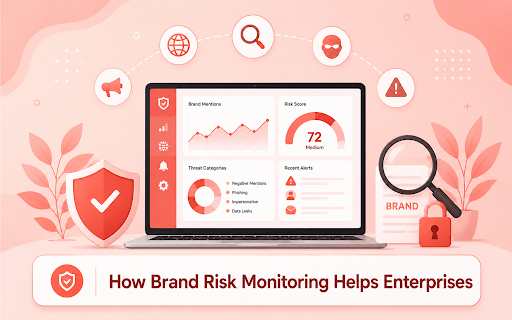
This is the gap that Brand Risk Monitoring, or BRM, is built to close. It tracks how a brand is being used, copied or misrepresented across the open web, social platforms, app stores and the dark web, surfacing impersonation and phishing infrastructure before it reaches customers at scale. For enterprises operating in banking, fintech and other trust-dependent sectors, that visibility has stopped being optional.
What Brand Risk Monitoring Actually Covers
BRM is often mistaken for a narrower discipline than it is. It sits closer to continuous external reconnaissance than to a one-time scan. A working BRM programme tracks lookalike domain registrations, fraudulent mobile apps published under a company’s name, spoofed social media profiles, leaked credentials tied to the brand and phishing kits built to mimic a specific login page. Each of these signals arrives separately, often from unrelated sources, and the value of BRM comes from correlating them into a single view of exposure rather than treating them as isolated alerts.
Microsoft accounted for 22 percent of all brand impersonation attempts globally, with Apple and Google following at 11 and 9 percent. Brand phishing has basically become two separate problems, where a brand gets weaponised against its own customers on one side, and employees get targeted through other trusted brands on the other. Most security budgets are still weighted toward the second problem. BRM exists to address the first.
Why Phishing Keeps Exploiting Brand Trust
The scale is difficult to overstate. Industry phishing research places brand impersonation in roughly 45 percent of all phishing attacks, with over 80 percent of domains globally still lacking DMARC enforcement, leaving them exposed to direct spoofing. In India specifically, Seqrite’s threat telemetry recorded over 265 million detections across more than eight million endpoints between October 2024 and September 2025, and separate industry monitoring has put weekly attacks per Indian organisation well above the global average.
What makes impersonation different from a conventional breach is timing. A fraudulent domain can be registered, populated with a cloned login page and pushed into circulation within days. By the time a takedown request works through a registrar or hosting provider, the damage to customers may already be done. Detection speed is really the entire game here, not detection accuracy alone.
How Brand Risk Monitoring Fits into a Security Programme
Explaining BRM in the abstract only goes so far. It helps to see how the workflow moves from raw signal to resolved threat, which is easier to follow as a sequence than as a paragraph.
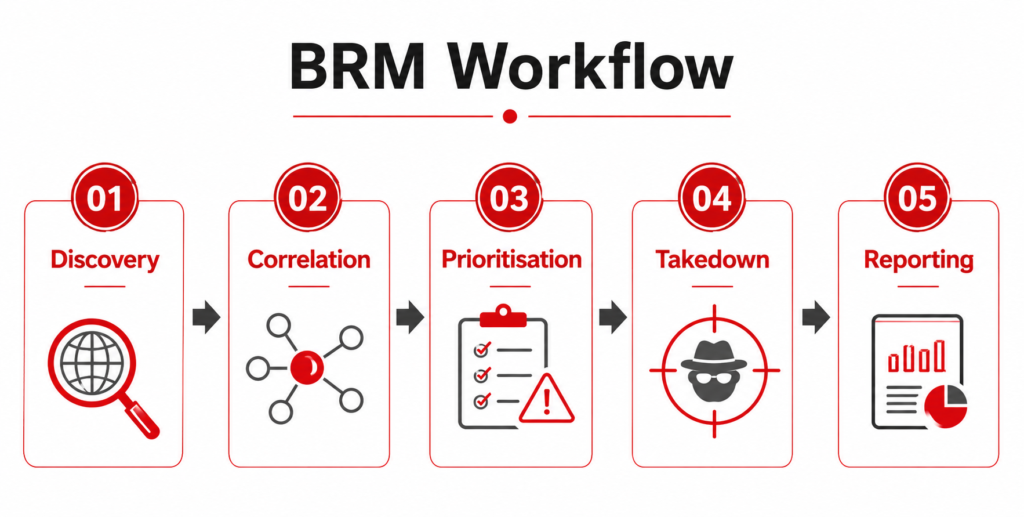
- Discovery: Automated crawlers and threat feeds scan domain registrations, app stores, social platforms and paste sites for anything referencing the brand, its logos or its executives.
- Correlation: Findings are cross-referenced against known phishing kits, prior incidents and leaked credential dumps to separate genuine threats from noise.
- Prioritisation: Each finding is scored by likely impact, so a cloned banking login page is treated differently from an inactive lookalike domain sitting unused.
- Takedown: Verified threats are escalated to registrars, hosting providers and platform trust teams, with the goal of removal rather than just documentation.
- Reporting: Findings feed into compliance and board-level reporting, giving regulated entities an auditable record of external exposure over time.
The sequence rarely runs in a straight line in practice. A takedown can trigger a new registration within hours, and mature BRM programmes account for that by treating the cycle as continuous rather than something to be closed out and forgotten.
The Regulatory and Business Case in India
Indian regulators have started treating this as more than good practice. CERT-In’s incident reporting rules already require organisations to report qualifying incidents within six hours, and RBI’s guidance for banks and payment providers increasingly expects visibility into fraud vectors that originate outside the organisation’s own network. For BFSI entities specifically, an inability to demonstrate awareness of impersonation campaigns targeting their customers is becoming a documented gap during audits, not just a reputational risk.
There is also a quieter cost that rarely appears on an incident report. Every successful impersonation campaign erodes a small amount of trust between a brand and the customers who interact with it daily through UPI, net banking or mobile apps. That erosion compounds. Customers who have been burned once by a fake bank alert tend to treat legitimate communications with more suspicion afterward, which creates friction for the business long after the fraud itself has been resolved.
Conclusion
Brand Risk Monitoring gives enterprises a way to see the phishing pages, fake apps and impersonation attempts built around their name before those threats reach customers directly. It will not stop every attacker from registering a lookalike domain, but it shortens the distance between a threat appearing and a threat being removed, which is usually where the real damage is decided.
If your company handles customer trust at scale and needs continuous visibility into how your brand is being used or misused across the web, connect with CyberNX’s experts to see how a dedicated BRM programme can be built around your existing security operations.