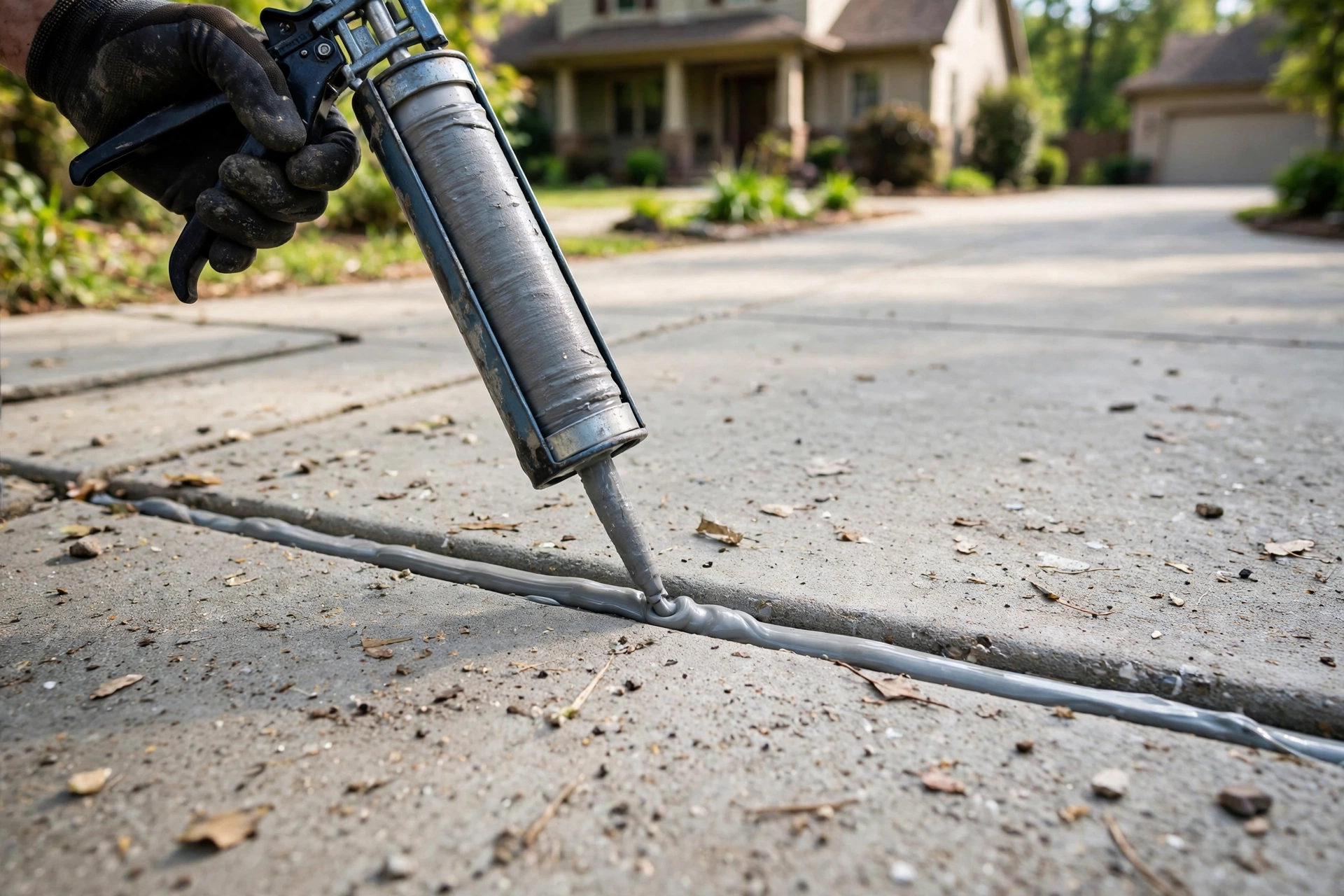
For most large residential concrete surfaces, choose a one-part, self-levelling polyurethane sealant rated to ASTM C920 Class 25, Use T, in a colour close to your concrete. It bonds strongly to concrete, flexes as slabs expand and contract, stands up to traffic, and can be painted once cured. That works for driveways, patios, pool decks, and garage floors — but only if the joint width fits the product, the depth is controlled with backer rod, and the concrete is clean and dry.
Large slabs behave differently from a small garden path. A long driveway or a wide patio contains more concrete, so it moves more in total and holds more water when a joint fails. This guide covers movement, traffic, sun, water, and joint size first, then matches those conditions to the main sealant types.
Why Large Residential Concrete Surfaces Put Extra Strain on Expansion Joint Sealant
Concrete expands in summer heat and contracts in cold weather, and it also shrinks slightly as it cures and shifts with moisture changes in the soil below. On a short slab, that movement is small. On a long run, it adds up: guides note that a 100-foot concrete slab can move about three-quarters of an inch between summer and winter, so a sealant in a large joint must stretch and compress again and again without tearing or pulling away.
Size also changes what happens when the seal fails. A failed joint on a small step lets in a little rain. The same failure on a large driveway lets water reach the base and leave slabs unsupported. Freeze-thaw cycles then widen the damage, weeds take hold, and grit stops the joint closing properly. Rigid mortar or grout fails fast here: with almost no movement capability, it cracks at the first hot spell or cold snap.
What Movement, Traffic, and Weather Your Expansion Joint Sealant Must Handle
Start with three questions before you look at any tube. First, how much will this joint move? Sealants are commonly rated at plus or minus 25 percent or plus or minus 50 percent of the joint width, printed as the Class on the label. A Class 25 product suits most residential joints; Class 50 is worth considering for very long runs. Second, what crosses the joint? A soft silicone that survives on a wall can tear under car tyres, while a tougher polyurethane resists it. If vehicles will drive over it, look for a traffic-rated product — Use T in the ASTM C920 marking.
Movement: long slabs and wide temperature swings need Class 25 at least, and Class 50 for the widest seasonal change.
Traffic: foot-only patios can use a softer sealant; driveways need a traffic-rated, abrasion-resistant product.
Exposure: full sun, standing water, salt, and pool chemicals each matter — check the label for them.
Paint: if you want the joint to blend into a painted surface, you need a paintable sealant, which rules out most silicones.
Polyurethane, Silicone, Hybrid, and Polyurea Sealants Compared for Large Concrete Joints
Polyurethane is the workhorse for large residential concrete. It bonds aggressively to clean concrete, resists abrasion from feet and tyres, and can be painted after it has fully cured. Most one-part polyurethanes carry a movement rating of plus or minus 25 percent, with some reaching plus or minus 50 percent. Self-levelling polyurethane is the usual form for flat joints: it flows into the gap and settles flat without tooling. Its weaknesses are slower curing — three to five days, longer in cool weather — and sensitivity to prolonged ultraviolet light.
Silicone is the flexibility and weather champion, but a weaker partner for concrete itself. Quality silicones commonly carry movement ratings around plus or minus 25 to plus or minus 50 percent and resist ultraviolet light for decades. The trade-offs matter, though: ordinary silicone bonds less strongly to porous, dusty concrete, cannot be painted, and tears more easily under traffic. Hybrid polymer sealants, often sold as MS polymer products, bond well to concrete, stay paintable, and usually offer around plus or minus 25 percent movement. Polyurea is fast-curing and hard-wearing, but two-part systems are harder to mix neatly. Acrylic latex, with only about plus or minus 7 to 12 percent movement, hardens and cracks within a season or two.
Matching Expansion Joint Sealant to Driveways, Patios, Pool Decks, and Garage Floors
A driveway is the hardest test a residential sealant faces. The joint takes vehicle weight, turning tyres, rain, salt, and oil drips, and it is usually in full sun. Choose a self-levelling, traffic-rated polyurethane or a traffic-rated hybrid, Class 25 at least, and recess the finished bead slightly below the concrete surface so tyres roll over concrete, not over sealant. Keep vehicles off for at least a few days while it cures, because driving on a soft bead dents it permanently.
A large patio is gentler on traffic but harder on sun and water. Here a hybrid polymer or a paintable polyurethane often wins. Pool decks add chlorinated splash water, so pick a product whose label mentions pool decks. Garage floors take oil, hot tyres, and heavy point loads, so a self-levelling polyurethane with good chemical and abrasion resistance is the usual answer.
How to Measure Joint Width and Set Backer Rod Depth Before Buying Sealant
The right sealant in the wrong joint shape still fails, so measure before you buy. Clean out one joint, then measure its width in several places: large slabs are rarely even, and the widest point decides the product. Most residential expansion joints are half an inch to one inch wide, and self-levelling sealants are generally not recommended for joints wider than about one inch.
Depth matters as much as width. The standard rule is a width-to-depth ratio of about two to one: the sealant bead should be about twice as wide as it is deep. Manufacturers commonly call for a sealant depth of at least a quarter of an inch and no more than half an inch in a moving joint. Backer rod makes that shape possible. Choose a closed-cell polyethylene rod about 25 percent wider than the joint, and push it in until the depth above it matches the sealant depth you need. The rod also acts as a bond breaker: the sealant should bond to the two sides only, never to the bottom.
Measure width at several points; buy for the widest measurement, not the average.
Aim for a two-to-one width-to-depth ratio, with sealant roughly a quarter to half an inch deep.
Use closed-cell backer rod about 25 percent wider than the joint, set to leave the correct sealant depth above it.
Estimate quantity first: a 10.1-ounce cartridge covers about 12 feet at half an inch wide, but only about 3 feet at one inch wide.
Installing Expansion Joint Sealant on a Large Residential Slab Without Trapping Water
Good installation is mostly preparation, and on a large slab it pays to work in sections. Remove the old sealant, weeds, and grit with a scraper, a stiff brush, and a vacuum, then wash the joint and let it dry completely. Sealant bonds to clean, dry concrete; it does not bond to dust, oil, or a damp face. Set the backer rod next, pressing it in evenly with a blunt tool. Then apply self-levelling sealant in a slow, continuous pour. Do not overfill: the finished surface should sit flush with, or slightly below, the concrete so water runs off it. A self-levelling polyurethane typically needs three to five days for a full cure, so keep vehicles off until then.
- Clean, dry, and vacuum the joint; prime dusty concrete only if the manufacturer recommends it.
- Set backer rod to a consistent depth before any sealant goes in.
- Pour self-levelling sealant slowly; tool non-sag sealant against both faces.
- Finish flush or slightly recessed, and keep traffic off until fully cured.
Reading ASTM C920 Labels and Colour Choices for Large Concrete Surfaces
The label is the fastest way to check whether a tube matches your joint. ASTM C920 is the main standard for elastomeric joint sealants, and its marking reads as Type, Grade, Class, and Use. Type S means a single-component product. Grade P means pourable or self-levelling, for horizontal joints; Grade NS means non-sag, for vertical or sloped joints. Class 25 means plus or minus 25 percent movement, and Class 50 means plus or minus 50 percent. Use T means traffic-rated.
When a Wide or Heaving Expansion Joint Needs a Concrete Professional Instead of DIY Sealant
Most residential resealing is a straightforward do-it-yourself job, but some joints are telling you the slab itself needs attention. Call a concrete contractor if a joint is wider than about two inches, if one slab has lifted, sunk, or tilted relative to its neighbour, if the same joint keeps failing within a year despite correct preparation, or if water is undermining the base and slabs rock when you step on them.
Get the cause checked before you reseal: improving drainage, fixing a leaking downpipe, or stabilising the base often matters more than the brand of sealant. Wear gloves and eye protection, work in fresh air, and follow the manufacturer’s safety sheet. If a joint runs beside a gas, water, or electrical service, or if cutting or grinding is needed, leave that part to a professional.
Final Thoughts: Matching Sealant to Your Concrete Surface
The right expansion joint sealant for a large residential concrete surface is rarely the cheapest tube, and rarely the most flexible one either. It is the product whose movement rating covers your slab’s seasonal change, whose hardness survives the traffic that crosses it, and whose weather resistance suits your sun and water. For most driveways, patios, and garage floors, that means a self-levelling, traffic-rated polyurethane in a concrete-matching colour, installed over correctly sized backer rod at a two-to-one width-to-depth ratio.
Expansion Joint Sealant for Large Concrete Surfaces FAQs
What expansion joint sealant lasts longest on a large residential driveway?
A properly installed polyurethane sealant on a trafficked driveway typically lasts about five to ten years in exposed conditions, while a quality silicone in a sheltered, low-traffic joint can last ten to twenty years or more. On a driveway, polyurethane’s stronger bond and better abrasion resistance usually make it the longer-lasting choice.
Can I use silicone sealant on a concrete expansion joint?
You can, but it is rarely the best choice for a driveway or garage floor. Silicone resists sun and movement well, yet it bonds less strongly to porous concrete, cannot be painted, and tears more easily under tyres and feet. It suits a wide, sunny, low-traffic joint.
How wide can an expansion joint be for self-levelling sealant?
Self-levelling sealants are generally made for joints up to about one inch wide. Wider joints need a different solution, such as a preformed compression seal or professional joint work, because a liquid sealant can sag and cure unevenly in a very wide gap.
Do I need backer rod in a concrete expansion joint?
Yes, for any joint deeper than about half an inch. Backer rod sets the sealant depth, gives the correct two-to-one width-to-depth shape, and stops the sealant bonding to the bottom of the joint. Without it, the sealant bonds on three sides and is far more likely to tear.
How long before I can drive on a newly sealed expansion joint?
Allow at least a few days, and follow the product label: a self-levelling polyurethane commonly needs three to five days for a full cure, longer in cool or dry weather. Driving on a soft bead dents it and breaks its bond.
Why does my expansion joint sealant keep cracking or peeling away?
The usual causes are the wrong product for the movement, a bead that is too deep or too narrow, missing backer rod, dirty or damp concrete, or traffic before curing. A crack down the middle points to a shape or movement problem, while peeling from the sides points to poor preparation.
Can expansion joint sealant be painted to match concrete?
Polyurethane and most hybrid sealants can be painted once fully cured, which helps the joint blend with the surrounding surface. Silicone generally cannot be painted, so choose its colour carefully at the time of purchase.