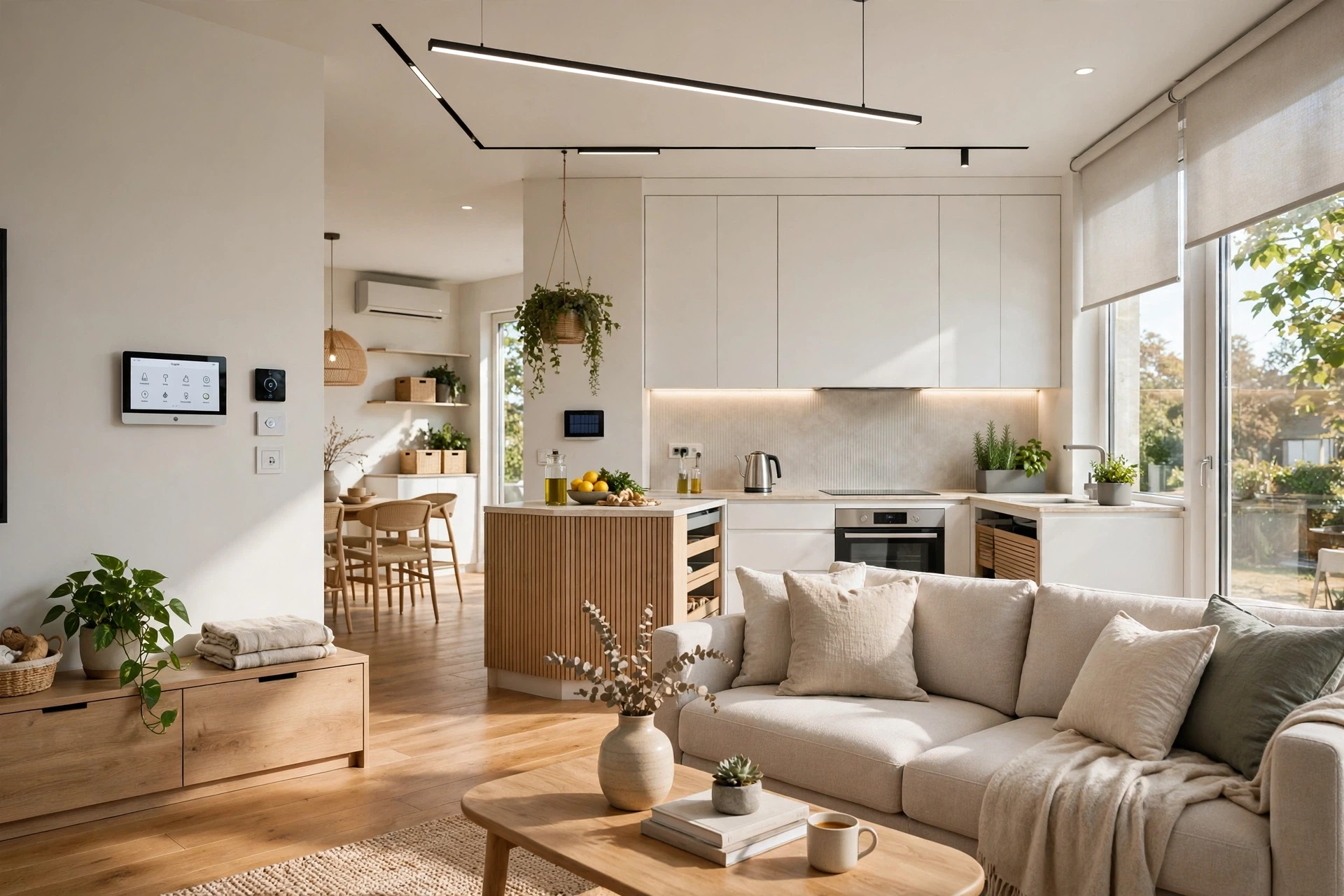
The best home upgrades are the ones you stop noticing. The light that turns itself on when you walk into a dark hallway, the drawer that holds every pan exactly where your hand expects it, the shower that feels like a spa on an ordinary Tuesday — these are the innovations that make everyday living easier, and they rarely look like technology at all. A truly innovative home is not a showroom full of gadgets. It is a house that quietly removes friction from your daily routines.
The short answer is this: start with upgrades that solve a daily annoyance — smart lighting and climate control, hidden storage, flexible furniture, wellness touches in the bathroom, and energy-smart surfaces — and choose versions that work in the background rather than demanding your attention. The right upgrade pays for itself in comfort, time, or lower bills, and it keeps working for years without an update.
This guide covers smart home upgrades, hidden storage and flexible furniture, wellness spaces, energy-smart design, indoor-outdoor living, accessibility, and when an innovative upgrade needs a licensed professional.
What Counts as an Innovative Upgrade in Everyday Home Design
Innovation in home design is not about buying the newest device. It is about solving a real problem in a smarter way. A motion-sensor light in a hallway solves the problem of fumbling for a switch with full hands. A pull-out pantry solves the problem of food disappearing into the back of a cupboard. A quiet, well-insulated window solves the problem of street noise and draughts at the same time. If an upgrade does not remove a daily frustration, it is a novelty, not an innovation.
The second test is whether the upgrade disappears into the home. The best smart technology is useful without being intrusive: lights that adjust themselves, shades that close at sunset, a thermostat that learns your routine. If a device needs an app open, a hub rebooted, or a subscription renewed every month, it is adding friction rather than removing it. Choose systems that work simply and keep working when the internet does not.
Smart Home Upgrades That Stay Helpful and Out of Sight
Start with lighting, because it is the smart upgrade you will use most. Smart bulbs and switches let you dim the living room for a film, brighten the kitchen for cooking, and set the hallway to a soft glow at night, all from one switch or a voice command. Put the most-used rooms on smart controls first, and keep a normal switch as a fallback so guests and children are never confused. A system nobody can operate without a phone is a system that will be abandoned.
Climate control is the second high-value upgrade. A learning thermostat adjusts heating and cooling around your routine, and zoned controls let you warm the rooms you use instead of the whole house. Motorised blinds add comfort and privacy while reducing glare and heat in summer. Whole-home audio, hidden in ceilings or shelving, turns music into part of the house rather than a speaker on a shelf. Keep the interfaces simple: one app, one remote, and clear labels on every switch.
Hidden Storage and Flexible Furniture That Make Daily Life Easier
The most innovative storage is the storage you cannot see. A staircase with drawers built into the risers, a window seat with a lift-up lid, a hallway bench that hides shoes and coats — these use dead space that would otherwise be wasted, and they keep the visible rooms calm. Tiered pull-out organisers inside kitchen cabinets turn a deep, dark cupboard into a set of drawers you can actually reach, and a charging drawer keeps phones and tablets out of sight but still charged.
Flexible furniture does the same work in a different way. A modular sofa rearranges for a party or a quiet evening. A coffee table that lifts to dining height turns the living room into a workspace. A wheeled kitchen island adds prep space where you need it and moves out of the way when you do not. The rule is simple: every piece of furniture should earn its floor space by doing at least two jobs, and the room should still have empty floor left over when everything is in place.
Wellness Upgrades That Bring Spa Comfort Into Ordinary Days
Wellness at home is not a luxury reserved for large houses. A rainfall shower head, a heated towel rail, and a bidet seat with warm-water cleansing turn an ordinary bathroom into a spa-like space for a modest cost, and they are used every single day. A soaking tub, if the room allows it, becomes the centrepiece of a calm evening routine. Natural materials — stone, wood, linen — add warmth that tile alone cannot provide.
Beyond the bathroom, wellness means light, air, and quiet. A small sauna or a dedicated stretching corner can fit into a spare room or a garage conversion. Good ventilation and a quiet, well-insulated bedroom protect sleep, which is the foundation of every other kind of wellness. Plants, natural light, and a place to sit in the morning sun cost almost nothing and change how a home feels. Choose wellness upgrades you will actually use daily, not ones that look impressive in a photograph.
Spend on wellness you will feel every day. A shower you love is worth more than a gadget you forget about within a month.
Energy-Smart Design Upgrades That Pay You Back Quietly
Energy-smart upgrades are the quietest kind of innovation, because they work while you are not thinking about them. Good insulation, draught-proofing, and well-sealed windows reduce the energy a home needs before any smart device gets involved, and they make every room more comfortable in both summer and winter. LED lighting uses a fraction of the electricity of old bulbs, and it lasts for years. A heat pump or a modern efficient boiler can cut heating costs significantly, though the upfront cost is higher.
Smaller energy upgrades add up too. A smart thermostat that turns the heating down when nobody is home, window film that blocks summer heat, and appliances chosen for efficiency rather than size all reduce bills without changing how you live. Before spending on any energy upgrade, check for the basics first: draughts around doors and windows, thin loft insulation, and an old thermostat. The cheapest energy saving is almost always the one that stops heat escaping, not the one that generates more of it.
Indoor-Outdoor Upgrades That Stretch Your Living Space
The most dramatic way to make a home feel larger is to blur the line between inside and outside. Wide bifold doors, a covered terrace, an outdoor kitchen, and layered lighting on a patio turn a garden or balcony into an extension of the living room for much of the year. Even a small balcony benefits from comfortable seating, a windbreak, and a light you can dim, because the space becomes somewhere you actually sit rather than somewhere you look at through glass.
The details matter more than the size. Level thresholds between inside and outside make the transition feel seamless and help anyone with limited mobility. Durable, weather-resistant furniture and fabrics mean the space is ready to use without a setup ritual. And good outdoor lighting — warm, low, and shielded — extends the usable hours of the space into the evening without flooding the neighbours’ gardens. Start with the opening between house and garden, and the rest of the space will follow.
Accessibility Upgrades That Make a Home Easier for Everyone
Accessibility upgrades are often framed as something for later in life, but they make daily living easier for everyone right now. A step-free entrance, wider doorways, lever handles instead of round knobs, and a walk-in shower with a low threshold help children, guests with luggage, and anyone carrying a laundry basket. A residential lift or a stairlift can make a multi-storey home usable for decades longer, and it adds genuine value for many buyers.
Smaller accessibility upgrades are cheap and invisible. Good lighting on stairs, contrasting edges on steps, grab rails that look like towel rails, and a kitchen with pull-out shelves instead of deep cupboards all reduce daily strain. Design for the way your body actually moves through the house — carrying, reaching, bending — and you will find that accessible design and beautiful design are usually the same thing. Plan these upgrades early, because retrofitting them later is always more expensive.
When Innovative Home Upgrades Need a Licensed Professional
Innovative upgrades often touch the systems that keep a home safe, and that is where professional help is essential. Any new electrical circuit, a hardwired smart switch, or work inside the consumer unit belongs to a licensed electrician. Gas appliances, boilers, and heat pumps belong to licensed gas or heating engineers. Structural changes — removing walls, adding a lift shaft, or cutting a new opening for bifold doors — need a structural engineer and usually a permit.
Smart home systems deserve the same caution in a different way. A system installed by a professional will have proper wiring, labelled circuits, and a fallback if the network fails. A system improvised with extension leads and overloaded sockets is a fire risk, however clever it looks. If an upgrade involves mains electricity, gas, water inside a wall, or the structure of your home, get a professional quote before you start, and keep the documentation for the next owner.
Innovative Home Design Upgrade FAQs
What is the best smart home upgrade to start with?
Smart lighting is the best starting point for most homes, because you use it every day and it changes how every room feels. A learning thermostat is the second best choice, because it saves energy and improves comfort without any daily effort.
Are smart home upgrades worth the cost?
The upgrades that solve a daily problem — lighting, climate control, and storage — are usually worth it, because they are used constantly. Gadgets that need frequent attention or subscriptions often are not. Judge each upgrade by how often it will be used, not by how impressive it sounds.
Can I add smart upgrades to an older home?
Yes. Most smart lighting, thermostats, and blinds can be retrofitted without rewiring a whole house, though very old wiring may need an electrician’s check first. Wireless systems are usually the simplest option in older homes, because they avoid chasing new cables into plaster.
How do I keep smart home technology simple?
Choose one system and one app, keep a normal switch as a fallback in every room, and label everything clearly. If a guest cannot turn on a light without instructions, the system is too complicated and needs simplifying.
Which home upgrades save the most energy?
Insulation and draught-proofing usually save the most, because they reduce the energy a home needs in the first place. After that, a learning thermostat, LED lighting, and efficient appliances give steady, reliable savings without changing how you live.
Do innovative upgrades increase home value?
Well-chosen upgrades — good insulation, a modern kitchen and bathroom, smart lighting, and accessibility features — generally help a home show well and appeal to more buyers. Very personal or gadget-heavy systems can limit appeal, so keep the big decisions practical and let the technology stay in the background.
Final Thoughts: Everyday Living, Made More Beautiful and Easy
An innovative home is not the one with the most devices. It is the one where the light is right without thinking about it, where everything has a place, where the shower feels like a spa, and where the garden is part of the living room. Start with the annoyance that bothers you most, fix it properly, and let each upgrade make the next one easier. That is how everyday living becomes more beautiful — one quiet improvement at a time.