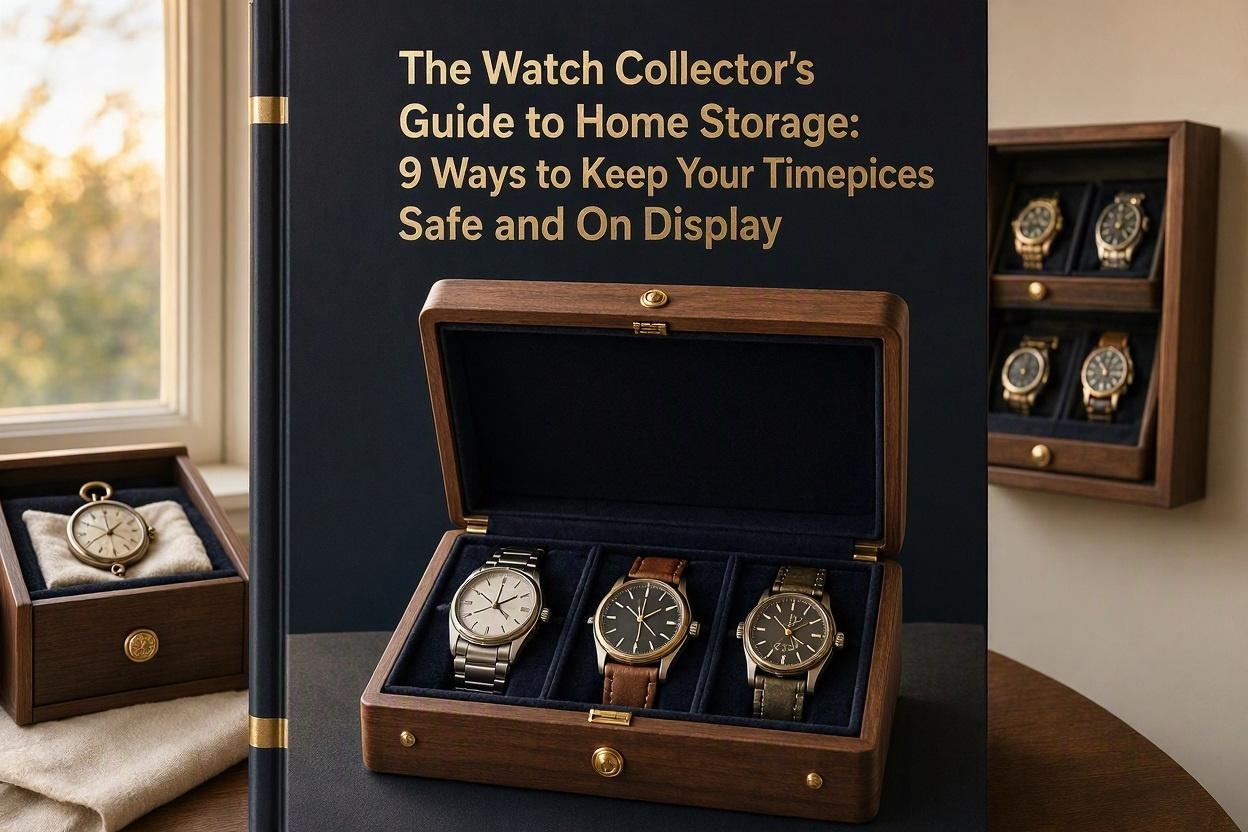
If you own more than one or two watches, you’ve probably reached the point where a bedside drawer just doesn’t cut it anymore. Automatic movements need to keep moving, leather straps need to breathe, and a £3,000 chronograph deserves better than sitting in a sock drawer next to spare change and old receipts.
How you store your watches affects more than tidiness. It affects accuracy, resale value, and how long the movement lasts before it needs servicing. The good news is that proper storage doesn’t have to mean expensive vaults or complicated routines — it just means matching the right method to the way you actually wear and rotate your collection.
Here are nine practical, tested ways to store and display a watch collection at home, along with what to look for in each option and who it suits best.
1. A Simple Watch Box for Everyday Protection
For most collectors with two to eight watches, a padded watch box is the starting point. A good box does three things: keeps dust off the crystal, cushions the case from knocks, and separates each watch so straps and bracelets don’t scratch each other.
Look for boxes with individually cushioned compartments rather than one open tray. Soft microsuede or velvet lining is gentler on leather straps than hard plastic inserts, and a lid that closes securely keeps light and dust out between wears. If you’re building out a home collection setup for the first time, this is the piece to buy first before anything more elaborate.
2. Jewellery Boxes That Double as Watch Storage
Not every collection needs a dedicated watch box. If your watches sit alongside cufflinks, rings, or a partner’s jewellery, a multi-tier jewellery box with a dedicated watch section is often more practical. These boxes usually combine soft watch pillows with drawers or compartments for smaller pieces, so everything lives in one spot instead of scattered across the dresser.
This is a good option for couples sharing storage or for anyone whose collection includes a mix of watches and other accessories. If you want to see what a well-made option looks like, you can learn more about the range of jewellery boxes built with watch storage in mind, including options with lockable lids for added security.
3. Watch Rolls for Travel and Minimal Collections
A watch roll is a soft, zip-up case that holds two to four watches in individual padded slots. It’s not built for daily home storage, but it’s the best option for travel, and many minimalist collectors use one as their only storage solution because it’s compact, discreet, and easy to tuck into a bag or drawer.
Leather or canvas rolls are the most common. If you fly often or move between a home and office watch, a roll keeps your pieces protected in transit without adding bulk to your luggage.
4. Watch Winders for Automatic Movements
If any of your watches are automatic (self-winding) rather than quartz or manual, a winder is worth considering once your collection grows past two or three pieces. Automatic movements rely on the natural motion of your wrist to keep the mainspring wound. Leave one sitting still for more than a day or two and it will stop, meaning you’ll need to reset the time and date every time you pick it up.
A winder gently rotates the watch at intervals that mimic wrist movement, keeping the mainspring wound and the lubricants inside the movement evenly distributed. This matters most for watches with complications like a perpetual calendar, moon phase, or annual calendar, where resetting the date after the watch stops can take several minutes of fiddly crown adjustment.
Not every automatic watch needs a winder. If you wear a piece every few days, manual winding or simply wearing it is enough. Winders earn their keep for watches that sit unworn for a week or more at a time, or for anyone rotating through five or more automatics on a regular basis.
5. Display Cases for Watches You Want to See
Storage doesn’t have to mean hiding your watches away. Glass-topped display cases let you keep a collection visible on a dresser, shelf, or desk while still protecting it from dust and accidental knocks. This works particularly well for watches you’re proud of and want to enjoy looking at, even on days you’re not wearing them.
The right case depends on how many watches you own and how much shelf or counter space you have. Some sit flat like a jewellery display; others stand upright, similar to a small cabinet. If you’re weighing up which style suits a growing collection, it’s worth taking a look at some current options here before deciding between a flat case and an upright one.
6. Wall-Mounted or Cabinet Storage for Larger Collections
Once a collection grows past ten or twelve pieces, drawer-based boxes start to feel cramped. Wall-mounted cases or dedicated cabinets solve this by giving each watch its own visible slot without taking up desk or dresser space. These work well in a dressing room or study and turn a collection into something closer to a small gallery.
The main thing to check with wall-mounted storage is UV exposure. Direct sunlight fades dials and dries out leather straps over time, so position any wall case away from windows or use one with UV-filtering glass.
7. Safes for High-Value Pieces
For genuinely high-value watches — pieces you wouldn’t want to lose to theft or a house fire — a safe is worth the investment, even if it’s just for your one or two most valuable timepieces. A small fireproof, humidity-controlled safe keeps a watch secure without sacrificing the environmental stability that mechanical movements need.
If you go this route, keep a small humidity pack inside to prevent condensation, since safes are sealed environments and can trap moisture if a watch goes in slightly damp from being worn.
8. Climate and Humidity Control, Whatever Storage You Choose
Whichever method you land on, temperature and humidity matter more than most people realise. Metal components inside a mechanical movement expand and contract with temperature changes, which affects accuracy over time, and swings in humidity can lead to condensation under the crystal or, in worse cases, corrosion inside the case. A stable room temperature and moderate humidity — avoiding damp bathrooms, garages, or anywhere near a radiator — is the simplest way to protect a collection long-term. For a closer look at how climate affects a watch’s internals and what conditions to aim for, Longines has a useful storage guide worth reading if you want the full picture.
9. A Rotation System for Growing Collections
Once you own more than four or five watches, storage becomes as much about organisation as protection. A simple rotation system — deciding which watches are “in play” for the week and which are resting in a box or winder — keeps automatics from running down unnoticed and makes it easier to actually wear the collection you’ve built, rather than defaulting to the same one or two pieces out of convenience.
Some collectors keep a rough log of wear; others just rotate by season or occasion. Either way, having a system prevents watches from sitting untouched for months, which is when most storage-related issues (stopped movements, dried-out straps) tend to show up.
Final Thoughts
There’s no single correct way to store a watch collection — the right setup depends on how many pieces you own, whether they’re automatic or quartz, and whether you want them visible or tucked away. A single watch box is plenty for a small, everyday collection. A winder becomes worthwhile once automatics start sitting idle. Display cases and cabinets make sense when you’ve built something you’re proud to show off. Whatever combination you choose, the underlying goal is the same: keep dust, moisture, and sudden temperature swings away from the movement, and your watches will hold their accuracy and their value for years longer than they would in a drawer. For anyone building out their storage setup, Aevitas UK carries boxes, winders, and cases designed specifically around these needs.
FAQs
How many watches do I need before I should buy a watch winder?
There’s no strict number, but most collectors find a winder useful once they own two or more automatic watches that don’t get worn daily. If an automatic sits unworn for more than a day or two, it will stop and need resetting, which is the main problem a winder solves.
Is it bad to store a watch flat versus upright?
Not generally. Either position is safe for most watches, though very high-precision or vintage movements can sometimes show slight timing differences depending on position. For everyday luxury watches, flat storage in a padded box or upright in a display case are both fine.
Do quartz watches need any special storage?
Quartz watches are more forgiving than automatics since they don’t need winding, but they still benefit from a dust-free, temperature-stable environment. Remove the battery if you’re storing one for many months to avoid leakage damage.
Can humidity really damage a watch that’s water-resistant?
Yes. Water resistance ratings apply to submersion, not necessarily to long-term humidity exposure through worn gaskets or seals. Storing watches in a stable, moderately dry environment protects against condensation and corrosion even in water-resistant models.
Should I keep my watch collection in a safe or on display?
It depends on value and risk tolerance. High-value pieces are often best kept in a humidity-controlled safe when not worn, while more everyday pieces are perfectly safe in a display case or watch box on a dresser. Many collectors use both — a safe for their most valuable watches and a display case for the rest.