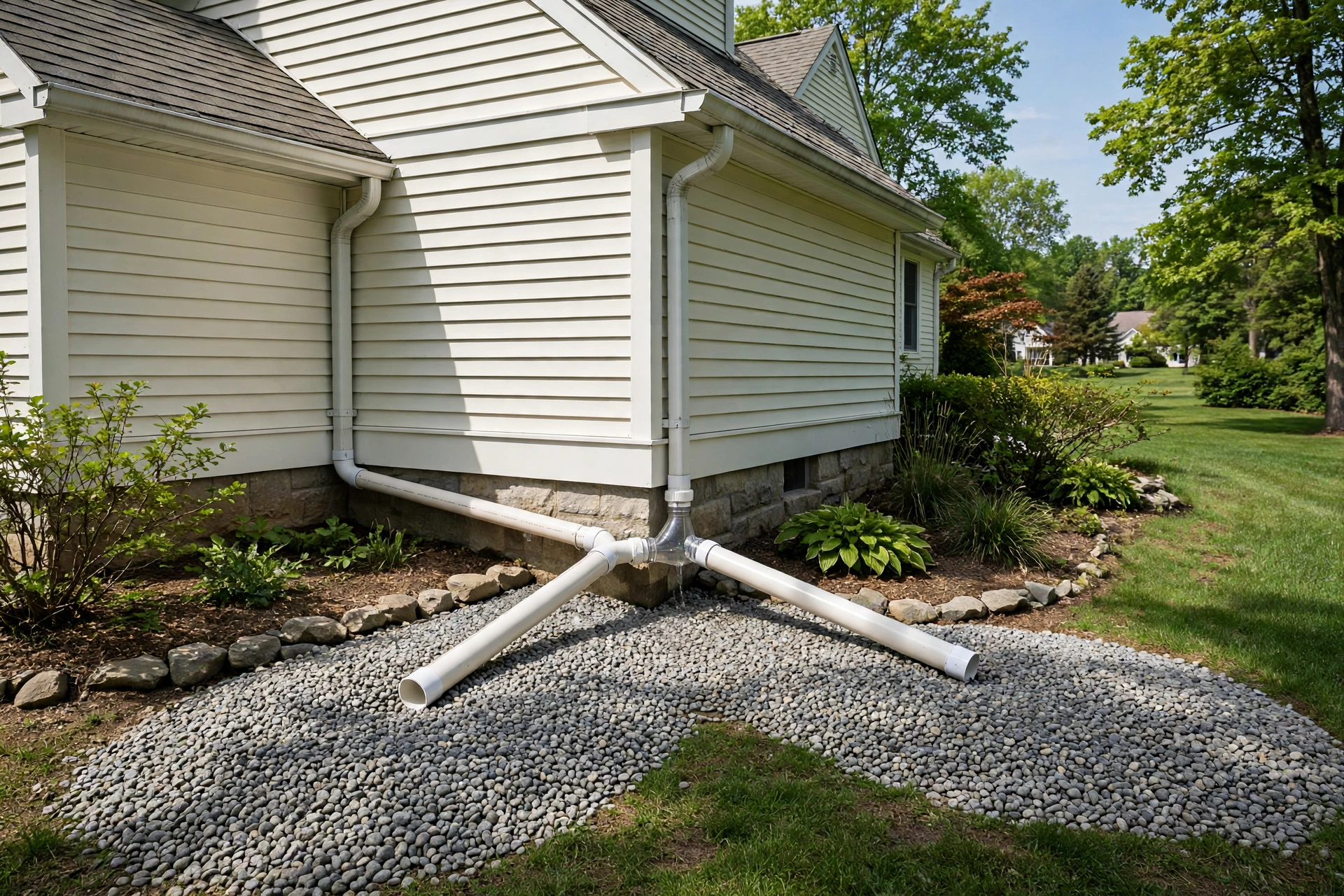
Every downspout is a funnel that concentrates the rain from a large roof area into a single narrow stream, and where that stream lands decides whether the foundation stays dry or sits in permanently saturated soil. A downspout that discharges beside the wall can pour hundreds of gallons against the foundation in a single storm, and repeated soaking is one of the most common and most preventable causes of basement leaks, cracked walls, and settlement. Separating the downspout from the foundation, by moving the discharge point well away from the house, is a small project with outsized results.
Downspout separation simply means breaking the direct path between roof water and foundation soil. It can be as simple as a surface extension or as complete as a buried drain running to a pop-up emitter in the yard, and the right choice depends on soil type, lot shape, and how much water the roof collects. This article explains how to measure the problem, compare the separation options, install the common systems, and keep them working through every season.
How Roof Water Saturates the Soil Beside Your Foundation
Roof water does not spread evenly across a yard. Gutters collect it from hundreds of square feet of roof and deliver it through a downspout to a single point, often within a foot of the foundation wall. That concentrated flow overwhelms the soil’s ability to absorb it, so water ponds, runs back toward the wall, and soaks the backfill that was placed loosely around the foundation during construction.
Saturated soil causes two kinds of damage. First, it exerts hydrostatic pressure against basement and foundation walls, pushing water through cracks, joints, and porous concrete into the interior. Second, in clay soils it swells when wet and shrinks when dry, and that repeated expansion and contraction moves the foundation itself, opening cracks that let in even more water. The cycle feeds on itself, which is why a downspout problem left alone for years often ends as a foundation repair rather than a drainage job.
How Much Water One Downspout Really Delivers in a Storm
Homeowners routinely underestimate roof runoff because a downspout looks small, but the numbers are startling. A single inch of rain falling on a 1,000-square-foot roof generates more than 600 gallons of runoff, and a downspout serving a 500-square-foot section of roof can discharge more than 300 gallons in one inch of rain, often in under an hour during a heavy storm. That volume arriving at one spot beside the foundation is equivalent to emptying a small swimming pool against the wall several times a year.
The concentration matters more than the total, because soil can absorb a gentle rain spread over a lawn but cannot absorb hundreds of gallons dumped on one square metre. Clay soils are worst, absorbing slowly and holding water against the wall for days, while sandy soils drain faster but still erode around the discharge point. Knowing the volume reframes the job: the goal is not to manage a trickle but to move a serious flow safely away from the structure.
- Measure your roof area feeding each downspout by pacing the gutter length and the roof slope depth.
- Estimate the storm volume at roughly 600 gallons per inch of rain per 1,000 square feet of roof.
- Watch one storm and time how long water runs from each downspout to see which ones carry the most.
- Check the soil after rain: if it stays soft and wet for days near a downspout, that outlet is failing.
- Note the foundation signs such as damp patches, efflorescence, or cracks that align with downspout positions.
These observations decide how far the water must travel and how robust the system needs to be. A downspout on sandy soil with a gentle roof may be fixed with a simple extension, while the same downspout on expansive clay with a large roof catchment usually needs a buried drain.
Separation Options at a Glance
Separation systems fall into three families: surface, subsurface, and reuse. Surface systems are cheap and fast but visible and vulnerable to mowing and foot traffic. Subsurface systems are permanent and discreet but need digging and careful grading. Reuse systems store water for the garden but need overflow planning so a full barrel does not dump beside the wall during the next storm.
| System | Discharge distance | Cost level | Best situation |
|---|---|---|---|
| Rigid surface extension | 6 to 10 feet | Low | Quick fix, clay soil |
| Flexible roll-out extension | 6 to 10 feet | Low | Temporary or seasonal |
| Underground drain to pop-up emitter | 10 to 20 feet | Moderate | Permanent, tidy lawns |
| Dry well or soakaway | 10 feet or more | Moderate | Permeable soil, space |
| Rain barrel with diverter | At the wall, overflow away | Low to moderate | Garden watering |
| French drain connection | 10 feet or more | Higher | High water table |
No single option suits every home, and many houses end up with a mix: surface extensions on the easy sides, a buried drain where the lawn is used heavily, and a rain barrel where the garden needs water. The unifying rule is the discharge distance, and any system that still releases water within a few feet of the wall has not actually separated anything.
Surface Extensions: The Fastest Fix for Foundation Saturation
A surface extension is a length of pipe or flexible tube that connects to the downspout elbow and carries water further across the ground. Rigid aluminium or PVC extensions hold their shape, resist crushing, and can be hinged upward for mowing, while flexible corrugated tubes are cheaper and follow the ground but can kink and trap debris. Either type works when it is long enough and sloped so water flows out rather than pooling inside.
Length is the critical detail. On clay soils six feet is the practical minimum and eight to ten feet is better, because the backfilled soil beside a foundation typically extends several feet out and stays looser and more absorbent than undisturbed ground. Water released inside that backfill zone simply returns to the wall. Aim the extension downhill and away from walkways, and anchor it so wind and mowing do not shift it back toward the house.
- Use rigid extensions where the run crosses a walkway or lawn that gets mowed.
- Use flexible extensions for short-term fixes or awkward angles that rigid pipe cannot follow.
- Keep a downhill slope along the whole extension so water drains fully and does not freeze inside.
- Secure the joint at the elbow with screws or a clamp so the extension cannot slip off in a storm.
- Add a splash pad at the outlet to spread flow and stop erosion where water leaves the pipe.
Surface extensions are the right first step for almost every home because they cost little and prove the concept immediately. If the soil beside the foundation dries out within a season of fitting them, the diagnosis was correct and a permanent buried system can follow with confidence.
Installing an Underground Drain to a Pop-Up Emitter
An underground drain is the permanent version of the surface extension, carrying roof water through buried solid pipe to a pop-up emitter well away from the house. The work is straightforward but physical: dig a trench, lay pipe with a consistent fall, connect it to the downspout, and finish with an emitter that opens under water pressure and closes again to keep out soil and pests.
Mark the route from the downspout to a discharge point at least ten feet from the foundation.
Dig a trench about eight inches wide and deep enough to keep the pipe below frost and mower depth.
Connect a downspout adapter at grade level and run solid, non-perforated pipe along the trench.
Maintain a fall of at least one percent, roughly one inch of drop per eight feet of run.
Fit a pop-up emitter at the end, set flush with the lawn so a mower passes over it.
Backfill carefully, compact lightly, and test with a hose before the first rain.
Solid pipe is essential here, because perforated pipe would leak water along the whole run and defeat the purpose. The most common installation mistake is a flat section or a dip in the trench, which holds water, freezes in winter, and eventually blocks the pipe. A string line and a level during digging prevent that, and a hose test before backfilling proves the fall is right.
Rain Barrels, Diverters, and Dry Wells That Store the Flow
Reuse systems turn roof water from a problem into a resource, but they need overflow discipline. A rain barrel holding 50 to 200 gallons connects through a diverter fitted in the downspout, and when the barrel fills, the diverter must send the excess water away from the foundation rather than letting it spill at the wall. Elevating the barrel on concrete blocks gives enough head for a garden hose, and a firm level base stops it tipping when full.
Dry wells suit homes with permeable soil and space to spare. A gravel-filled pit buried ten feet or more from the house receives downspout water through solid pipe and lets it soak away slowly, which works well where the water table is low and the soil drains. In clay soil a dry well fills and overflows, so it is a poor choice there, and a French drain connection is usually the better investment. Whichever reuse option is chosen, the overflow route matters more than the storage itself, because every system is full during the storm that matters most.
Grading and the Six-Foot Rule for Dry Foundation Walls
Separation works best when the ground itself helps, and that means positive grading: soil sloping away from the house so surface water keeps moving outward. A common guideline is at least six inches of fall over the first ten feet from the wall, and five inches over the first six feet is a useful minimum where space is tight. Without that slope, even a well-placed discharge can flow back toward the foundation along the surface.
| Soil type | Minimum discharge distance | Grading notes |
|---|---|---|
| Sandy, free-draining | 6 feet | Slope matters less, erosion matters more |
| Loam, mixed | 6 to 10 feet | Standard grading, watch for low spots |
| Expansive clay | 10 feet or more | Critical grading, avoid ponding |
| High water table | 10 feet or more | Discharge to daylight, not a soakaway |
Check grading with a level and a tape after heavy rain, when low spots show as puddles. Top up settled soil beside the foundation with compacted fill, not loose topsoil that washes away, and keep mulch and planting beds from damming water against the wall. Grading and separation together do more than either alone, because one moves the water and the other keeps it moving.
Maintaining a Separated Downspout System Through the Seasons
A separated system needs little attention, but neglect undoes it quietly. Leaves in the gutter become leaves in the pipe, a crushed extension becomes a pond beside the wall, and a pop-up emitter jammed with silt becomes a sealed pipe that backs water up to the foundation. A short seasonal routine prevents all three.
- Spring: flush each downspout and extension with a hose and check pop-up emitters open freely.
- Summer: clear gutters after storms and check flexible extensions for kinks and crushing.
- Autumn: remove leaves from gutters, guards, and emitter grates before the rainy season.
- Winter: confirm buried pipes drain fully so standing water cannot freeze and split them.
- After any storm: walk the discharge points and confirm water actually left the system.
This routine takes under an hour a year and protects the whole investment. Keep a spare emitter cap and a short length of matching pipe on hand, since those are the parts most often damaged by mowers, and replace them the same weekend they break.
Downspout Separation FAQs
How far from the house should a downspout discharge?
At least six feet on free-draining soil and ten feet or more on clay soil or where the house has a basement. Splash blocks alone only move water two to three feet, which is rarely far enough to protect a foundation.
Can I bury a downspout drain myself?
Yes, a straight run to a pop-up emitter is a manageable DIY job with a shovel, solid pipe, and a level. Call a professional if the route crosses utilities, needs to pass under a driveway, or the yard has no downhill outlet.
Will a rain barrel solve my foundation water problem?
Only if its overflow is routed away from the house, since a full barrel spills at the wall during the heaviest rain. Use a diverter that returns excess flow to a separated outlet, and treat the barrel as storage, not drainage.
What slope does an underground downspout drain need?
A minimum fall of about one percent, roughly one inch per eight feet of run, keeps water moving by gravity. Some installers use one-eighth to one-quarter inch per foot for extra reliability on long runs.
Why is water still pooling near my foundation after separation?
Check that the extension or pipe actually discharges beyond the backfill zone, that the ground slopes away from the wall, and that the pipe is not blocked or flat. Water released inside the backfill or on ground sloping toward the house returns to the wall.
Final Thoughts: Separation Is the Cheapest Foundation Insurance
Downspout separation is unglamorous work, yet it prevents the most expensive problems a house can develop. Moving hundreds of gallons per storm from the foundation wall to a safe discharge point costs little, takes a weekend at most, and pays back every time it rains. Measure the roof area, pick the system that fits the soil and the lot, and verify the discharge with a hose before the next storm, because a foundation that stays dry is a foundation that stays still.