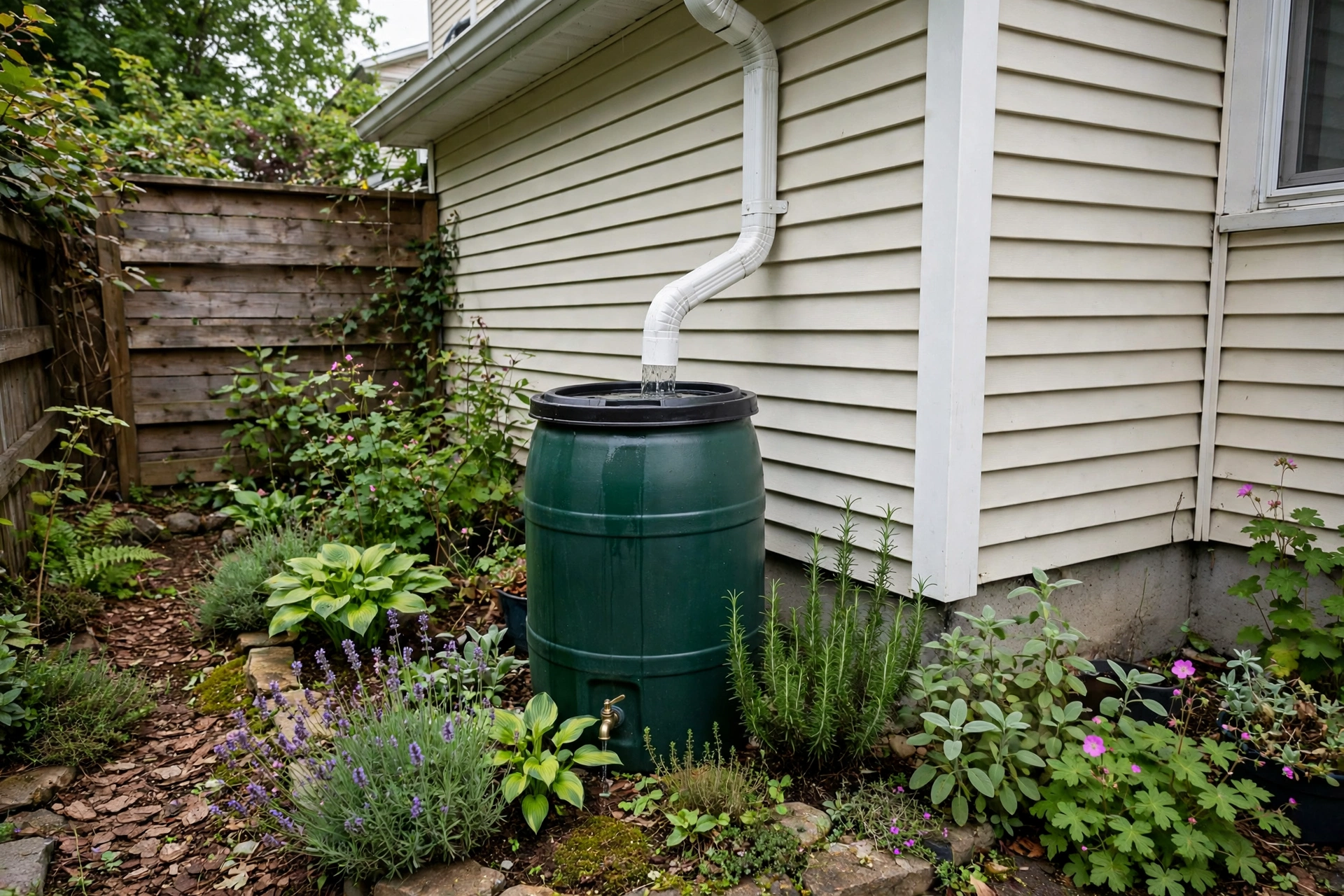
A compact garden leaves no room for trial and error. When the only free ground is a narrow side passage or a corner behind the bins, a rain barrel in the wrong spot becomes a tripping hazard, a mosquito nursery, or a slow leak against your foundation. Placed well, it quietly waters containers and beds for months.
The short version: put a slim, flat-backed barrel as close to the downspout as the wall allows, on level, load-bearing ground, raised just high enough to slide a watering can under the spigot, with its overflow piped to lawn, a rain garden, or a second barrel well away from any foundation, and never pointed at a neighbor's property.
Start With the Downspout: Reading Your Roof Before You Pick a Spot
Most placement guides start with the barrel. Start with the roof instead. A barrel only catches what a downspout delivers, and in a small yard you rarely get a free choice: one or two downspouts will be usable, while the rest sit over a driveway or a front yard where local rules may forbid a barrel.
Map Which Roof Section Feeds Each Downspout
Each downspout drains a specific roof section, not the whole roof. Measure that section's length and width, then multiply: square feet, times inches of rain, times 0.623 gives you gallons. A 400-square-foot section in a one-inch storm sends roughly 249 gallons toward one downspout, nearly five standard 55-gallon barrels.
The 623-Gallon Reality Check for a Single Storm
One inch of rain on 1,000 square feet of roof produces roughly 623 gallons of runoff, so a 55-gallon barrel often fills in a single moderate storm. In a compact garden, placement is really overflow management: choose the downspout whose overflow path is easiest to route safely.
Slim, Flat-Backed, or Linked: Barrel Shapes That Fit Tight Footprints
A standard round drum is about two feet across. In a three-foot side passage, that leaves almost no walking room and no space to crouch beside the spigot. Slim tanks, flat-backed barrels, and linked smaller barrels were designed for exactly this problem.
Why a Slim Profile Beats a Round Drum in a Side Passage
A slim or flat-backed barrel sits flush to the wall, so the passage stays passable and the spigot stays reachable. Look for an opaque body, a tight-fitting lid, a screened inlet, and an overflow fitting near the top. If you reuse a drum, confirm it is food-grade and previously held only food ingredients such as juice or vinegar. Never use one that held chemicals, fuel, or pesticides.
Daisy-Chaining Two or Three Small Barrels Along a Fence
Linking two or three 15- to 25-gallon barrels with short hoses spreads the same capacity across several corners instead of one bulky tank. As the first barrel fills, its overflow runs into the next one. Keep every barrel on the same level: a lower one will overflow before the higher barrels have filled.
Four Tight Spots Worth Considering Around a Small Home
Rank each candidate by three tests: can the downspout reach it, can the overflow leave it safely, and can you still reach the spigot, lid, and screen for maintenance?
Beside the Downspout, Tucked Tight Against the Wall
The simplest placement and usually the best. The inlet connection stays short, the barrel is sheltered by the wall, and the overflow hose has a clear run. Leave a few inches of breathing room behind the barrel, and keep it clear of basement windows and window wells, where spilled water can collect.
The Side Passage Between House and Fence
A side passage works if it stays wide enough to walk past the barrel with a watering can. Measure with the barrel in place, not empty: you need room to crouch, lift, and turn. Keep the barrel on the house side where possible, so overflow runs toward the garden, not the fence line.
Under the Deck or Stairwell Void
The dead space beneath a raised deck or exterior stair is often the largest unused pocket in a small yard. A slim tank or bladder fits here and stays out of sight, but set it on the ground below, not on the deck itself: a full 55-gallon barrel weighs more than 450 pounds, which most decks are not designed to carry.
The Utility Corner Near Bins and the Air Conditioner
The corner holding bins, meters, and the air-conditioning unit is usually the least-loved patch of ground, which makes it a good candidate. Keep the barrel clear of the air conditioner's airflow and service access, and do not block meter readers or bin collection.
Overflow First: Routing Extra Rain Barrel Water Away From Walls
A barrel spends most of the rainy season full. What happens to the water that arrives after that point decides whether your barrel protects your home or quietly damages it. Unmanaged overflow saturates soil against the foundation and can run straight onto a neighbor's lot. Plan the overflow route before you connect anything.
How Far From the Foundation Is Far Enough?
Extension guidance commonly recommends routing overflow at least 10 feet from buildings, while some municipal guides accept about 2 meters when a diverter is fitted. In a small yard, 10 feet may be impossible, so aim for the safest destination on your own ground: a sloped lawn area, a bed that tolerates extra moisture, or a small rain garden away from foundations and doors. Never let overflow pool against a wall, collect in a window well, or cross a property line.
Diverter Kits Beat Cut Downspouts in a Small Yard
The older method cut the downspout and aimed it into the barrel's open top, so when the barrel filled, water gushed over the rim beside the house. A diverter kit sits inside the existing downspout and channels rain through a hose into the barrel; when the barrel is full, back-pressure sends water back down its original path. Still fit an overflow hose as a backup, since a heavy downpour or clogged screen can overwhelm any diverter.
Weight, Level Ground, and Gravity Flow in a Space You Can't Spare
Two facts govern every placement decision, and both bite harder in a small yard: water is heavy, and gravity only flows downhill.
A Full Barrel Weighs More Than a Bathtub
Water weighs about 8.34 pounds per gallon, so a full 55-gallon barrel weighs more than 450 pounds before counting the barrel itself. Set it on compacted gravel, concrete pavers, cinder blocks, or a purpose-built stand, on ground that is flat and firm. Avoid stacked bricks, uneven pavers, and lightweight plastic stands, which can shift under load.
Raising the Spigot Just Enough for a Watering Can
A stand 18 to 36 inches tall makes it easy to slide a watering can under the spigot and improves flow through a short hose. Each foot of elevation adds only about 0.43 pounds per square inch, so taller is not meaningfully better, and a tall, narrow stand wobbles when full. Keep the spigot at the barrel's lowest point, the overflow at its highest, and every hose run ending lower than the water level, or nothing will flow.
Keeping a Small-Space Barrel Mosquito-Free and Neighbor-Friendly
In a compact garden, a barrel sits close to your windows, your patio, and your neighbor's fence. That closeness makes mosquito control and neighbor relations part of placement, not an afterthought. A barrel that breeds mosquitoes or floods a boundary will cost you goodwill fast.
Screens, Lids, and the One-Sixteenth-Inch Rule
Keep every opening covered: a tight-fitting lid, a fine mesh screen over the inlet, and screens on the overflow and any vent. Vector-control agencies recommend mesh around one-sixteenth of an inch, fine enough to keep mosquitoes out while letting water through. Use the stored water regularly, empty the barrel between rains when you can, and clean sediment each season. A mosquito dunk labeled for rain barrels is an added option. Never drink collected rainwater unless it has been properly treated.
What to Check Before a Neighbor Notices a Problem
After the first heavy rain, walk your boundary and check four things: overflow crossing onto a neighbor's ground, standing water against a shared fence, any smell from stagnant water, and mosquitoes near the barrel. Rules vary widely, so check your city and homeowners association first. As an example, one municipal code limits barrels to 55 gallons each, allows two to be interconnected, and forbids front-yard downspout connections. Colorado allows most households two barrels totaling 110 gallons.
Placement Mistakes That Turn a Rain Barrel Into a Puddle Problem
- Most rain barrel failures are placement failures. Avoid these six:
- Parking the barrel over a basement window well or tight against a foundation with no overflow route planned.
- Setting it on soft soil or a slope, where it slowly sinks, tilts, and can tip once full.
- Running the overflow onto a path, driveway, or a neighbor's lot instead of lawn, a rain garden, or a second barrel.
- Leaving the inlet open or unscreened, which invites mosquitoes within days in warm weather.
- Stacking it high on bricks for extra pressure, which trades a small flow gain for a real tipping risk.
- Skipping the winter drain-down in a freezing climate and discovering a cracked barrel in spring.
What a Compact Rain Barrel Setup Actually Runs in Cost Estimates
Prices vary by region and retailer, so treat these figures as estimates, not quotes. A slim or flat-backed barrel typically runs about $80 to $150, a diverter kit about $25 to $50, and pavers or a basic stand about $30 to $80. Add roughly $15 to $30 for an overflow hose and fittings, and $40 to $90 to link a second small barrel. putting a straightforward do-it-yourself setup around $150 to $300 in total. An underground cistern costs far more and usually needs professional installation.
Rain Barrel Placement Questions for Compact Gardens, Answered
Can a Rain Barrel Sit Right Against My House Wall in a Narrow Side Yard?
Yes, provided the ground is level and firm, the overflow is routed away from the wall, and air can circulate behind the barrel. Keep it clear of basement windows and window wells, and use a flat-backed or slim barrel so the passage stays walkable.
How Close Can a Rain Barrel Overflow Outlet Sit to a Property Line?
There is no universal distance, and local rules vary, so check your city and homeowners association first. As a practical rule, keep all overflow water on your own ground, directed to lawn, a rain garden, or a second barrel. never onto a neighbor's lot.
Will One 55-Gallon Barrel Actually Water a Small Garden?
For containers, pots, and a few raised beds, yes, especially if you water with a can rather than a hose. A 55-gallon barrel holds enough for several watering rounds, but it refills only when it rains, so treat it as a supplement to tap water during dry spells.
Can I Put a Rain Barrel on a Balcony or Raised Patio?
Only if the structure and building rules allow it. A full 55-gallon barrel weighs more than 450 pounds on a small footprint, which many balconies are not rated for. A small 15- to 25-gallon unit is usually safer, and written permission is wise in a rental.
Do I Need a Permit or HOA Approval for a Rain Barrel in a Small Yard?
Sometimes. Some cities cap barrel size, number, height, or location, and some homeowners associations restrict front-yard installations or visible tanks. Check with your municipality and HOA before buying.
How Do I Stop a Rain Barrel From Breeding Mosquitoes in Summer?
Fit a tight lid and fine mesh, about one-sixteenth of an inch, over every opening, including the overflow. Use the water regularly, empty the barrel between rains when possible, and clean sediment each season. A mosquito dunk labeled for rain barrels adds protection where water stands over a week.
What Happens to a Rain Barrel Left Full Over Winter?
In a freezing climate, trapped water expands as it freezes and can crack the barrel or split seams. Drain the barrel fully before the first hard freeze, disconnect the diverter hose, leave the spigot open, and cover or invert the barrel so it cannot refill with snowmelt.
Final Thoughts: Fitting Rain Storage Into the Garden You Actually Have
A compact garden does not need a smaller ambition, only a smarter footprint. Start at the downspout, size the barrel to the roof section it serves, route the overflow before you celebrate the installation, and pick a shape that hugs a wall or splits across corners. Your next step: measure your downspout's roof section, check local rules, and sketch the overflow route before you buy.