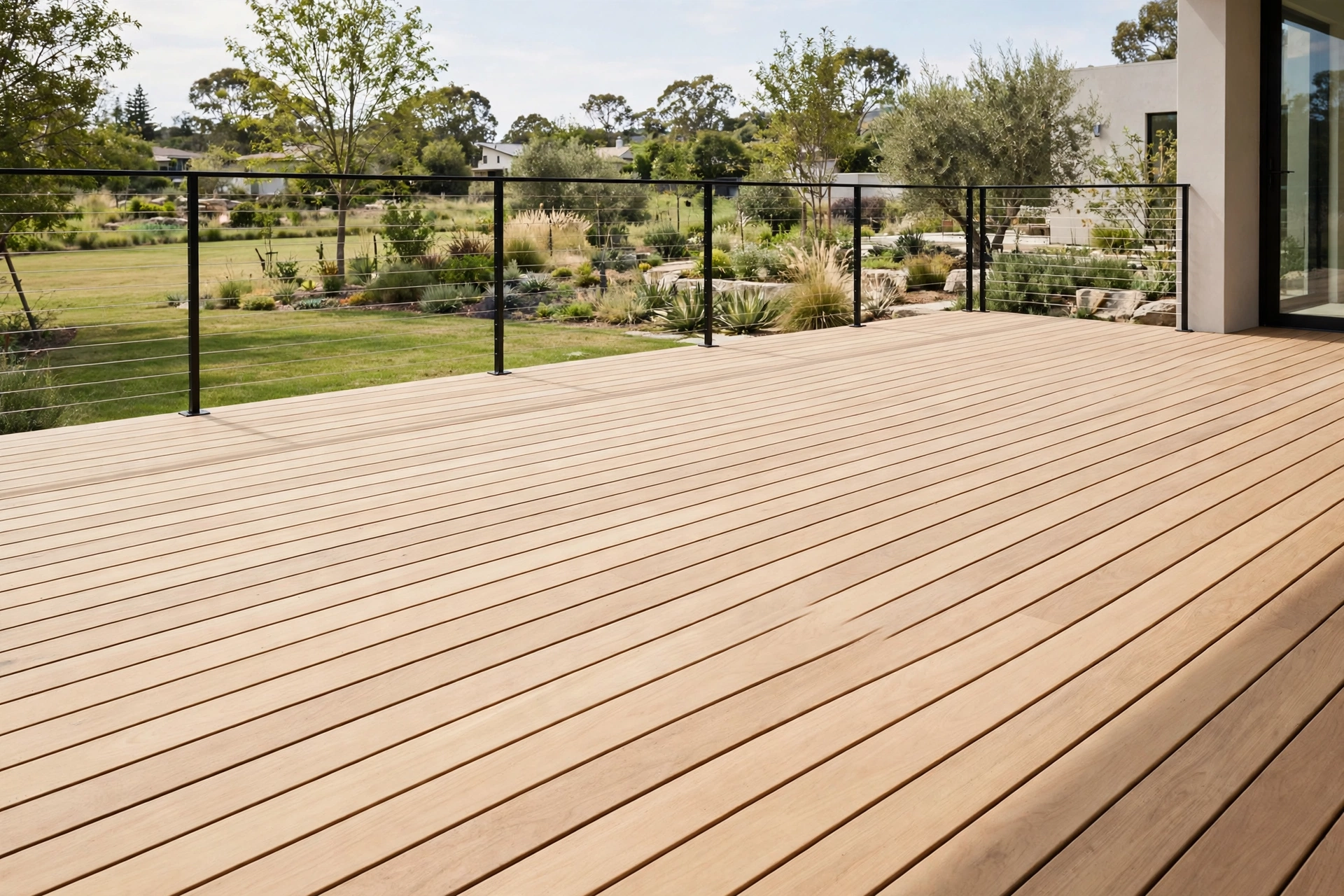
A deck covered in screw heads never looks finished, no matter how expensive the boards are. Every dark dot breaks the clean lines of a modern deck, catches bare feet, and gives water a place to sit. Hidden deck fastening systems move the hardware out of sight, so the walking surface stays smooth and unbroken.
In short, a hidden deck fastening system secures deck boards to the joists without leaving a visible screw head on the board face. Most systems use small clips that slide into grooves along the board edges, while others use edge-mounted biscuits, countersunk screws covered with matching plugs, or tracks mounted beneath the boards. For a typical grooved deck, a clip-based system gives the cleanest finish, provided the clips match the board profile.
What a Hidden Deck Fastener Actually Grips, and Why Grooves Decide Everything
A face screw drives straight through the board into the joist. A hidden fastener works sideways. The clip sits in the narrow channel, or groove, milled into the long edge of a deck board, and a short screw drives down through the clip into the joist. When the next board slides against the clip, its groove captures the other side, and the gap between the boards is set by the thickness of the clip itself. Nothing touches the walking surface.
That groove is the whole system. If your boards are not grooved, a standard clip cannot grip them. Some hardwood installers cut grooves on site with a router or biscuit joiner, and some manufacturers sell both grooved and square-edge versions of the same board, so confirm which profile you have before ordering. A clip made for one brand's groove will not necessarily fit another's, and several decking manufacturers require their own approved fastener to keep the board warranty valid. Treat the fastener as part of the same system as the board. A clip grips only one edge, so the connection relies on friction rather than the through-bolt effect of a face screw.
Clip, Biscuit, Plug, or Under-Deck Track: Sorting the Concealed Fastening Family
Four concealed approaches dominate residential decks. Grooved-board clips are the most common: a small glass-filled nylon or metal clip with a pre-set stainless screw, installed from above at every joist crossing. Edge-mounted biscuit fasteners serve dense hardwoods such as ipe; the biscuit sits in a routed edge slot and is screwed at an angle into the joist, with a spacer leg setting the gap. Plug systems drive screws through the board face, countersink them, then cover them with plugs cut from the same decking material and sanded flush. Under-deck tracks fasten boards from below, giving a fully clear surface but requiring access beneath the frame.
For most homeowners chasing a minimalist finish, grooved-board clips are the simplest choice, because the clip does the spacing work. Biscuit systems suit hardwood decks, where seasonal movement demands a fastener that tolerates expansion. Plug systems suit square-edge boards, and under-deck tracks fit low, open-framed decks.
Fitting Hidden Clips Board by Board: A Weekend Install Sequence
Hidden clip installation is methodical rather than difficult. Set the first board straight, and every board after it follows.
- Frame check first. Confirm joists are level, crown-side up, and spaced to the board manufacturer's requirement, commonly 16 inches on center, with tighter spacing for diagonal layouts.
- Start with a square-edge starter board. The first board at the house or rim edge usually cannot take a clip on both sides, so secure it with approved starter clips or face screws and keep it perfectly straight.
- Place clips at every joist crossing. Slide the clip into the groove, drive its screw into the joist at the recommended torque, and do not over-tighten, since crushing the clip weakens its grip.
- Slide the next board into place. Press its groove over the exposed clip ears, tap it snug with a scrap block, and check the gap before moving on.
- Repeat across the field, one row at a time. Do not lay several boards loose and clip them later; gaps drift quickly once boards are unanchored.
- Finish edges with the right accessory. Perimeter boards, picture-frame borders, and stair treads usually need face screws, plugs, or special end clips, because a standard clip cannot grip a cut board end.
Hidden Fastener Gaps, Joist Spacing, and Board Movement: The Numbers That Hold a Deck Together
Gap width is not a cosmetic choice. Boards need room to expand in heat and humidity and to drain water after rain. Most clip systems set the side gap automatically, commonly around 3/16 inch to 1/4 inch depending on the brand, while hardwood biscuit systems often run tighter, near 3/32 to 5/32 inch. End gaps between butt joints need separate attention: composite and PVC boards move most along their length, so follow the manufacturer's end-gap chart for your installation temperature. A gap set on a cool morning can close up on a hot afternoon if boards were installed tight.
Joist spacing controls bounce. Hidden clips do not restrain lateral movement as firmly as face screws, so a deck framed wider than the board maker allows will feel springy and can stress clip screws at board ends, where movement concentrates. Keep at least one clip at every joist crossing, including the last joist before a butt joint, so no board end floats unsupported. In coastal or wet climates, use stainless steel screws, typically 304 or 305 grade, since plain steel rusts and stains decking.
Where Hidden Fasteners Fall Short Next to Face Screws
Face screws hold more firmly against lateral movement, install faster, cost less, and make single-board replacement straightforward: remove the screws, lift the board, and fit a new one. Their drawback is visible heads on the surface, even with color-matched screws, and the risk of mushrooming, where composite material bulges around an overdriven screw head.
Hidden clips trade some holding power for appearance. Because a clip grips one edge only, it relies on friction, and boards can shift slightly at the ends during strong seasonal swings. Some builders add two face screws at board ends to restrain that movement, accepting a few visible screws for stability. Repairs are also slower, since removing a damaged mid-field board may mean unclipping neighboring boards first. The practical answer for most decks is a hybrid: hidden clips across the main field, and approved face screws or plugs for starter boards, perimeter boards, picture frames, stairs, and board ends.
The Hidden-Fastener Price Tag: Estimating Clips, Screws, and Starter Pieces
Hidden fastening costs more than face screwing, and the difference is worth budgeting before you buy boards. As a rough planning estimate, hidden clip systems typically run about $0.75 to $1.50 per square foot for clips and screws, while basic face screws run closer to $0.20 to $0.50 per square foot. Some guides put clip systems nearer $1 to $2 per square foot once starter clips, end clips, and waste are included. Treat every figure here as an estimate: prices vary by brand, region, and retailer.
To estimate quantities, multiply boards by the joists each board crosses, then add your waste allowance. Butt joints and picture-frame borders add fasteners beyond the field count, so measure those separately. If a contractor quotes the job, ask whether the quote includes the fastening system and which brand it specifies.
Slipped Clips, Squeaks, and Uneven Gaps: Fixing Hidden-Fastener Headaches
Most hidden-fastener problems trace back to a handful of installation errors. A rocking board usually means a clip was over-tightened and crushed, or a screw missed the joist center: back the screw out, replace the clip, and re-drive into solid joist material. A squeak often means a board not pulled tight, or debris in a groove: clear the groove, re-seat the board, and tighten to snug.
Uneven gaps usually appear when boards were laid loose before clipping, or a bowed board was never straightened. Sight down the gap line: if one board wanders, unclip that run, straighten the board with a pry bar against the joist, and re-clip it. A gap that closes entirely in summer usually means end gaps were set too tight for the installation temperature, which may need a board trimmed rather than a new fastener. A clip that pops out of a hardwood groove often signals the wrong clip for the species; replace it with a hardwood-rated biscuit system.
Keeping a Screw-Free Deck Surface Sound Through the Seasons
A clip-fastened deck needs little special care. Sweep debris out of the gaps each spring and autumn, because trapped leaves hold moisture against clips and joists. Wash the boards with the manufacturer's recommended cleaner, and avoid close-range pressure-washing, which can damage composite caps. After winter, walk the deck and check for boards lifted slightly at the ends, gaps that have narrowed, or clips visible in a widened gap, and fix small issues before they spread. With that routine, a well-installed hidden system should last as long as the boards.
When a Clip-Fastened Deck Job Belongs in a Pro's Hands
Hidden clip installation is within reach of a careful DIYer on a simple, ground-level, rectangular deck. Call a professional for an elevated deck, a deck attached to the house with ledger flashing, stairs, railings, or a structure that needs a permit and inspection. Ledger connections and guardrail posts are safety-critical and code-regulated, and mistakes there can cause collapse or water damage to the house. A pro is also the right call for dense hardwood decks that need on-site grooving, curved or multi-level layouts where clip spacing gets complicated, and any deck where you suspect rot, insect damage, or an undersized frame beneath old boards. If a contractor handles the work, confirm in writing that their fastening system matches your board manufacturer's approved list.
Final Thoughts: Does a Hidden Fastener System Earn Its Place on Your Deck?
For a residential deck built around clean lines and a minimalist finish, hidden fasteners earn their keep. They remove every visible screw from the walking surface, set consistent gaps automatically, and let boards expand and contract with less surface damage than face screws allow. They cost more, hold a little less firmly against lateral movement, and make mid-field repairs slower, so they are not right for every board or budget. But on the main field of a grooved deck, a matched clip system is the simplest way to get a smooth, barefoot-friendly surface.
Hidden Deck Fastening Questions Homeowners Ask Before Buying Clips
Can hidden deck fasteners be used on any deck board?
No. Standard clips need a grooved board edge to grip, so they suit grooved composite, PVC, and pre-grooved hardwood boards. Square-edge boards need a plug system, an under-deck track, or on-site grooving.
Do hidden fasteners really leave zero visible screws?
Almost, but not entirely. The main field will show no screw heads, but starter boards, perimeter boards, picture-frame borders, and stair treads usually need face screws, plugs, or special end clips, because a standard clip cannot grip a cut edge.
How many hidden fasteners does a typical deck need?
As a planning estimate, a 90-count clip box covers roughly 50 square feet at 16-inch joist spacing, and a 900-count bucket covers roughly 500 square feet. Multiply boards by joist crossings, add 10 to 15 percent for waste and butt joints, and count perimeter and stair boards separately.
Are hidden fasteners strong enough for a family deck?
Yes, for normal residential use, when the system matches the board and the framing meets the manufacturer's spacing. Face screws hold more firmly against lateral movement, so decks in extreme climates or with heavy loads may benefit from face screws at board ends or a hybrid layout.
Can I replace a single damaged board on a clip-fastened deck?
It depends on the system. Some clip designs let you release one board by removing its clips from the gap, while others require unclipping neighboring boards first. Ask about single-board replacement before you buy, and keep spare boards and clips from the original batch for color matching.
Will hidden fasteners void my decking warranty?
They can, if you use an unapproved system. Several manufacturers require their own fasteners or an approved list, and using the wrong clip can affect warranty coverage. Check the installation guide for your board brand before ordering, and keep the fastener receipt with your deck records.