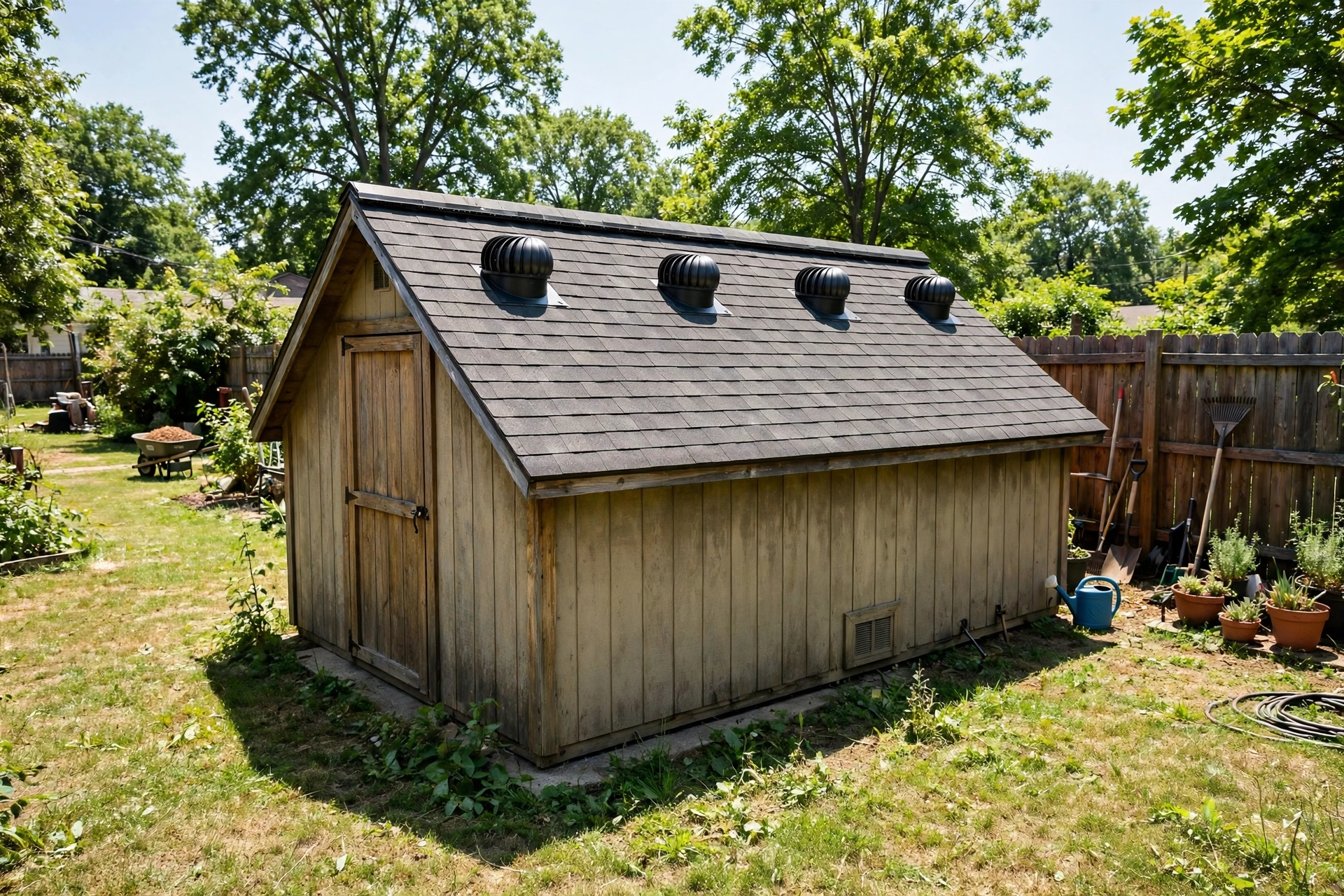
A storage shed in full afternoon sun can feel like a furnace by evening, and the harm goes beyond discomfort. Paint skins over, adhesives separate, batteries age faster, and tools pick up rust as hot, damp air condenses on cool metal overnight. Roof ventilation tackles the problem where the heat collects: under the roof deck.
The short answer: pair low intake openings near the eaves with high exhaust openings at or near the ridge, so rising hot air escapes and cooler air replaces it. For a typical garden shed, aim for roughly one square foot of total vent opening per 150 square feet of floor area, split evenly between intake and exhaust, with every opening screened against insects. Passive vents suit most storage sheds; powered fans earn their place when the shed is large, sheltered from wind or used as a workshop.
Why a Storage Shed Turns Into an Oven (and Why the Roof Is the Main Culprit)
A shed roof absorbs solar radiation all day, and a thin, uninsulated roof deck passes that heat straight into the air beneath it. Dark roofing makes it worse, and a low-pitched roof leaves less air volume to dilute the heat, so the hottest air pools at the highest point of the building. After sunset, the same trapped air causes a second problem: as the roof deck cools quickly, warm moist air inside meets its cold underside and condenses, which is why tools can feel damp in the morning even though the roof never leaked.
Ventilation breaks both cycles at once, flushing hot air out by day and carrying moisture-laden air out before it can condense at night. Be honest about its limits, though: vents move air; they do not cool it below the outdoor temperature. On a very hot afternoon a ventilated shed will still be warm, but it will track much closer to the shaded outdoor temperature than an unvented shed. For a genuinely cool workspace, add insulation or shade on top of ventilation.
How Shed Roof Airflow Works: Intake Low, Exhaust High, and How Much Opening You Need
Every passive system runs on two forces. The first is the stack effect: warm air is lighter than cool air, so it rises to the highest point of the shed and pushes out through any opening there, while cooler air is drawn in through lower openings to replace it. The second is wind, which pressurises one side and pulls air out of the other. Both forces strengthen as the vertical distance between intake and exhaust grows, which is why a single high vent disappoints on its own: without low intake openings, an exhaust vent can only stir the air already inside.
Balance matters as much as total area. If exhaust dwarfs intake, the system starves; if intake dwarfs exhaust, air enters but has nowhere to leave. Aim for a roughly equal split, and never block either half with stored boxes or insulation. The widely used sizing rule is one square foot of net free vent area per 150 square feet of floor area, split evenly. Net free area is the actual open area after louvre blades and insect screen are accounted for, so use the manufacturer's stated figure rather than measuring the frame.
Ridge Vents Along the Peak: The Quiet Workhorse for Gable Sheds
A ridge vent is a continuous, low-profile opening running along the peak of a pitched roof, covered by a cap that sheds rain. Because it exhausts along the whole ridge, it vents the roof evenly rather than at one or two points, and with no moving parts to seize or replace. For a gable-roofed shed that already has, or can gain, eave intake vents, it is usually the best exhaust choice.
The catch is that a ridge vent only performs when fed by low intake air. Without soffit or eave vents it can pull air from the nearest gap instead, sometimes drawing in wind-driven rain. It also needs a genuine continuous ridge, so it suits simple gable roofs far better than hip roofs or dormer-broken roofs. Retrofitting one means cutting a slot along the ridge and re-capping it, so pick a dry day and seal the cap carefully. On a metal roof, use a ridge vent made for that profile.
Gable, Soffit, and Eave Vents: Building the Low Intake That Makes the System Work
Gable vents are louvred openings set high in the triangular end walls of a gable shed. They are cheap, simple to fit with a jigsaw, and effective at moving air horizontally across the top of the shed. Their weakness is that they leave still pockets near the eaves, so they work best as part of a system rather than as the whole system.
Soffit vents, fitted into the underside of the eaves, are the ideal intake partner for a ridge vent. They sit at the lowest point of the roof assembly, so incoming air is the coolest available, and they are discreet and rain-sheltered. Continuous soffit strip gives the most even intake, but individual vents work if their combined area matches the exhaust. The common failure is blockage: insulation pushed into the eaves, wasp nests, or paint sealing the slots shut can strangle the intake, so inspect soffit vents each spring.
Turbines, Static Roof Vents, and Solar Fans: When the Wind or the Sun Does the Pulling
Turbine vents, often called whirlybirds, are wind-driven spinning vents mounted on the roof. They actively draw air out whenever there is a breeze, need no electricity, and are easy to retrofit without opening the ridge, which suits simple gable roofs in breezy, open sites. Their limits are real: on calm days they barely turn, and cheap models can squeak as bearings wear. Never mix turbines with a ridge vent on the same roof, because the turbine will pull air from the nearby ridge opening instead of from the low intakes, short-circuiting the system.
Static roof vents, sometimes called turtle or dome vents, are small fixed openings set into the roof deck. Each covers only a small area, so a larger shed needs several. Solar-powered roof fans are the powered option that fits a storage shed best, because they need no mains wiring and run hardest exactly when the sun is strongest. The panel must face the sun, the fan needs a weatherproof roof penetration, and an oversized fan will pull air through gaps and can draw rain in around poorly sealed flashing, so size the fan to the intake area.
Matching the Vent System to Your Roof Shape: Gable, Skillion, Flat, and Metal
Roof shape decides which vent combination makes sense. A gable roof takes the classic pairing: soffit intake plus ridge exhaust. A skillion, or single-pitch, roof has no ridge, so the system becomes low vents at the low eave and high vents or a fan at the high wall. Flat and very low-pitched roofs are the hardest to ventilate passively, because there is little height difference for the stack effect; low wall vents plus a powered exhaust fan usually outperform a token passive vent there, and penetrations should be kept to a minimum and flashed meticulously.
Fitting a Shed Roof Vent Without Inviting Rain, Wasps, or Dust Inside
A vent that leaks or admits pests is worse than no vent at all. Choose the position before you cut: exhaust vents go as high as the roof allows, intakes as low as the eaves allow, and both go where prevailing wind helps rather than fights the airflow. Mark the opening from the manufacturer's template, and cut to suit the roof material. Flashing separates a lasting installation from a drip: bed the vent flange in compatible sealant, lap flashing so water runs over it rather than behind it, and on a metal roof use the profile-matched flashing kit rather than generic flat flashing.
Screen every opening with insect mesh fine enough to stop wasps but coarse enough not to choke airflow, and fit the mesh where you can reach it for cleaning, because dust and cobwebs accumulate over a season and cut vent area. Check screens and seals each spring. Safety belongs in the plan: roof work means working at height, so use a stable ladder or scaffold, never work on a wet roof, and keep clear of overhead power lines. If the job requires cutting a rafter, notching a purlin, or any electrical work for a powered fan, bring in a qualified carpenter, roofer, or electrician.
The most frequent failure is an unbalanced system: a new ridge vent or turbine installed with no low intake, or intake vents blocked by insulation, stored boards, or paint. The fix is free: clear the intake path and confirm the split between intake and exhaust is roughly equal before buying anything else. The second slip-up is mixing exhaust types on the same roof, which short-circuits airflow. Other mistakes include vents fitted without insect screens, static vents placed low on the slope, and powered fans wired without a thermostat, so they run all night.
Shed Roof Vent Budgets: What Each Option Costs in Materials and Labour
Ventilation is one of the cheapest upgrades a storage shed can get. Prices below are broad estimates for typical residential products and DIY-friendly installation; local rates vary, so treat them as a guide rather than a quote. The cheapest effective system for most small sheds is a pair of gable vents plus low wall or soffit vents, often fitted in an afternoon with basic tools. Spend on the intake side first if funds are tight: exhaust vents without matching intake are the most common wasted purchase in shed ventilation.
Final Thoughts: Picking the Vent Setup Your Storage Shed Will Actually Benefit From
For most residential storage sheds in summer heat, the winning formula is simple and cheap: low intake vents at the eaves or low walls, a high exhaust at the ridge or gable peak, roughly equal areas on both sides, and screens on everything. Add a turbine or solar fan only if the site is sheltered from wind, the shed is large, or still days leave it stifling despite balanced passive vents. Measure your shed, apply the one-to-150 sizing rule, check the intake path is clear, and fit the system on a dry day with proper flashing.
Shed Roof Ventilation Questions Storage Owners Ask Before Cutting a Hole
Does a storage shed really need roof ventilation if nothing valuable is stored inside?
Yes, in most cases. Even basic storage suffers: cardboard softens, adhesives fail, and tools rust when hot, damp air is trapped. Ventilation also protects the shed itself, because repeated condensation rots timber framing and corrodes metal fixings.
Can I fit just one vent and call the job done?
One vent alone rarely works well. Ventilation needs an entry and an exit: low intake plus high exhaust. A single high vent can relieve some pressure, but without intake air it cannot create steady through-flow. Always fit vents as a matched intake-exhaust set.
Will roof vents let rain into my shed?
Properly fitted, no. Ridge vents are capped, gable vents are louvred to shed wind-driven rain, and turbine and static vents come with flashing kits designed for their roof profile. Leaks almost always trace back to poor flashing or a mismatched kit.
Is a solar fan better than a turbine vent for a storage shed?
It depends on the site. A solar fan forces air on still, sunny days when turbines stall, which makes it stronger for sheltered sheds in extreme heat. A turbine costs less, has no panel to position, and works in windy weather regardless of sunlight.
How do I know if my shed vents are actually working?
On a warm, breezy day, hold a strip of tissue near an intake vent: it should flutter inward, and near an exhaust vent it should flutter outward. On a still day, compare the interior temperature with the shaded outdoor temperature in the late afternoon; a well-ventilated shed tracks much closer to outdoor shade temperature.