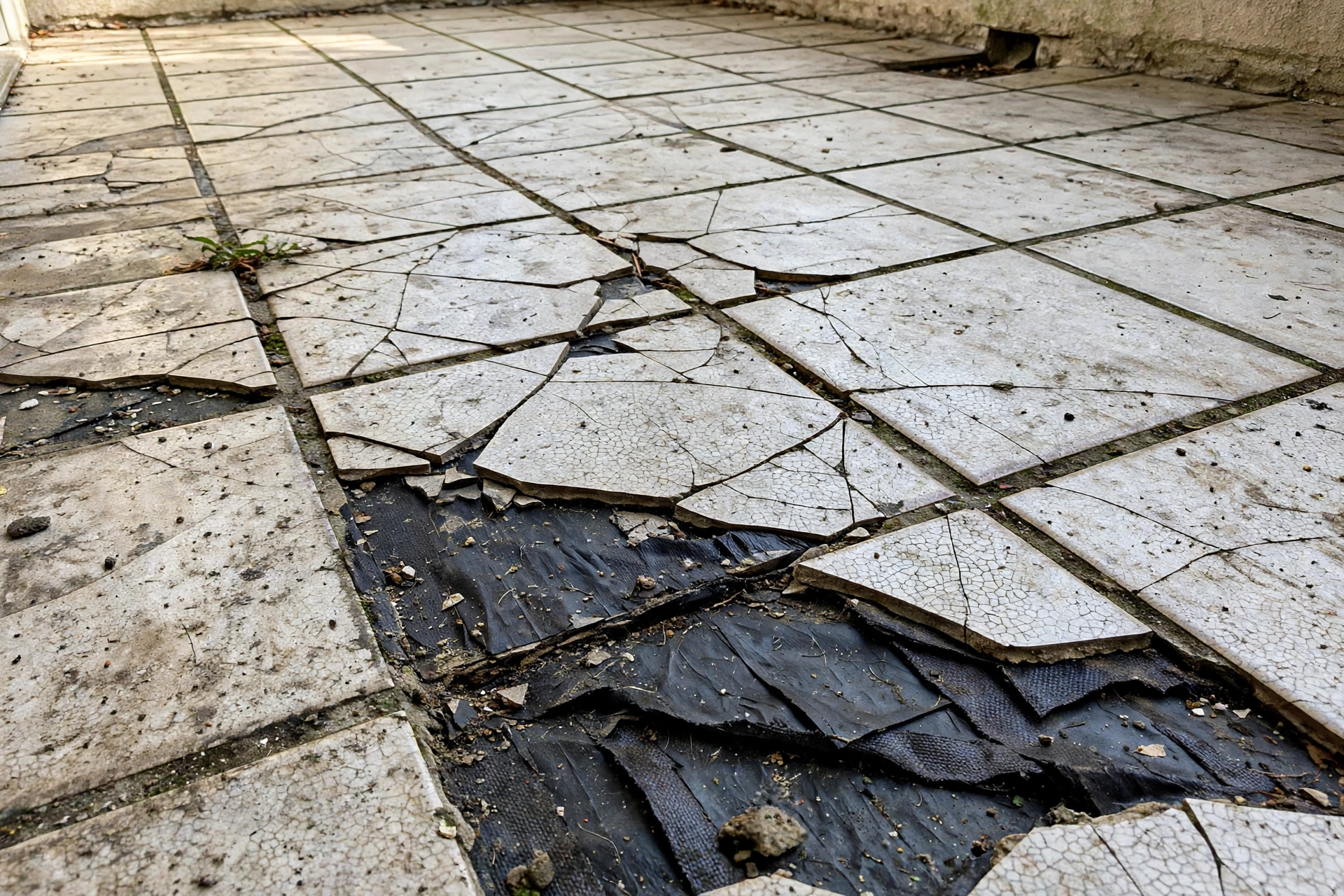
A hairline crack across a balcony tile is easy to dismiss: it looks cosmetic, the balcony still feels solid, and the membrane underneath should keep water out anyway. But the tile is the stiffest, most brittle layer in the floor build-up, so it is usually the first to show that something beneath it is moving, shrinking, or holding water. Patching the tile without finding the cause is how a small repair becomes a leaking balcony.
The Short Answer: Balcony Tiles Crack Because the Layers Beneath Them Move at Different Speeds
In short, balcony tiles crack because the tile, adhesive, screed, and slab all expand, contract, shrink, and absorb moisture at different rates, and the rigid tile cannot bend to absorb the difference. When that movement has nowhere to go — joints missing, screed tiled before it cured, water trapped under tiles, or a patchy bond — stress concentrates until the tile fractures. The membrane rarely causes the crack; more often it is the victim, torn by a tenting tile field or a slab crack. So the real question is what is moving underneath, and whether the waterproofing is still intact.
How a Balcony Tile Build-Up Is Supposed to Work, Layer by Layer
A tiled balcony is a system, not just a surface. From the bottom up, a typical build-up is the structural slab, a screed laid to falls so water drains to the outlet, a liquid-applied or sheet membrane, flexible tile adhesive, the tiles, and grout. Each layer has one job: the slab carries load, the screed creates the slope, the membrane is the only true waterproof barrier, the adhesive bonds tiles while absorbing a little movement, and the grout fills joints without being expected to keep water out.
Tiles and grout are not waterproofing. Grout is porous, and even a well-laid floor lets some water through at joints and cracks. The system assumes water reaching the membrane drains away, and layers can shift slightly without fighting each other. Cracking starts when that fails: the slope is too flat and water ponds, the adhesive cannot flex, or the field is locked tight against walls and thresholds.
Sun, Shade, and the Daily Stretch: Thermal Movement on an Exposed Balcony
No part of a home swings through temperature changes like an exposed balcony. Dark tiles in direct sun grow far hotter than the air, then cool rapidly when a storm or evening shade arrives. Tiles, adhesive, and concrete all expand and contract, but at different rates. Over a long, unbroken run, even tiny movement per tile adds up across the whole field.
Two slower forces make it worse. Some ceramic tiles gradually absorb moisture over years — moisture expansion — so the field grows almost imperceptibly, while the slab and screed shrink as they dry. The tile field is squeezed from both sides. When the squeeze exceeds what the bond can hold, tiles buckle upward into a ridge, a failure called tenting. It often arrives suddenly, sometimes with a loud pop after cold rain hits a sun-baked balcony, and it can tear the membrane as tiles lift.
When the Slab and Screed Shrink Underneath a Rigid Tile Field
Fresh concrete and screed are full of water, and as they cure, that water leaves and the material shrinks. Industry guidance commonly calls for around 28 days of curing before tiling, because most shrinkage happens in that window. Tiles fixed to a green, still-shrinking screed get pulled apart from below as the substrate contracts — sometimes months after the job looked perfect.
Cracks in the slab itself cause a related failure. Concrete naturally develops shrinkage cracks, and a slab crack tends to reflect straight through the tile above, producing a long, continuous crack across several tiles. This reflective cracking is why decoupling membranes are used in some installations: a dimpled sheet between substrate and tile absorbs lateral movement and bridges small cracks so stress never reaches the tile. A waterproofing membrane is not automatically a decoupling membrane, though — a standard liquid membrane bonded tightly on both sides transfers movement straight through.
The Missing Flexible Joint: Why a Balcony Tile Field Needs Room to Breathe
Movement joints are the single most commonly skipped detail in failed balcony tiling. A movement joint is a flexible, sealant-filled gap — not a grout joint — that divides a large tile field into smaller panels and runs around the perimeter where tiles meet walls, upstands, and door frames. It gives the tile field somewhere to expand into. Without intermediate joints at sensible intervals and a clear perimeter gap, an expanding field presses against itself and its boundaries until something gives: tiles crack, grout crumbles, or tiles lift.
The failure is often invisible at handover because joints were never drawn on the plans, or were filled with rigid grout instead of flexible sealant. A grouted joint looks finished but acts like a solid bridge, locking tiles together exactly when they need to move. Dark and cheaper, more porous tiles make it worse because they absorb more heat and moisture and move more. When inspecting a cracked balcony, a good tiler first checks whether movement joints exist, whether they hold flexible sealant, and whether the perimeter gap has been bridged.
The three joint types that matter are perimeter joints where the field meets walls and thresholds, intermediate joints dividing large fields into smaller panels, and junction joints where the floor meets a different material, a step, or a drain surround.
Water That Gets In and Cannot Get Out: Ponding, Frost, and Trapped Moisture
A balcony that does not drain properly punishes its tiles twice. Ponding water sits against grout joints and cracks, finding its way into the bedding layer. Then that trapped water attacks from below: it can soften cement-based adhesive, especially one not rated for prolonged water exposure, and keeps the screed saturated so it never stabilises. Efflorescence — white, chalky staining on grout lines — shows water moving through the build-up carrying dissolved minerals.
In cold climates, trapped water adds freeze-thaw damage: water in the adhesive bed or a porous tile expands when it freezes, prising tiles apart and widening cracks. In warmer climates the same moisture drives adhesive breakdown and mould. Either way, the membrane carries a burden it was not designed for. A perfectly applied membrane can still fail if the balcony ponds, which is why falls and clear outlets matter as much as the membrane itself.
Adhesive and Tile Choices That Turn a Sound Membrane Into a Cracked Floor
Even with correct joints and drainage, the wrong adhesive can crack a balcony floor. The most common error is a rigid or interior-grade adhesive, or one not rated for immersion or the tile type. Flexible, polymer-modified adhesives exist because outdoor beds must absorb movement; a cheap, non-flexible adhesive transfers every stress into the tile. Coverage matters just as much: spot-bonded tiles, or tiles fixed with the wrong trowel notch, end up with voids beneath them, and an unsupported section cracks under ordinary foot traffic.
Tile selection plays its part too. Large-format tiles concentrate stress and demand full coverage, usually with back-buttering, to avoid hollow spots. Highly porous tiles absorb more water and move more, while non-frost-rated tiles suffer in cold climates. Expensive tiles are not automatically safe — a premium tile on rigid adhesive over a shrinking screed will still crack. The system must be specified as a whole.
Reading the Crack Pattern: What Each Shape of Balcony Tile Crack Is Telling You
Before deciding on a repair, read what the cracks themselves are saying. Different shapes point to different causes, and the pattern often tells a tiler more than lifting a single tile will. A tile cracked by a dropped object looks nothing like a movement failure, and treating them the same way wastes money.
What a Cracked Balcony Tile Floor Costs to Put Right, and What Drives the Bill
Costs vary widely with balcony size, tile type, and how much of the system has failed, so treat the figures below as broad planning estimates only, not quotes. The cheapest outcome is a few isolated impact cracks over a sound membrane. The expensive outcome is a full strip-out: tiles and adhesive removed, membrane replaced, falls corrected, and the balcony re-tiled with proper joints. That gap is why diagnosis comes before repair.
The first is access: upper-floor balconies and edge protection add labour. The second is matching tiles: tiles are fired in batches, and one bought years later may differ in shade or size, so keeping spares from the original batch helps. Get the diagnosis and repair specification in writing before work starts.
Balcony Tile Cracks You Can Patch, and the Ones That Need a Waterproofer or Engineer
A single cracked tile from a dropped pot, with solid adhesive beneath and no damp below, is a reasonable DIY repair: lift it carefully without damaging the membrane, check for tears, bed the replacement in flexible exterior adhesive, and re-grout. Stop and call a professional if you find tenting or widespread lifting, a hollow drummy sound across large areas, damp patches below, efflorescence streaming from edges, ponding water, or a crack pattern mirroring a slab crack.
For those cases, a waterproofing specialist or remedial engineer should diagnose the build-up first — often with moisture readings and a test section of lifted tiles — and specify whether the membrane can be repaired locally or the balcony needs a full rebuild. Structural warnings such as a sagging slab, widening cracks in the slab edge, or rust staining from reinforcing steel should go to a structural engineer first. On apartment balconies, check strata rules too: the membrane and slab are often common property.
Final Thoughts: A Cracked Balcony Tile Is a Symptom, Not the Disease
Balcony tiles do not crack because tiles are fragile. They crack because they are the rigid surface of a system that moves, shrinks, absorbs water, and freezes — and because that system was designed without room to move, or installed without the curing time, drainage, and joints it needed. Read the crack pattern, check the joints and drainage, and verify the membrane before you re-tile.
Balcony Tile Cracking Above Membranes: Questions Homeowners Ask
Can I Just Replace the Cracked Balcony Tiles and Leave the Rest Alone?
Only if the cause is local, such as impact damage, and the membrane beneath is intact. If cracking comes from missing joints, a shrinking screed, or trapped water, new tiles will crack again, often within a season or two.
Does a Cracked Tile Mean the Waterproofing Membrane Has Already Failed?
Not necessarily. Tiles can crack from thermal movement while the membrane stays sound, but a crack lets water into the bed, and tenting tiles can tear a membrane. Lift a tile and inspect it, or have a waterproofer test the area.
Why Did My Balcony Tiles Crack Years After Installation Instead of Straight Away?
Because several causes are slow: tiles grow as they absorb moisture, screeds keep shrinking, and adhesive weakens over years of wetting cycles. Failure often appears suddenly — after a hot spell followed by cold rain — but the stress built up for years.
Will Sealing the Cracks With Grout or Sealant Stop the Problem?
Sealing can slow water entry temporarily, but rigid grout in a moving crack will crack again, and sealant over a tenting field hides the symptom while the membrane may still be tearing. Treat it as a stopgap, not the repair.
Do I Need to Re-Waterproof the Whole Balcony When Tiles Crack?
Not always. If the membrane is intact and the cause is missing joints or a local adhesive failure, a targeted repair can work. Full re-waterproofing is needed when the membrane is torn, ponding is chronic, or failure is widespread — confirmed by inspection, not guesswork.
Is a Tenting or Lifting Balcony Tile Dangerous?
Yes. Lifted tiles have sharp edges and create a trip hazard, and buckling can damage the membrane and leak into rooms below. Keep people off the area, do not glue tented tiles back down, and arrange an inspection promptly.