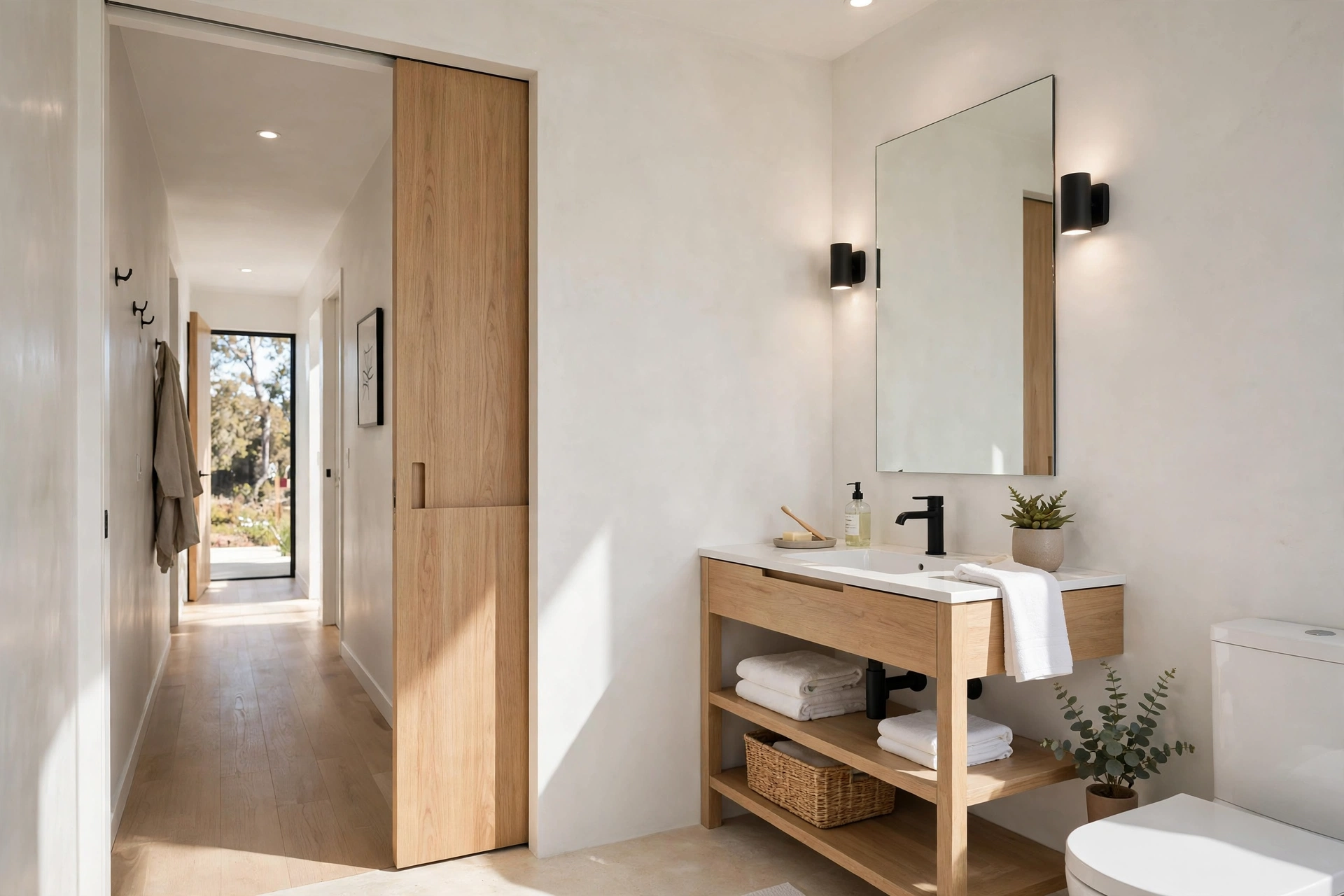
A swinging bathroom door can turn a narrow hallway into an obstacle course. It needs a clear arc to open, it can block a towel rail, a linen cupboard, or the path to the next room, and in a compact home that arc is often space you do not really have. A pocket door changes the geometry of the problem: instead of swinging into the hallway or the bathroom, the panel slides sideways into a cavity inside the wall, leaving both rooms free to be used in full.
That simple change is why pocket doors are so popular in small bathrooms, en suites, and homes where a hallway is barely wide enough for one person to pass comfortably. The trade-off is that the wall itself has to do more work. It must hide the track, the rollers, and the full width of the door, and it cannot contain pipes, wires, or structural framing in the way. This article explains which pocket door designs work best in tight layouts, how to measure and plan around what is inside your walls, and what to watch for on privacy, moisture, and long-term maintenance.
The Short Answer: Why a Pocket Door Frees a Narrow Bathroom Hallway
A pocket door saves usable space because it removes the door swing entirely. A standard hinged door for a bathroom is usually about 28 to 32 inches wide, and it needs roughly that same distance of clear floor in front of it to open. In a hallway that is only 36 to 42 inches wide, that swing can consume most of the passage and force you to step aside every time someone enters or leaves the bathroom.
How a Bathroom Pocket Door Actually Works Inside a Tight Wall
A pocket door system has four main parts working together. At the top, a metal track is fixed to a header inside the wall cavity. Hangers attached to the top of the door panel carry rollers that run along that track. At the bottom, a guide keeps the panel from swinging sideways, and a frame kit forms the pocket itself, with vertical studs that are thinner and more closely spaced than ordinary wall framing.
- Track and hangers: The track must be level and firmly fixed, because even a small slope will make the door drift open or closed on its own.
- Rollers: Good-quality rollers, ideally with ball bearings, make a heavy solid-core door feel light and keep it from jumping off the track.
- Pocket frame: The frame kit replaces ordinary studs in the pocket area and leaves a slot just wide enough for the panel to slide through.
- Guides and stops: A floor guide and end stops prevent the door from rattling, over-travelling, or disappearing too far into the pocket.
- Trim and jambs: Split jambs on each side of the opening hide the pocket edges and give the finished doorway a clean, framed look.
When the door is closed, it looks much like a normal door, except that the handle sits flush or nearly flush with the panel. When it is open, only the leading edge remains visible, which is why a pocket door can make a small bathroom feel larger even though the room itself has not changed size at all.
Pocket Door Styles That Fit Narrow Hallways and Compact Bathrooms
Not every pocket door suits a bathroom. A glass panel that looks beautiful in a living room may feel too exposed beside a bath, while a very heavy timber door may need a stronger frame than a thin partition wall can provide. The table below compares the styles most often used in compact bathrooms and narrow hallways, so you can match the design to your need for privacy, light, and durability.
Measuring a Narrow Hallway Before You Choose a Pocket Door Frame
Measurement is where pocket door projects succeed or fail, and it deserves more care than a hinged door replacement. You are not just measuring the opening; you are measuring the whole wall that will swallow the door. Start with the finished opening width and height, then measure the pocket wall from the opening to the nearest corner, junction, or obstruction, and confirm that the wall is thick enough for the frame kit you plan to use.
Measure the finished opening at the top, middle, and bottom, and use the smallest width as your working figure.
Check the pocket wall length: it should be at least twice the door width, so the panel has somewhere to go when fully open.
Confirm the wall thickness and the depth of the frame kit, especially if you want a solid-core or glass door.
Look for switches, sockets, and plumbing on both faces of the pocket wall, and plan to move anything that sits in the sliding zone.
Check the floor: a level, continuous floor finish helps the bottom guide work smoothly and prevents the door from catching.
If the pocket wall is too short, too thin, or full of services, do not force a recessed pocket door into it. A surface-mounted sliding door, sometimes called a barn-style door, can give you much of the same floor-space saving without opening the wall, although it will sit proud of the wall and needs clear wall space beside the opening when it is open.
Privacy, Sound, and Moisture: What Changes With a Bathroom Pocket Door
Privacy is the most common worry about a bathroom pocket door, and it is a fair one. A pocket door does not seal against its frame in quite the same way as a hinged door pressed against a stop, so a small gap around the panel is normal. That gap matters less if you choose a solid-core panel, fit a proper bathroom privacy lock with an emergency release, and add brush seals or soft-close hardware that pulls the door gently into its closed position.
Pocket Door Installation Hurdles Hidden Inside Bathroom Walls
Opening a bathroom wall can reveal surprises, and the most common are the ones you cannot see from the hallway. Water pipes for a shower or basin, waste pipes, electrical cables for lights and shaver sockets, and heating pipes often run through the very wall that looks ideal for a pocket. Moving any of those services adds cost and time, and in some homes it makes a pocket door impractical in that particular wall.
Pocket Door Mistakes That Make a Narrow Hallway Harder to Use
The most expensive pocket door mistakes are usually planning mistakes, not hardware mistakes. Choosing a door that is too wide for the pocket, fitting a handle that cannot be gripped when the door is fully open, or forgetting to leave a finger pull on the leading edge can all turn a space-saving door into a daily frustration. The same applies to the hallway side: if the pocket wall is the only place for a light switch, a towel rail, or a radiator, moving the door may simply move the obstruction somewhere else.
- Forgetting a privacy lock: a bathroom door without a lock, or with a lock that is hard to reach, will not feel private no matter how good the panel looks.
- Skipping soft-close hardware: without it, a pocket door can slam into its stop and wear the rollers and frame much faster.
- Painting over the track: paint or filler in the track is a common cause of a door that sticks halfway.
- Using the pocket wall for heavy fixings: shelves, grab rails, and heavy mirrors should not be screwed into the pocket zone, where they can block the panel.
A useful test before you commit is to walk the hallway with the new layout in mind. Stand where the door will be, imagine it open, and check whether you can pass, carry laundry, or help a child into the bathroom without stepping back. If the answer is no, the pocket may be in the wrong wall, or the door may need to be narrower than you first planned.
Keeping a Bathroom Pocket Door Sliding Smoothly Year After Year
A pocket door needs less visible maintenance than a hinged door, but it needs regular attention in places you cannot easily see. Dust, hair, and cleaning products can build up in the track, and rollers can wear over years of daily use. A quick vacuum of the track, a wipe of the bottom guide, and a check that the door still sits level will catch most problems early, before they become a door that sticks or jumps off its track.
Final Thoughts: Choosing a Pocket Door That Keeps Your Narrow Hallway Moving
A bathroom pocket door is worth it when the hallway is genuinely tight, the pocket wall is clear, and you choose a solid, well-sealed panel with proper privacy hardware. It is less convincing when the wall is load-bearing, full of pipes, or too short for the panel, and in those cases a surface-mounted slider or a well-planned hinged door may serve you better. Measure the wall, not just the opening, check what is inside it, and choose hardware that will still feel smooth in five years, not just on installation day.
Bathroom Pocket Door FAQs for Narrow Hallways and Compact Layouts
Can a pocket door really save space in a very narrow hallway?
Yes, because it removes the swing arc, which is often the largest single obstruction in a narrow passage. The saving is greatest when the hallway is under about 42 inches wide and the bathroom door would otherwise open into the passage. The wall pocket itself does take up wall space, so the benefit depends on having a clear, straight pocket wall.
Will a bathroom pocket door feel private enough?
It can, with the right choices. A solid-core panel, a bathroom privacy lock with an emergency release, and brush or soft-close seals will make a pocket door feel far more private than a light hollow-core panel with a simple pull. It will still have a slightly larger gap around the edges than a hinged door, so it is not the best choice if complete sound sealing is your top priority.
Can I fit a pocket door in a wall that has plumbing in it?
Usually not without moving the plumbing. Pipes in the sliding zone will block the panel, and a pocket frame cannot simply be built around a live pipe. If the pipes cannot be rerouted, consider a different wall for the pocket, or a surface-mounted sliding door that does not need a wall cavity.
Are pocket doors difficult to repair if the rollers fail?
They are more awkward than a hinged door, but not impossible. In a well-installed system, the trim can be removed and the panel lifted off its hangers for roller replacement. The difficulty rises sharply if the trim was glued or tiled over, which is why removable trim and access to the track are worth planning from the start.
Is a pocket door a good choice for a small en suite?
Often, yes. En suites are usually tight, and a pocket door keeps the bedroom side clear as well as the bathroom side. Just make sure the pocket wall does not take away the only place for a wardrobe, a mirror, or essential switches, and that the door can be locked easily from inside the bathroom.
How much does a bathroom pocket door cost to install?
Costs vary widely by region, door material, frame kit, and whether plumbing, wiring, or structural work is needed, so treat any single figure as a broad estimate only. As a general guide, a straightforward replacement in a clear partition wall will cost noticeably less than a project that requires moving services or altering a load-bearing wall. Get a written quote that separates the door, the frame kit, the hardware, and any wall work.